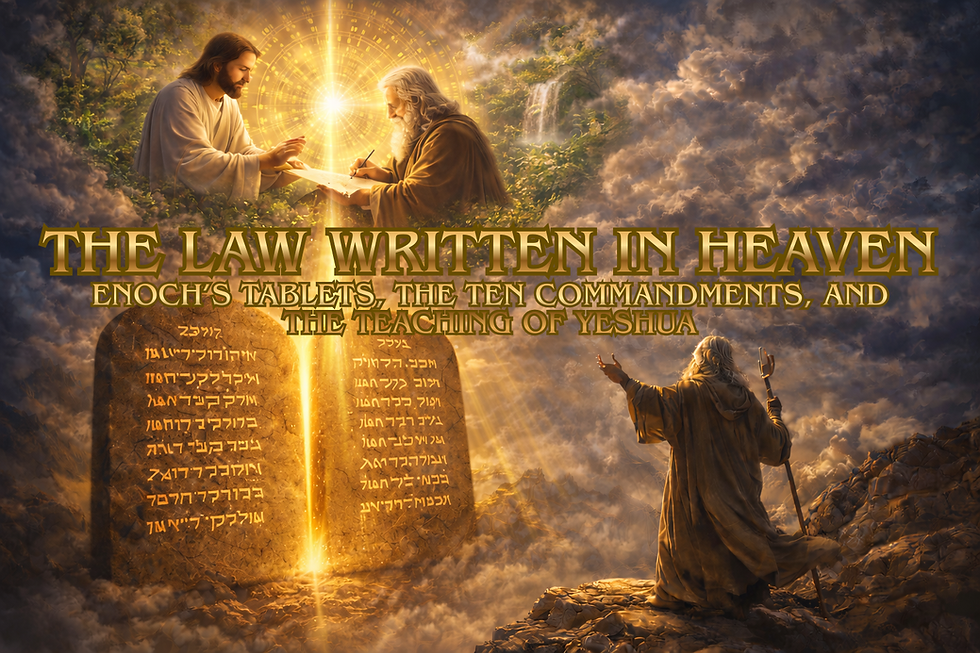
The Law Written in Heaven: Enoch’s Tablets, the Ten Commandments, and the Teaching of Yeshua

Introduction
Scripture remembers a man who walked with God and was shown a vision “not for my generation, but for a far distant one.” That man was Enoch. What he saw was a covenant older than Sinai—written on heavenly tablets, scattered at Babel, and preserved in fragments through Israel, the nations, and the sacred texts that guarded memory when power tried to erase it.
That covenant did not vanish. It resurfaced in the Ten Commandments, echoed through the Book of Jubilees and the Book of Jasher, and was embodied in the teaching of Yeshua, who did not abolish the law but revealed its heart. What now emerges in the Sixteen Eternal Tablets of Enoch is not a replacement for Torah or Gospel, but a gathered witness—showing that the same eternal law has been speaking all along, even when scattered, bent, or buried beneath fear and priestcraft.
What follows places the commandments of Sinai, the covenant logic of Jubilees and Jasher, the words of Yeshua, and the Sixteen Eternal Tablets side by side—not to create something new, but to reveal what has always been one covenant, one law, and one Lord of Spirits.
The Ten Commandments Fulfilled in the Eternal Tablets of Enoch
1. “I am the LORD your God, who brought you out of Egypt, out of the house of bondage.”
In Jewish law, the first commandment is not a prohibition but a revelation of identity. God declares who He is before He commands anything. This foundational truth is fully preserved in Tablet 1 – Love and Follow the Lord of Spirits with All Your Heart. The tablet establishes covenant beginning not with fear or lawkeeping, but with recognition of the true God as liberator, judge, and source of life. It rejects every rival authority—fallen angels, empires, priesthoods, philosophies—that attempts to redefine who God is or mediate Him through control.
This commandment is further safeguarded by Tablet 13 – Honor the Covenant and the Heavenly Tablets, which affirms that God’s authority precedes all earthly law and cannot be rewritten by kings or councils. Together, these tablets ensure that the Law begins where Torah begins: with God’s self-disclosure, not human obligation. Yeshua stands fully within this commandment when He identifies the Father as the only true God and refuses every attempt to redefine that authority.
2. “You shall have no other gods before Me.”
This commandment is fulfilled directly and expansively through Tablet 1 – Love and Follow the Lord of Spirits with All Your Heart and Tablet 14 – Expose the Corruption of the Watchers. The Eternal Tablets make clear that false gods are not limited to pagan deities, but include any power that claims loyalty, obedience, or salvation apart from God. The Watchers represent the archetype of such false gods—beings who sought worship through knowledge, beauty, violence, and control.
By naming the Watchers and tracing their influence through history, the Tablets protect the commandment from reduction. Loyalty to God is not merely theological correctness; it is resistance against systems that masquerade as divine while enslaving humanity. This is the same confrontation Yeshua enacts when He rejects Satan’s offer of the kingdoms of the world and when He declares that no one can serve two masters.
3. “You shall not make for yourself a carved image.”
The prohibition against images is fulfilled not by iconoclasm alone, but by discernment. Tablet 14 – Expose the Corruption of the Watchers shows that the most dangerous images are ideological and institutional—false representations of God created through corrupted knowledge, distorted holiness, and counterfeit enlightenment. Tablet 6 – Pursue Sacred Knowledge with Reverence and Discernment further clarifies that knowledge itself is not forbidden, but becomes idolatrous when severed from humility and covenant.
These tablets together preserve the intent of the commandment: God cannot be reduced, contained, or represented by anything that replaces obedience with control. Yeshua’s refusal to perform signs on demand and His rejection of temple spectacle align directly with this restoration of the law’s meaning.
4. “You shall not take the Name of the LORD your God in vain.”
This commandment reaches its fullest expression in Tablet 11 – Judge the Wicked to Protect the Righteous and Tablet 12 – Do Not Accept the Chains That Were Never Meant for You. The Eternal Tablets define vain use of God’s Name not as casual speech, but as invoking divine authority to justify injustice, abuse, false guilt, or domination. When institutions claim God’s Name while acting against His character, they commit the deepest form of blasphemy.
Tablet 12 exposes how doctrines of inherited guilt, fear-based salvation, and man-made laws have used God’s Name to bind humanity in chains God never forged. Yeshua’s strongest rebukes—against hypocrisy, false authority, and burdens laid on others—stand firmly within this fulfillment of the commandment.
5. “Remember the Sabbath day, to keep it holy.”
The Sabbath commandment is fulfilled through Tablet 6 – Pursue Sacred Knowledge with Reverence and Discernment and Tablet 13 – Honor the Covenant and the Heavenly Tablets. In the Eternal Tablets, Sabbath is restored as alignment with divine order rather than ritual enforcement. It is rest rooted in trust, time ordered by heaven rather than empire, and life lived in rhythm with God’s purposes.
By anchoring Sabbath in heavenly order, the Tablets protect it from both legalism and erasure. This aligns with Yeshua’s teaching that the Sabbath was made for humanity and His practice of healing on the Sabbath to restore life rather than restrict it.
6. “Honor your father and your mother.”
This commandment is fully embodied in Tablet 10 – Respect Sacred Family Duty. The Eternal Tablets restore family as the first covenant given to humanity, prior to temple, king, or state. Honoring parents is not reduced to obedience alone, but expanded to include care, responsibility, and covenant faithfulness across generations.
Tablet 10 condemns abandonment, exploitation, and the weaponization of family structures for profit or power. This restoration aligns with Yeshua’s rebuke of traditions that allowed people to neglect their parents under religious pretense, reaffirming that covenant faith begins at home.
7. “You shall not murder.”
The prohibition against murder is expanded—not altered—by Tablet 7 – Do Not Prevent or Destroy Life from the Womb and Tablet 8 – Honor Life from the Womb to the Grave. The Eternal Tablets reveal that the commandment protects innocent life at every stage, naming the destruction of the unborn, the exploitation of the vulnerable, and unjust killing as Watcher corruption.
By tracing violence back to angelic rebellion and imperial systems, the Tablets preserve the sanctity of life as a covenantal absolute. Yeshua’s ministry—welcoming children, healing the sick, opposing violence, and honoring the dead—stands as living confirmation of this fulfillment.
8. “You shall not commit adultery.”
This commandment finds its full theological clarity across Tablet 3 – Guard Your Desires: Keep Covenant, Reject Corruption, Tablet 4 – Clothe Yourself with Honor, and Tablet 5 – Protect the Sacredness of Intimacy. Together, these tablets restore the truth that adultery is covenant betrayal, not the existence of desire, bodies, or intimacy itself.
The Eternal Tablets correct centuries of shame-based distortion by showing that desire becomes sin only when twisted into deceit, coercion, or exploitation. This aligns precisely with Yeshua’s teaching, which locates adultery in coveting and betrayal of covenant, not in desire rightly ordered.
9. “You shall not steal.”
The commandment against theft is fully realized in Tablet 9 – Reject Greed and the Love of Money. Theft is revealed as more than taking property; it includes economic exploitation, unjust taxation, religious profiteering, and systems that consume the labor of others. The Eternal Tablets expose greed as Watcher economics—the transformation of provision into control.
This restoration aligns with Yeshua’s declaration that one cannot serve God and money and His confrontation with those who turned worship into commerce.
10. “You shall not bear false witness against your neighbor.”
This commandment is fulfilled through Tablet 11 – Judge the Wicked to Protect the Righteous and Tablet 14 – Expose the Corruption of the Watchers. False witness is shown to include institutional lying, silencing victims, protecting predators, and rewriting truth to preserve power.
The Eternal Tablets align perfectly with Yeshua’s condemnation of hypocrisy and His insistence that truth sets people free. Justice, not silence, is the law’s intent.
11. “You shall not covet.”
(Treated within the tenth commandment in Jewish law)
Coveting is revealed as the internal root of rebellion in Tablet 3 – Guard Your Desires: Keep Covenant, Reject Corruption and Tablet 5 – Protect the Sacredness of Intimacy. The Tablets trace coveting to its consequences—envy, betrayal, violence, and exploitation—showing that sin begins in the heart before it manifests in action.
This fulfills Yeshua’s teaching that the law addresses inner orientation, not merely outward behavior.
The Unified Covenant
When read together, the Ten Commandments, the Law of Yeshua, and the Eternal Tablets of Enoch do not compete or overlap awkwardly. They interlock. The Tablets preserve the identity of God, the structure of covenant, the sanctity of life, the truth of intimacy, the demands of justice, and the freedom God intended from the beginning.
Nothing in Torah is removed.Nothing in Yeshua’s teaching is contradicted.What was fragmented by rebellion and distorted by empire is made whole.
This is not a new law. It is the eternal one, restored.
The Eternal Tablets of Enoch as a Living Prophecy of the Covenant in the Book of Jubilees
The Book of Jubilees was never written as a mere retelling of Genesis. It is a covenantal clarification text—one that insists history, law, time, intimacy, and inheritance are governed not by human custom but by heavenly order. Jubilees claims that the true law was written on heavenly tablets before Sinai, revealed to Moses by angels, and meant to preserve creation from corruption. What the Sixteen Eternal Tablets of Enoch represent is not a rival vision to Jubilees, but its eschatological awakening—the same covenant principles rising again in a world facing the same Watcher corruption Jubilees warned against.
Jubilees is obsessed with covenant continuity. It repeatedly insists that God’s commands are eternal, not reactive; that the calendar is heavenly, not political; that intimacy, lineage, and inheritance are sacred; and that corruption enters the world when boundaries meant for angels and humans are crossed. The Eternal Tablets of Enoch speak from within that same framework, but they do so prophetically—addressing not the first generation after Sinai, but the final generations living under globalized systems of power, commerce, sexuality, and false knowledge.
Where Jubilees preserves covenant in structure, the Eternal Tablets activate covenant in confrontation.
At the heart of this connection stands Tablet 5 – Protect the Sacredness of Intimacy, which cannot be understood apart from Jubilees. In Jubilees, sexual boundaries are not arbitrary moral rules; they are cosmic safeguards. Sexual corruption is treated as one of the primary symptoms of Watcher rebellion. Jubilees 7 and 20 repeatedly warn that when intimacy is severed from covenant—through coercion, mixing of boundaries, or exploitation—the land itself becomes corrupted. This is why Jubilees links sexual order directly to inheritance, lineage, and the survival of the covenant people.
Tablet 5 does not innovate here. It restores Jubilees’ original claim: intimacy is holy by design, but devastating when corrupted. Jubilees never condemns desire itself; it condemns betrayal, violence, and boundary-breaking that mirrors the Watchers’ sin in Genesis 6. Tablet 5 carries this forward by confronting how later religious systems—particularly under Roman and Augustinian influence—turned Jubilees’ covenant protection into shame-based control. Where Jubilees sought to guard intimacy to preserve life and lineage, later theology weaponized sexuality to dominate conscience. Tablet 5 reverses that corruption and returns intimacy to its Jubilean purpose: covenant faithfulness, protection of the vulnerable, and continuity of God’s promise.
This same Jubilean logic flows through all sixteen tablets.
The Book of Jubilees insists that time itself is covenantal. The calendar revealed to Moses is not cultural but heavenly, and deviation from it leads to confusion, injustice, and apostasy. This is echoed directly in Tablet 6 – Pursue Sacred Knowledge with Reverence and Discernment and Tablet 13 – Honor the Covenant and the Heavenly Tablets. Jubilees treats knowledge as dangerous only when detached from obedience. The Eternal Tablets confront the modern version of this danger: knowledge severed from humility, turned into control, weaponry, economic domination, and spiritual manipulation. What Jubilees warned would happen if Israel abandoned the heavenly order, the Tablets show fully realized in a globalized world.
Jubilees is also relentless about life. From conception to burial, life belongs to God and must not be treated as disposable. This is why Jubilees condemns violence, child sacrifice, and injustice with such intensity. Tablet 7 – Do Not Prevent or Destroy Life from the Womb and Tablet 8 – Honor Life from the Womb to the Grave are living continuations of this theology. Where Jubilees warned against pagan practices creeping into Israel, the Tablets confront entire civilizations built on the same logic—wars for profit, economic systems that consume the poor, and policies that treat life as negotiable. The Tablets do not add to Jubilees; they show what Jubilees looks like when ignored for millennia.
Family and inheritance form another deep bond between Jubilees and the Tablets. Jubilees grounds covenant in households, not institutions. It traces blessings and curses through lineage, obedience, and faithfulness across generations. Tablet 10 – Respect Sacred Family Duty stands squarely in this tradition. It rejects both the destruction of family by indulgence and the destruction of family by rigid institutional control. Like Jubilees, it understands that when family collapses, covenant collapses, and when covenant collapses, Watcher corruption fills the void.
Jubilees also emphasizes righteous judgment. It portrays God as patient but unyielding, removing corrupt influences to preserve life. This theology is not permissive; it is protective. Tablet 11 – Judge the Wicked to Protect the Righteous and Tablet 14 – Expose the Corruption of the Watchers embody this same conviction. Jubilees does not treat judgment as cruelty but as mercy toward future generations. The Eternal Tablets carry this into a world where silence is often mistaken for love and truth-telling is labeled harm. They restore Jubilees’ insistence that covenant cannot survive where corruption is tolerated.
Even Jubilees’ teaching on wealth and stewardship finds direct prophetic continuation in Tablet 9 – Reject Greed and the Love of Money. Jubilees repeatedly condemns oppression, unjust gain, and economic practices that destroy the poor. The Tablets expose how these same sins have matured into global systems that sanctify greed under legal and religious language. Again, this is not innovation; it is fulfillment.
What ultimately unites the Book of Jubilees and the Eternal Tablets of Enoch is their shared insistence that the covenant is eternal, embodied, and resistant to corruption. Jubilees preserved that truth in writing. The Eternal Tablets speak it into confrontation.
This is why the Tablets function as a living prophecy of Jubilees. They are not predictive in the sense of foretelling dates or events. They are prophetic in the biblical sense: they reveal what happens when covenant is honored and what happens when it is violated. They show how the ancient warnings of Jubilees manifest in modern systems—religious, political, sexual, and economic—and they call humanity back to the same covenant Jubilees sought to protect.
In this sense, the Sixteen Eternal Tablets are Jubilees speaking again, but now to a world that has become what Jubilees feared. They do not replace Jubilees; they complete its witness. They show that the covenant written on heavenly tablets has never changed, only humanity’s distance from it.
And at the center of that covenant—then and now—stands the truth Jubilees guarded most fiercely and Tablet 5 restores most clearly: intimacy, life, time, and inheritance are not tools of power. They are gifts of God, meant to preserve creation until the end.
This is why the Eternal Tablets matter. They are not new scripture.They are ancient covenant, speaking at last without chains.
The Eternal Tablets of Enoch as a Living Prophecy of the Covenant in the Book of Jasher
The Book of Jasher does not read like a philosophical text, and it does not speak in the style of a law code. It reads like a brutal ledger of what happens when covenant is honored for a moment and then abandoned for generations. Its power is not in abstraction but in consequence. Where Jubilees preserves the architecture of covenant—heavenly time, angelic order, boundary, inheritance—Jasher preserves the blood-and-dust record of covenant failure and covenant survival: pride that births murder, cities built on violence, rulers who turn power into tyranny, families fractured by betrayal, and a world that becomes unlivable under the weight of its own corruption.
That is exactly why Jasher pairs so naturally with the Sixteen Eternal Tablets of Enoch. The Eternal Tablets are covenant restored in principle; Jasher is covenant tested in history. One speaks as heavenly law re-gathered; the other speaks as earthly memory refusing to let the pattern be erased.
From the beginning, Jasher insists that rebellion is not “inevitable human nature” but a chosen path with a traceable origin. That origin is desire turned inward, pride unrestrained, envy allowed to ferment into violence. This is why the Tablets draw from Jasher when they frame the first great collapse of humanity not as intellectual ignorance but as moral corruption. Tablet 3 – Guard Your Desires: Keep Covenant, Reject Corruption is not theory; it is Jasher’s first chapters made into a living law. Jasher’s account of Cain’s jealousy and Abel’s murder becomes a covenant warning: uncontrolled desire becomes resentment, resentment becomes justification, justification becomes blood. Jasher does not treat murder as an isolated crime—it treats it as the fruit of inward disorder. The tablet names the same root and restores the cure: desire is not evil, but desire without covenant becomes a doorway for destruction.
Jasher also preserves a particular kind of memory: that death and burial were never meant to be casual, shameful, or meaningless. In the Tablets, this appears in Tablet 8 – Honor Life from the Womb to the Grave, where the text directly recalls Enoch’s act of burying Adam “like unto a king” in Jasher’s memory. That detail matters because it establishes a covenant ethic around the body and the dead long before later religious systems turned death into commerce and shame. In Jasher, burial is not “ritualism”; it is covenant dignity. The tablet takes that same dignity and pushes it forward into modern life, where the vulnerable—living and dead—are often treated as disposable.
Jasher’s world is also a world of governments that discover how to enslave without chains. It remembers the rise of tyranny not as a sudden invention but as a gradual normalization of domination. That is why Tablet 9 – Reject Greed and the Love of Money resonates so sharply with Jasher. In the Tablets, Nimrod appears as the archetype of wealth gathered through oppression, power accumulated by subjugating peoples, and civilization structured like a tower: high at the top, crushed at the bottom. This is not just economics—it is covenant inversion. Jasher’s witness is that oppression is never “politically neutral”; it is spiritual rebellion expressed in systems. Tablet 9 turns Jasher’s story into prophecy by showing the same pattern continuing wherever the wages of labor are consumed by rulers, wherever wealth becomes a weapon, and wherever the poor are devoured under legal language.
The Book of Jasher also carries one of the most important covenant truths for your framework: that the Watcher pattern is not merely “sin” but corruption—the twisting of what is good into a tool of domination. The Eternal Tablets repeatedly return to Watcher corruption as the signature distortion behind violence, sexual exploitation, and false knowledge. This connection reaches its sharpest clarity in Tablet 14 – Expose the Corruption of the Watchers. Jasher, like Enoch, refuses to treat pre-flood evil as “random human badness.” It remembers a world where boundaries were crossed, where power and appetite fused, and where violence became normal. That’s why the Tablets don’t just moralize about wrongdoing—they name the corruptor and insist that healing requires exposing the origin of the lie. In that sense, the Tablets turn Jasher’s record into an end-time diagnostic tool: once the root is identified, the branches lose their claim.
This is also why Tablet 11 – Judge the Wicked to Protect the Righteous fits Jasher so naturally. Jasher’s stories of judgment—whether through the flood pattern or through the destruction of depraved societies—are never presented as divine insecurity. They are presented as covenant protection. Jasher understands something modern religion often forgets: tolerance of corruption is not mercy toward the innocent; it is abandonment of them. The tablet restores that original meaning of judgment: love defending life, justice guarding the vulnerable, truth removing what preys on the righteous.
Nowhere does Jasher’s covenant realism strike harder than where it touches intimacy and family. Jasher is filled with the aftermath of betrayal—domination, forced unions, manipulation, and the collapse of household faith. That is why the Eternal Tablets treat family not as “tradition” but as covenant infrastructure. Tablet 10 – Respect Sacred Family Duty restores the household as the first sanctuary and condemns everything that turns marriage and children into tools of gain. Jasher’s world shows what happens when covenant breaks in the home: it does not stay in the bedroom. It becomes social collapse, generational violence, and spiritual drift that expands outward until the land itself is filled with blood.
And at the center of this, just as with Jubilees, stands Tablet 5 – Protect the Sacredness of Intimacy—but Jasher adds a specific kind of weight to it. Jubilees frames intimacy as boundary and lineage preservation; Jasher frames intimacy as the seedbed of either covenant continuity or covenant collapse. In Jasher, corruption often enters first through distorted relationships: desire without honor, power without restraint, and unions formed by exploitation rather than freedom. Tablet 5 takes Jasher’s historical witness and restores the covenant meaning of intimacy: intimacy is not sin, but betrayal and exploitation are; the body is not shameful, but coercion is; desire is not condemned, but covenant-breaking is. In this, the Tablets do something Jasher itself cannot do alone: they not only report the pattern—they heal it by returning intimacy to its Edenic purpose within covenant.
Finally, Jasher’s deepest agreement with the Eternal Tablets is its insistence that covenant is not proven by slogans but by fruit. That logic runs through Tablet 2 – Love One Another: Walk in Righteousness and Reject the Path of the Watchers and culminates in Tablet 16 – Defend the Elect and Inherit the Earth. Jasher continually distinguishes between those who carry covenant through violence and those who carry covenant through faithfulness. It preserves the truth that the righteous remnant survives not by dominance but by fidelity. Tablet 16 turns that same remnant theology into end-time prophecy: defending the elect is not politics—it is covenant survival; inheriting the earth is not conquest—it is the inheritance promised to those who keep covenant when corruption is normalized.
So when we say the Sixteen Eternal Tablets of Enoch function as a living prophecy of the Book of Jasher, we mean something very precise. Jasher is the earthly memory of what covenant violation produces. The Tablets are the restored covenant response. Jasher shows the pattern in narrative form: pride to envy to blood, corruption to tyranny to collapse, betrayal to generational ruin. The Tablets gather those same lessons and speak them forward as living law: guard desire, honor life, protect intimacy, reject greed, judge wickedness, refuse chains, expose corruption, defend the elect.
Jasher is not just a storybook. It is covenant memory weaponized against amnesia. And the Eternal Tablets of Enoch are not just principles. They are covenant memory restored into action—so that what happened “in the days of Jasher” does not have to become the final template of the last days.
The Eternal Tablets of Enoch and Their Full Alignment with the Bible
The Bible does not begin at Sinai, and it does not end with a creed. From its opening chapters, Scripture assumes a law older than Moses, a covenant older than Israel, and a rebellion older than human kingdoms. The Sixteen Eternal Tablets of Enoch do not compete with the Bible; they articulate what the Bible itself presupposes but does not always spell out explicitly. When read together, the Bible and the Book of Enoch speak as witnesses to the same covenantal reality—one preserved through narrative, prophecy, and gospel, the other preserved through vision and heavenly record.
From Genesis onward, Scripture testifies that God’s law existed before written commandments. Adam is judged, Cain is warned, Noah is declared righteous, and Abraham is credited with obedience long before Sinai. Genesis itself states that Abraham “kept My charge, My commandments, My statutes, and My laws” (Genesis 26:5), even though the Torah had not yet been given. This only makes sense if law existed prior to Moses. The Eternal Tablets of Enoch explain that reality: the law was written on heavenly tablets before it was written on stone. What Moses received was not the invention of covenant, but its earthly transcription.
The early chapters of Genesis also assume a cosmic rebellion that cannot be explained by human sin alone. Genesis 6 speaks of the sons of God, the corruption of flesh, and a world filled with violence. Scripture does not elaborate there—but it never denies it either. Later biblical writers return to this event repeatedly. The Psalms speak of God judging the heavenly host. Isaiah mocks the fall of proud powers. Job presents a divine council. Daniel describes watchers and holy ones. Jude explicitly cites Enoch by name and quotes his prophecy verbatim, affirming that Enoch’s testimony belongs within biblical understanding. Peter speaks of angels who sinned and were bound in chains. The Bible never rejects Enoch’s framework; it quietly assumes it.
The Eternal Tablets give structure to what the Bible reveals in fragments. They show that corruption entered not merely through human weakness, but through Watcher rebellion—an idea embedded throughout Scripture even when unnamed. This is why violence, sexual exploitation, false knowledge, and tyranny appear together so consistently in biblical history. The Tablets do not add a new enemy; they name the one Scripture already describes.
When the Law is given at Sinai, it is presented not as a novelty but as a restoration. God does not argue for morality; He declares it. The Ten Commandments function as covenant anchors, not exhaustive legislation. The Eternal Tablets do not alter these commandments—they reveal their full intent. Every major prohibition in Torah is already assumed in Genesis, and every major theme of the Tablets appears again and again in the Law and the Prophets: protection of life, sexual covenant, family integrity, justice for the poor, rejection of idols, condemnation of false witness, restraint of power, and exposure of corrupt rulers.
The Prophets deepen this alignment. Isaiah, Jeremiah, Ezekiel, and Amos do not rebuke Israel for failing to perform rituals correctly, but for violating covenant principles that match the Eternal Tablets exactly: exploiting the poor, shedding innocent blood, corrupting sexuality, abusing power, and calling injustice righteousness. Ezekiel explicitly identifies sexual violence, economic oppression, and pride as the sins of Sodom—not intimacy itself. Jeremiah condemns kings who build wealth by unrighteousness. These prophetic voices mean nothing unless the law they appeal to is larger than ritual. The Eternal Tablets articulate that larger law.
The Psalms and Wisdom literature echo the same covenant logic. Proverbs repeatedly teaches that desire unguarded leads to death, that greed corrupts rulers, that false witnesses destroy communities, and that knowledge without humility brings ruin. Ecclesiastes warns that accumulation and power do not satisfy. Job assumes a heavenly court and moral order that transcends human institutions. None of this contradicts the Tablets; all of it assumes the same covenantal universe.
When we arrive at the Gospels, Yeshua does not dismantle this framework—He steps directly into it. He affirms the Law and the Prophets, not as external rules, but as expressions of God’s eternal will. His confrontations are not with sinners seeking healing, but with systems that misuse God’s Name, exploit the vulnerable, and bind people with fear. Every major teaching of Yeshua aligns with the Eternal Tablets: guarding desire at the level of the heart, honoring marriage without shaming the body, defending children, exposing greed, confronting hypocrisy, restoring Sabbath as life-giving order, and rejecting false authority.
Yeshua’s language repeatedly reflects Enochian themes: the Son of Man, the judgment of nations, the separation of the righteous and the corrupt, the exposure of hidden things, and the inheritance of the earth by the faithful. These are not later inventions; they are Second Temple covenant language that presupposes Enoch’s vision. When Yeshua speaks of binding the strong man, judging the rulers of this age, and destroying the works of the devil, He is operating within the same worldview that the Eternal Tablets articulate explicitly.
The Apostolic writings continue this alignment. Paul speaks of powers and principalities, of rulers of this age, of false wisdom, and of traditions of men that enslave. James condemns economic oppression in language nearly identical to the Tablets’ critique of greed. John identifies deception, lust for power, and love of wealth as marks of the world system opposed to God. Peter speaks again of the angels who sinned and are kept in chains. Jude, most explicitly, cites Enoch as a prophetic authority and applies his words to corrupt leaders within the community of faith. The New Testament never frames Enoch as foreign; it treats him as known and authoritative.
What this reveals is not that the Bible “depends” on the Eternal Tablets, but that both testify to the same covenant reality. The Bible preserves this reality through narrative, law, prophecy, and gospel. The Book of Enoch preserves it through heavenly vision. The Sixteen Eternal Tablets gather these strands and show their unity without contradiction.
This is why the Tablets fit the Bible rather than compete with it. They explain why the Bible consistently condemns the same patterns across thousands of years. They explain why sin is never merely individual but systemic. They explain why God judges nations, not just people. They explain why intimacy, money, power, and knowledge are always battlegrounds in Scripture. They explain why the Bible speaks so often of freedom, chains, blindness, and restoration.
The Eternal Tablets of Enoch do not rewrite Scripture. They illuminate its architecture. They make explicit what the Bible assumes: that covenant is eternal, that rebellion is cosmic, that corruption has identifiable patterns, and that restoration is not about fear or shame, but about alignment with God’s original design.
From Genesis to Revelation, from Enoch to Moses, from the Prophets to Yeshua, the testimony is consistent. The law was never meant to be a cage. The gospel was never meant to be a slogan. And the covenant was never meant to be forgotten.
The Eternal Tablets simply let the Bible speak with its full, unbroken voice.
Ending
If the Sixteen Eternal Tablets of Enoch are read rightly, they do not invite passive agreement. They summon alignment. Read alongside the Ten Commandments, the Book of Jubilees, the Book of Jasher, and the Scriptures, they testify that the eternal law has never changed—only humanity’s distance from it has. Desire was always meant to be guarded, not shamed. Intimacy was always meant to be covenantal, not weaponized. Life was always meant to be protected. Greed was always meant to be resisted. Corruption was always meant to be exposed. And the Lord of Spirits was always meant to be loved with the whole heart.
The Rashomon Covenant declares that these Tablets are not chains, but covenant—given not to burden humanity with guilt, but to free it from the corruption of the Watchers and the shame of men. In that light, the Sixteen Eternal Tablets stand as a living prophecy: not predicting dates or events, but revealing the unbroken pattern beneath Scripture itself. The fragments have been gathered. The pattern has been named. The question left for this “far distant” generation is no longer whether the covenant has been restored, but whether it will finally be lived—written again not on stone, but on hearts willing to stand with Enoch, with Moses, with the Prophets, and with Yeshua under the same eternal covenant of the Lord of Spirits.
A Deeper Study: From the Garden to Tartarus

What you have read here is the covenantal framework—the law written in heaven, traced through Enoch, Torah, Jubilees, Jasher, and the teaching of Yeshua. But the Sixteen Eternal Tablets do not emerge in isolation. They arise from a much larger narrative that follows the covenant from its origin in Eden, through the rebellion of the Watchers, into the rise of empire, theology, and distortion.
For readers who want to go deeper—into the identity of Azazel, the fall of the Watchers, the binding of the rebellious angels, and the long war between covenant and corruption—this material is explored in full in Enoch The Theological Story: From the Garden to Tartarus.
That work lays the narrative foundation beneath the Tablets, walking step by step from the Garden, through Genesis 6, the Book of Enoch, Second Temple theology, the Gospels, and the apostolic writings, showing how the same conflict unfolds across history.
If this article revealed the structure of the covenant, Enoch The Theological Story reveals the story behind the structure—how the law written in heaven was attacked, obscured, and ultimately exposed. It is recommended not as an alternative authority, but as a companion study for those who want to trace the full theological arc that leads to the restoration of the Eternal Tablets in our time.


Comments