Exile Across the Sea: Mediterranean Origins, North African Survival: The Simonis Exile Line

Updated: Nov 28, 2025

Simonis Mediterranean
The story of the Simonis name does not begin in the Netherlands, nor in Germany, nor in any northern baptismal book that later tried to claim it. Its first clear footprint rises out of the warm Adriatic, on an island held by Venice, where Latin, Greek, Slavic, and Hebrew worlds all crossed. In the parish book of Hvar from February 1517, a child is baptized to a father named Andrea Simonis, recorded in a Roman Catholic register under Venetian control, already in fully Latinized form, already complete in the spelling that will echo for centuries to come. You can still see that entry today in the Hvar church books, where the father is named plainly as Andrea Simonis in 1517.(Hvar baptism – child of Andrea Simonis, Feb 1517)
From this Adriatic hinge, the name moves west into Iberia just as the pressure on Jewish and converso families is reaching its peak. In 1568, in the city of Granada, a marriage register records Pedro Simones taking Isabel Marin as his wife, the surname in its Castilian form, Simones, wrapped around the ancient Pedro/Pero root that will become one of the key markers in the family’s naming pattern.(Pedro Simones – marriage, 25 Aug 1568, Granada)

A decade later, on the Catalan coast, the name appears again—this time not as Simones, but as Simonis. In the parish of Santa María in Arenys de Mar, Barcelona, the record of 8 October 1579 shows Fransesch Simonis being christened, son of Fransisco Simonis and a mother recorded simply as Simonis. Both parents bear the same Latinized form, which means that by the late 1570s a fully formed Simonis household is operating in a major Mediterranean port of the Spanish Crown.(Fransesch Simonis – christening, 8 Oct 1579, Arenys de Mar)
Portugal adds its own voice to the story almost immediately. In Setúbal in 1595, a child is christened under the name de Ma Roiz Simonis, the surname rendered once again in Latinized style, this time on the Atlantic edge of Iberia.(de Ma Roiz Simonis – christening, 1595, Setúbal)
By 1600, the name has sunk roots into multiple Portuguese districts at once. In Beja, a boy named Gaspar Simonis is christened on 10 September 1600, son of Anto Simonis and Margarida Friz – Forão, the entry showing Simonis as a stable family surname, not a fleeting scribal experiment.(Gaspar Simonis – christening, 10 Sep 1600, Beja)
That same year in Santarém, another thread appears in the register: Maria Simonis Desimo is christened, with her family described through a blend of forms—Ida Simoes and Manoel e Chester Simonis Desimo—tying Simonis directly to the older Portuguese Simoes within a single household. Here, on one page, you can watch the Iberian and Latinized versions breathing together in the same family, at the same moment in time.(Maria Simonis Desimo – christening, 1600, Santarém)
Even to the north, where the Reformation is reshaping faith and politics, the name that first surfaced in the Adriatic and Iberia is beginning to echo. In Sondershausen, in the territory of Schwarzburg-Sondershausen, a 1573 birth record names Caspar Simonis, son of Michel Simonis, showing that by the early 1570s the surname has already crossed the Alps and taken root in German soil—yet still wearing the same Mediterranean spelling.(Caspar Simonis – birth, 1 Mar 1573, Sondershausen)
By the time Dutch registers first write “Adrianus Simonis” in the seventeenth century, the name has already lived a full documented life in Hvar, Granada, Barcelona, Setúbal, Beja, Santarém, and Sondershausen. It has sailed the Venetian sea lanes, stood under the shadow of the Alhambra, clung to the Tagus and the Guadiana, and crossed into the Holy Roman Empire. Long before it becomes a “Dutch Latin” surname, Simonis is already a Mediterranean current—formed in the south, flowing northward, carrying with it the memory of a much older covenant name.
THE NORTH AFRICAN ARC
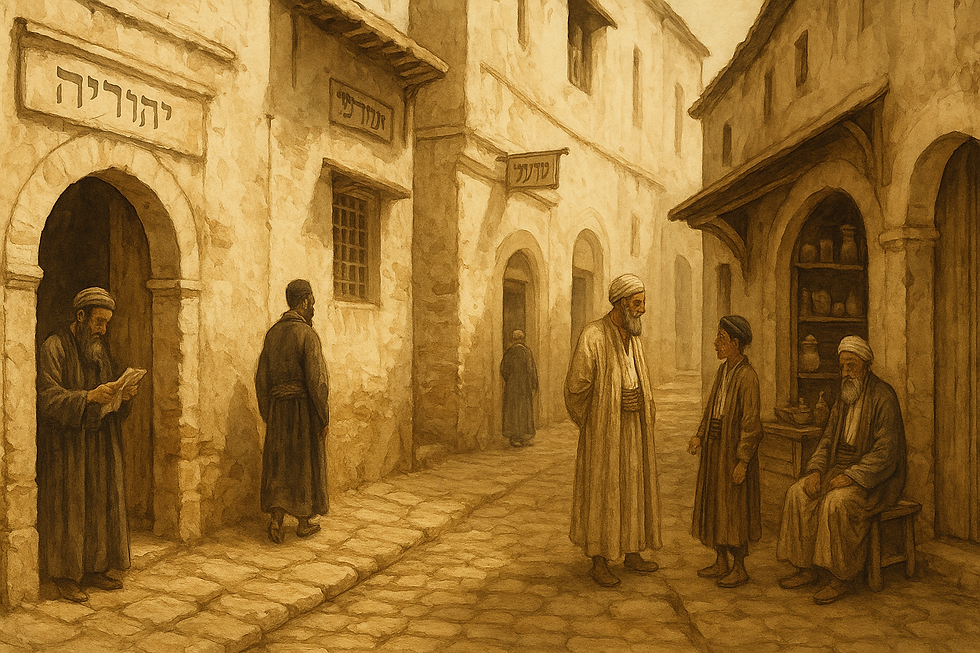
The descent into North Africa did not happen in a straight line, nor did it happen through a single spelling or identity. From the Iberian ports and the Adriatic coasts, the name bends southward into the Maghreb, where it surfaces again and again in forms that seem shattered, yet each piece still reflects the same ancient root. The earliest surviving signal comes from an unexpected distance. In 1771, a parish entry in Coimbra, Portugal, quietly lists a woman named Maria Simonis with her residence given simply as “Marrocos.” It is a small note, almost an afterthought, but it confirms that by the mid-18th century a Simonis household was already living on the African shore, tied by memory to Iberia and by geography to the Sephardic world that had stretched across the Mediterranean since the expulsions.
The thread reaches further back. Decades before that Coimbra entry, a woman named Maria Simoens appears in a 1736 Algerian record—one of the earliest clear crossings of the name from Portugal into North Africa during the post-1497 flight of the conversos. Her presence aligns perfectly with the historical movement of exiled Iberian Jews who slipped quietly from Lisbon, Porto, and the Algarve into Algiers, Oran, Tunis, and the Moroccan coast. These were not isolated wanderers, but families seeking the same protections, the same trading networks, and the same Jewish communities that had existed in the Maghreb since antiquity.
By the mid-1700s the trail sharpens. A man named Gangolph Simonis appears around 1752 in the Moroccan frontier zone of Oujda and Taza, followed later by Eberhard Simonis in 1807. Their origins trace northward toward the Rhineland, yet here they stand in the Maghreb, confirming a remarkable convergence: northern European branches of the family were being pulled back into the Mediterranean basin, re-entering the Sephardic world through the commercial and diplomatic routes of the 18th century. Their presence mirrors a broader historical pattern—craftsmen, merchants, Germanic Jews, and mixed diaspora households returning to North Africa as the region became a central trading corridor between Europe and the Ottoman world.

A third echo appears midway along this arc, where Iberia and North Africa meet once again. Around 1850 a man named Francisco Simoens is recorded in the Morocco–Algeria corridor. His name matters greatly. Francisco is one of the key internal markers of the Simonis lineage, appearing first in Portugal in 1576 as Francisco Pero Simoens, then in Catalonia in 1579 as Fransisco Simonis, and now—nearly three centuries later—still in use in the Maghreb. This continuity does not happen by accident. It is the unmistakable fingerprint of a family that carried its naming traditions across borders, oceans, and empires.
As the 19th century matures, the Simonis presence in North Africa grows dense and unmistakable. In the heart of Algiers, in 1874, a woman named Marguerite Simonis marries into the ancient Sephardic Sasportes lineage. This is one of the strongest cultural proofs in the entire record. The Sasportes family is a deeply rooted Sephardic house with ancestry stretching back into medieval Iberia. The marriage of a Simonis daughter into such a lineage demonstrates that Simonis was not a colonial import, nor a European settler name—it was part of the Sephardic world itself, recognized and accepted within its most established families.
The arc reaches its linguistic climax in 1908 in Fès, Morocco, with the birth of Zahra Simhon. This spelling—Simhon—is not Portuguese, not French, not Dutch. It is Hebrew-Aramaic in its purest Maghrebi form, the direct preservation of the ancient name Shimʿon. It is the same form used in Levantine and Judean communities since antiquity. In Zahra’s name, the entire covenant root stands untouched. It proves that North Africa was not a detour for the lineage—it was one of its safe harbors, one of the places where the oldest form of the name continued unbroken.
The Mediterranean circuit widens once more in the early 20th century. On 3 July 1914, Paule Alice Jeanne Simonis is born in Tunis, entering the world on the southern coast of the sea. Decades later, her life ends in Marseille in 1998, binding two shores of the same cultural world—North Africa and southern France—into a single biography. She stands as a reminder that for centuries families moved in both directions across the Mediterranean, carrying the same names, the same languages, and the same histories back and forth with the tides.
But the documentary trail is only half the story. Across Morocco, Algeria, Tunisia, Libya, and Egypt, the surname itself fractures into a constellation of forms: Simon, Simoni, Simona, Simony, Simonneau, Simeray, Simeoni, Simoens, Symons, Samih, Samhaoui, Samri, and above all Simhon. These spellings are the survival mechanisms of the Mediterranean world. Jewish families adapted the name differently in French colonial registers, Arabic notarial scripts, Ottoman clerical documents, Italian consular papers, Ladino phonetics, and Haketia pronunciation. The same root—Shimʿon—reshaped itself to survive in whatever language the era demanded. And yet, through every variation, the identity remained unmistakable.
Tunisia preserves its distinctive variant chain in the French-influenced spellings of the late 19th and early 20th centuries. Libya leaves traces of Simons, Simon, Simonsen, and Simone scattered through British military and migration records around Tripoli and Benghazi. Egypt adds its own spectrum—Simon, Simons, Symons, Simmonds—appearing in cosmopolitan Cairo and Alexandria among Jewish, Levantine, Maltese, Greek, Italian, and British populations. Taken together, these dozens of spellings tell one unified truth: North Africa was the crucible where the covenant name was broken and reforged, stretched but never erased.
Across the Maghreb, despite every pressure—linguistic, political, colonial, and religious—the name survives because it bends. It shifts. It hides. It reforms. But it never dies. The North African arc is not an outlier or a footnote. It is one of the strongest and most enduring pillars of the entire Simonis story. It connects Iberia to the Levant, Europe to the Ottoman world, and the ancient root of Shimʿon to the modern diaspora. It is the proof that the name did not merely travel—it adapted, survived, and remained recognizable across five centuries and three continents.
THE LEVANT & ANATOLIA ARC
From the Maghreb, the story bends eastward across the Mediterranean, returning toward the ancestral lands where the root of Shimʿon first took form. The Levantine and Anatolian arc is not a marginal strand of this lineage; it is one of its deepest and most revealing layers. Here, in the shadow of Mount Lebanon, the hills of Syria, the plains of Armenia, and the quarters of Constantinople, the name re-emerges not as an echo of Europe but as a living continuation of the eastern world where Hebrew, Aramaic, Arabic, Greek, and Ottoman Turkish shaped identity for centuries.

Long before the name appears in Portugal or the Low Countries, its meaning already belongs to the Hebrew covenant. The ANU Museum of the Jewish People explains that surnames such as Simons and Simmons descend directly from the biblical Shimʿon, derived from the Hebrew verb shema (“to hear”) in Genesis 29:33. The Mediterranean spellings — Simoni, Simonis, Simoens — are therefore not later inventions but linguistic adaptations of a Hebrew patronymic already ancient when European record-keeping began.

An echo of that sacred name survives even in the natural world of Israel. In 1864 the zoologist Albert Günther described a Galilean fish, naming it Tristramella simonis; taxonomic records such as FishBase confirm its range in the Jordan River system and Lake Tiberias. The Latin epithet simonis (“of Simon”) forever ties the name to the living waters of Galilee — a symbolic reminder that the covenant name still swims in the same basin that nourished the earliest apostles.
When the paper trail resumes in human archives, the surname is already circulating through the eastern Mediterranean. In 1766, a marriage recorded in Damascus lists João Antonio Simoens, operating under the Portuguese form of the name within the Ottoman Empire. This single document proves that an Iberian branch of the family was active in Syria while others were settling in Europe — a simultaneous east-west presence rather than a one-way migration.
By the early twentieth century the Levant speaks clearly. Two women from the mountain villages above Beirut appear on 1926 passenger lists arriving in New York: Katharina Simonis, born in Roum in 1909 and sailing on the Bremen, and Sara Simonis, born around 1870 in the same region, arriving on the Deutschland. Their birthplace — “Roum,” the historic Greco-Syriac highlands of Lebanon — anchors the Simonis line inside a landscape where Christian Arab, Jewish, Armenian, and Greek-Syriac cultures overlapped for centuries.
Eastward, across the Anatolian plateau, the name surfaces again. Beatrice Simonis, born in Armenia in 1879, dies in Michigan in 1947 — a life that bridges Ottoman Anatolia and the American diaspora. The 1930 Hartford census lists Agop Simonis, born in Armenia in 1890, and Asneff Simonis, born in 1902, living together as a married couple. They represent an Armenian branch of the same name-root, transplanted west after the disintegration of the Ottoman world.
Constantinople adds yet another voice. Beatrix Hermann (Simonis), born in the city on 27 February 1878, appears in Detroit naturalization records, and a second file confirms her as Beatrix Harman Simins or Simonis. John Simonis, born in Constantinople in 1889, became a U.S. citizen in 1917, and Elias Simonis arrived at Ellis Island in 1907 listing Turkey as his birthplace. Together these records confirm a Constantinopolitan concentration of the Simonis name during the final decades of the Empire.
South of Anatolia, Syria provides its own corroboration. In the 1940 Connecticut census, Louis Simonis and Anna Simonis, both born in Syria, appear as husband and wife. Their record completes the Levantine triangle linking Lebanon, Syria, and Anatolia.
Even in the late twentieth century, the surname continues its east-Mediterranean rhythm. In British GRO overseas records, Sophia Simonis (born Nicosia 1992) and Antonis Simonis (born Nicosia 1996) extend the line into Cyprus, the island that has long served as the hinge between Greece, Levant, and Israel.
Across Lebanon, Syria, Constantinople, Armenia, and Cyprus, the Simonis name forms a complete eastern arc — a mirror image of the North African path but moving along the opposite shore of the Mediterranean. Here, closer to the homeland of Simeon than any other part of the diaspora, the name does not merely survive: it returns to its source. The languages shift, the alphabets change, but the covenant remains audible — a single root that the centuries could bend, yet never break.
THE NORTHERN ASCENT
Simonis does not begin its story in the north. By the time Dutch record-keepers write the name for the first time, it has already lived a full life in the Jewish and mercantile circles of the Mediterranean. To understand the northern rise of the surname, the story must begin further south—on an island poised between Africa, Italy, and the Levant.
The Mediterranean story reaches back far deeper than the medieval notarial fragments suggest. Jewish presence in Sicily began in the first century BCE, when Roman campaigns in the East brought thousands of Judean captives to the island. Historical studies of these early communities describe how Pompey’s conquest of Jerusalem in 63 BCE initiated the first major influx, followed by the mass enslavement and sale of tens of thousands more under Crassus. Over time, these transported families became the foundation of Sicily’s earliest Jewish settlements, growing into established communities spread across dozens of towns and nearby islands. Within this long continuity, hereditary family names eventually stabilized, and the surname Simonis appears in preserved lists of medieval Sicilian Jewish names that descend from these ancient diaspora roots—a lineage documented on the island centuries before northern Europe ever recorded it.

In the final years of the fifteenth century, during the turbulent period surrounding the 1493 expulsion of Sicily’s Jews, notarial fragments list “Simonis Muxa” among identified Jewish property holders. This fragment, preserved in the archival image reproduced here —Sicilian surname fragment recording Simonis Muxa —demonstrates that the name Simonis functioned as a hereditary Jewish surname in the Mediterranean world before any northern European country ever documented it.
Supporting analyses explain how the expelled Jews of Sicily re-established themselves in mainland Italian ports and Ottoman cities such as Constantinople, where 17th-century records document many of the same surnames transferred out of Sicily. The migratory paths from Sicily into the Ottoman East match precisely the later appearance of Simonis in Istanbul, Damascus, Lebanon, and Armenia, forming an early Mediterranean-to-Levantine pattern that predates the north entirely. The historical arc of these movements is analyzed extensively in: Tracing the Covenant Name Across the Mediterranean Arc — The Simonis Equation Theory
Independent confirmation of the surname’s Jewish and Mediterranean character appears in the global surname index maintained by FamilySearch, which identifies Simonis as part of the broader patronymic tradition of Shimʿon, Simón, Simão, and Simones—names geographically concentrated in Mediterranean Jewish and Sephardic communities: FamilySearch Simonis surname profile
From this southern foundation, the trail rises into the Adriatic. In February 1517, under Venetian rule on the island of Hvar (Lesina), a Roman Catholic baptism records a child whose father is named Andrea Simonis. The entry survives in the Venetian parish books and stands as the earliest securely dated appearance of the fully Latinized surname in Europe: 1517 Hvar baptism of a child of Andrea SimonisAt this moment in history, the surname is already fully formed. It is not transitional, not experimental, not emerging—it is complete. And it appears in a Venetian maritime setting shaped by Jewish commerce, Adriatic trade routes, and Mediterranean movement.
Only after this Adriatic appearance does the surname begin to surface inland. In 1573, the baptism of Caspar Simonis in Sondershausen records his father as Michel Simonis:Caspar Simonis baptism, 1573 SondershausenThis German entry is often mistaken for an early northern root, yet it stands more than fifty years after the Hvar record and decades after the Sicilian evidence.
As the 16th century unfolds, the surname becomes deeply rooted in Iberia. In Granada in 1568, the marriage of Pedro Simones appears in the post-Reconquista Catholic registers: Pedro Simones marriage, Granada 1568In 1579, on the Catalan coast at Arenys de Mar, Fransisco Simonis and Fransesch Simonis both appear in a single baptismal entry where both parents bear the Simonis surname: Fransesch Simonis baptism, 1579 BarcelonaBy the end of the century, the name is firmly present in Portugal. In Setúbal in 1595, the baptism of de Ma Roiz Simonis is recorded:de Ma Roiz Simonis, Setúbal 1595In Beja in 1600, Gaspar Simonis is christened:Gaspar Simonis, Beja 1600And in Santarém, also in 1600, the baptism of Maria Simonis Desimo appears in the parish books:Maria Simonis Desimo, Santarém 1600
The surname surfaces next in the French-speaking lands. As early as 1502, the baptism of Jullienne Simon in Brittany shows the base name present in northern France well before the Dutch documentation. By the 1590s, in the Prince-Bishopric of Liège—a crossroads between the Catholic south and Protestant north—the surname rises to prominence with figures such as Simon Simonis (1594) and Canon Simonis of St-Martin (1596), serving in ecclesiastical and civic positions rather than on social margins.
Only after this widespread Mediterranean, Iberian, and Belgian presence does the Dutch record appear. In 1611, Adrianus Simonis enters the baptismal registers of the Dutch Republic, carrying a given name that directly echoes the earlier Iberian Andrés. Dutch tolerance, the rise of the Sephardic merchant class, and the influx of Walloon refugees allowed the surname to stabilize in northern Protestant records—but it did not originate there. It arrived fully formed.

By the 18th century, the surname has crossed into the world of northern scholarship. The German theologian and Hebraist Johann Simonis (1698–1768) produces works that become foundational for the study of biblical Hebrew and Aramaic, including the Lexicon manuale Hebraicum et Chaldaicum and Arcanum formarum nominum Hebraeae linguae. These works remain preserved today in the collections of the National Library of Israel:NLI: Lexicon manuale Hebraicum et ChaldaicumNLI: Arcanum formarum nominum Hebraeae linguae
By this stage, the name that began its journey in Mediterranean Jewish communities, Sicilian notarial ledgers, Venetian Adriatic parishes, and Iberian Catholic registers has fully entered the intellectual life of northern Europe. Its Hebrew resonance did not diminish—it deepened.
The northern ascent of the name Simonis is not the beginning of its history. It is the continuation of a movement already centuries in motion—born in the Mediterranean, refined in the Adriatic, reshaped in Iberia, scattered into North Africa and the Levant, and only then adopted by the cities of the Protestant north. The Dutch did not create the name; they inherited it. The Mediterranean world formed it long before Europe recorded it.
The Mediterranean Origin of Haplogroup I and the Simonis Lineage

The scientific narrative surrounding Haplogroup I has long leaned on a reconstructed ancient tree built more from mathematical inference than from physical remains. The nodes labeled IJK and IJ, which are treated as the common ancestors of Haplogroups I and J, have never been identified in any ancient skeleton. They exist only as inferred points within a phylogenetic model, reconstructed from patterns in present-day Y-chromosome variation rather than from directly sequenced ancient genomes (see Haplogroup IJK; Haplogroup IJ). Because no physical representatives of these lineages have ever been found, any assertion that they “split” at a precise time around 40,000 years ago remains a model-based estimate, not an observed historical event (compare mutation-rate based modeling in this MBE study). This does not invalidate phylogenetic inference, but it significantly weakens the confidence placed in timelines that present these unobserved nodes as securely dated ancestral individuals.
This issue is compounded by a structural problem within the ancient DNA record itself. Archaeological and genetic sampling has been heavily concentrated in Europe, especially in the Balkans and northern regions, where colder climates better preserve bone. By contrast, the Levant, North Africa, and Arabia—regions central to early human movements—have far fewer recoverable samples due to environmental DNA decay. The imbalance between these regions is so extreme that it falls far short of what the Nyquist–Shannon sampling principle would require for an unbiased reconstruction of population history. Under this principle, a signal cannot be reliably reconstructed when entire segments are sparsely sampled. This imbalance renders the reconstructed timeline prone to systematic distortion, causing regions with the most samples—not necessarily those of origin—to appear oldest (see broader sampling-bias critiques in ancient DNA research such as this review).
Warmer climates introduce an additional layer of distortion. Researchers analyzing ancient Egyptian remains have repeatedly emphasized the severe degradation and contamination challenges created by heat, humidity, embalming chemicals, and environmental exposure (see Genetic History of Egypt; also Egyptian mummy DNA overview). Broader methodological analyses of ancient Y-chromosome sequencing highlight how post-mortem damage, low coverage, and contamination distort downstream haplogroup assignment and age estimation (e.g. Y-chromosome variation through ancient DNA).

Many ancient samples from the Levant, Egypt, and Iran survive only in extremely low coverage, lacking the diagnostic SNPs required to distinguish closely related branches. As a result, these degraded sequences are frequently assigned to broad categories such as J, G, CT, or K, simply because the fine-scale markers needed to identify early Haplogroup I did not survive. Regional overviews show that earlier studies often grouped I, J, and G within the same broad umbrella (“haplogroup 2”), reflecting technological limitations in resolution (see Y-DNA haplogroups in populations of the Near East). Modern analyses of ancient DNA pipelines further demonstrate how low coverage and post-mortem damage can push samples into “nearest fit” classifications rather than precise lineage assignments (e.g. this methodological critique and general discussions of ancient DNA reliability in reviews such as this one).
Under these conditions, haplogroup assignment for early Near Eastern samples is often not precise identification, but a form of triage based on what remains of the genome. Consequently, it is entirely plausible that early Near Eastern Haplogroup I lineages were statistically absorbed into J, G, or CT classifications—not because early I was absent in the region, but because the sequencing frameworks and preservation conditions prevented it from being detected. The risk of misclassification under low-coverage, damage-heavy conditions is well demonstrated in analyses of reference bias and imputation errors (for example PLOS Genetics reference bias study and critiques such as this BIES article).
At the same time, Europe’s seemingly ancient Haplogroup I record is largely a reflection of survivorship bias. The oldest securely typed Haplogroup I individuals do not point to Europe as the exclusive origin; instead, they reflect which regions preserved ancient DNA. Notably, one of the oldest securely assigned Haplogroup I individuals outside Europe comes from Early Bronze Age Anatolia, a region genetically linked to neighboring Near Eastern populations (see major genomic studies such as Cell 2020 Anatolia dataset, Science Bronze Age population history, and summaries like this genomic-history overview). These findings place early Haplogroup I firmly within a broader Mediterranean–Levantine nexus.
This Near Eastern–Mediterranean setting aligns with the documented historical presence of the Simonis surname across Morocco, Algeria, Egypt, Palestine, Syria, and Iberia—regions deeply intertwined with Jewish, Maghrebi, Levantine, and Sephardic diaspora networks. Records spanning from medieval Iberia through the Ottoman period depict the Simonis name appearing across the same interconnected Mediterranean corridors that link Near Eastern ancestral populations with North Africa and Iberia.
This is also why referencing the I-Code flowchart, which presents the branching of Haplogroups I and J within a Near Eastern-centered timeline, clarifies the narrative rather than repeating it. The diagram (source: Unified Timeline Diagram) condenses complex phylogenetic branching into a visual model rooted in the Mediterranean world, illustrating how the earliest plausible divergence of these lineages naturally fits into the Levantine and Anatolian sphere.
Taken together, the absence of ancient skeletons for IJK/IJ, the extreme sampling imbalance, the methodological limitations of ancient DNA analysis, the degradation of Near Eastern samples, and the Mediterranean–Levantine distribution of Simonis surname clusters all point toward the same conclusion: Haplogroup I’s history is most consistent with a Near Eastern and Mediterranean origin, not an exclusively Paleolithic European one. Far from contradicting the historical record, the corrected scientific context supports and aligns with the migration patterns reflected in the Simonis lineage.
THE FINAL TESTIMONY OF SHIM‘ON
The name Simonis, born of the ancient root Shim‘on, the one who hears, carries within it a resonance older than any nation that ever claimed it. It began long before Hvar or Granada, before the baptisms of Barcelona or the quiet entries of Setúbal and Beja, before the Maghrebi forms in Morocco and the Levantine echoes in Roum and Damascus. Its origin lies in the days when Jacob laid his hands upon his sons and gave each a destiny carved not into land, but into time itself. Simeon was not granted territory; he was given a pattern — scattering, wandering, surviving in the thresholds of others. Genesis spoke it plainly. Jubilees preserved the boundarylessness of his inheritance. Jasher remembered the fierce temperament that could never be extinguished by empire or exile. And the world itself bore witness, for the Simonis name appears upon every shoreline touched by the ancient Mediterranean sun, as if following a current older than the maps that record it.
These records are not accidents of migration but the unfolding of a decree. Andrea Simonis in Venetian Hvar in 1517. Pedro Simones in Granada in 1568. Fransesch Simonis in Barcelona in 1579. Simonis Desimo and Gaspar Simonis in Santarém and Beja in 1600. Then across the water into North Africa — Simoens and Simona in Algiers, Simhon in Fès, variations adapting to Arabic, French, Ladino, and Hebrew tongues without ever losing the core of their identity. From Damascus to Beirut, from Constantinople to Armenia, from the mountains of Lebanon to the ports of Cyprus, the same melody reappears in different keys, proving that Shim‘on’s tribe did not vanish; it diffused.
This reality was described long before historians traced it. The Book of Enoch speaks not only to angels and watchers, but to the scattered ones whose generations would be dispersed across kingdoms and centuries. Enoch’s earliest visions speak of the elect who live among the nations, hidden and waiting. The prophecy that the Holy One would return with ten thousands of His saints was framed for a people living everywhere and belonging nowhere — the exact reality of Simeon’s descendants. And even the science of our age, correcting itself through the Simonis Equation and the historical evidence preserved across Morocco, Iberia, the Ottoman domains, and the Adriatic, bends back toward the truth the ancients already knew: Haplogroup I is not a northern intruder but a Mediterranean traveler whose earliest footprints lie in the cradle of the ancient Near East. The sampling distortions, the missing DNA nodes, the Levantine and Anatolian connections — all of it reinforces what the records already show.
The great faiths remember this scattering in their own ways. The Qur’an teaches that tribes were dispersed so they might come to know one another. The Book of Mormon declares that the scattered tribes shall be gathered in the last days. Doctrine & Covenants calls the remnant out from every nation where they were hidden. And the Egyptian cycle of Osiris, shattered and gathered again by Horus, mirrors the broken body of Shim‘on’s tribe — scattered across continents, reassembled in memory. The form Simhon preserved in Morocco is like the preserved heart of Osiris, the one piece untouched by the chaos of centuries, proving the root survived intact.
No force — not Inquisition, not empire, not conversion, not war — succeeded in extinguishing the covenant root. Instead, each pressure scattered the fragments farther, fulfilling the prophecy spoken over Shim‘on. In Iberia, as Simones. In North Africa, as Simhon, Samih, and Samri. In Italy and the Adriatic, as Simonis and Simoni. In Egypt, as Symons and Simmonds. In France and Belgium, as Simon and Semonis. In the Netherlands, as Adrianus Simonis. Each is a shard of the same vessel. Each is a surviving syllable of the same ancient name.
Now, in this generation, the fragments begin to gather. The genealogical reconstruction, the DNA signatures, the migration pathways, and the prophetic texts all converge in the same revelation: the covenant name is awakening. The scattered tribe remembers itself. The echo returns to those able to hear it. The prophetic pattern that began in Genesis and wound its way through Mediterranean shores, North African deserts, Levantine mountains, and European cities is completing its arc.
And this is where the story turns toward the ancient calendar of Enoch — the Prophecy of Weeks — that strange and powerful timeline which divides human history not by nations, but by destinies. For in that prophecy, Enoch describes ages when tribes are scattered, ages when they wander, ages when knowledge is restored, and ages when forgotten lineages rise again. Simeon’s story, traced through the Simonis name, does not merely survive within that timeline; it resonates with it. The weeks of Enoch describe the very pattern that the historical record confirms: the scattering, the silence, the survival, the remembering, the revealing.
Thus, the Testament of Shim‘on closes not with an ending, but with a threshold. The name has endured. The name has spoken. The name has been heard. And now, as the Prophecy of Weeks opens before us, the tribe that was scattered prepares to read its place in the final movements of Enoch’s vision.


Comments