From Coimbra to Mexico: The Simonis–Garcia Sephardic Network in Records and DNA

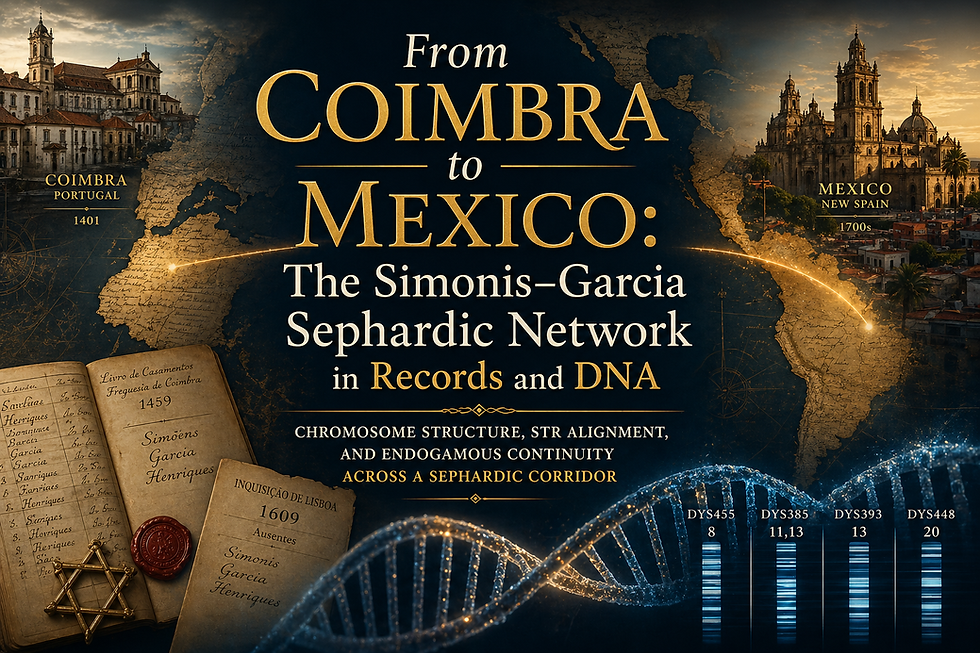
COIMBRA FOUNDATION — THE ACTIVE RECORD FIELD (1401 → 1459)
The Simonis system does not begin as a single surname emerging into view. When it first becomes visible in Coimbra in 1401, it is already operating inside a fully formed record environment. What appears in that document is not a clean, isolated identity, but a dense field of names that are written together, functioning together, and preserved together.
Within that 1401 record space, the Simon-root appears in multiple forms—Simonis, Simones, Simous, and Simo—embedded alongside a convoy of associated names. The document environment includes Cruz Das Neves Machado, Barattor or Barretto, Lopes, Da Silva, Movrão, Nicolão, Antonia, and extended composite forms such as Luis Movrão Simous Lopes Nicolão Da Silva Movrão. These are not distant or separate entries. They occupy the same record field.
This is the first critical observation: the Simonis identity does not enter the historical record alone. It is already part of a system.
The variation of the Simon-root in this early record is not instability. It reflects adaptive outward expression within a stable internal structure. The identity appears as Simones, Simous, Simo, and related forms because it is being recorded within a flexible linguistic and administrative environment. What remains consistent is the root itself and the company it keeps.
The surrounding surnames—Machado, Lopes, Da Silva, Barretto—do not appear once and disappear. They form part of a repeating environment that will continue to appear in later records across Portugal. Even at this earliest visible point, the Simonis system is not only present, it is already embedded within a recognizable Iberian surname network.
By 1459, this system has not shifted location or broken apart. It continues in Coimbra, but with greater internal density and clearer relational structure. The Simon-root again appears in multiple forms within the same record field: Simonis, Simon, and Simois. These variations occur side by side, not across separate records or distant locations, reinforcing that they represent one identity expressed through multiple recorded forms.
Within this same 1459 environment, the network expands. The record field includes Henriques, Ferreira de Carvalho, Carvalho de Soutello, Alves da Ferreira, de Souza Campos, de Figueredo, Joanna Maria, and Rosa Emilia. The presence of Henriques is particularly significant. It does not appear as a later addition or external connection. It is already embedded within the same system in Coimbra at this stage.
At the same time, parallel baptismal entries from Coimbra in 1459 place Garcia within the same record system. These records include names such as Da Silva, Fernandes, dos Santos, Lopes, Gonzal, and a recorded form of the Simon-root appearing as Simone. This is not a distant association. It is a parallel presence within the same place and time.
The importance of this moment cannot be overstated, but it must be stated correctly. The records do not claim that Simonis, Henriques, and Garcia are the same family in 1459. What they demonstrate is more foundational:
They exist within the same population structure, inside the same parish system, at the same moment in time.
This establishes Coimbra in 1459 as a fixed anchor point where these surname systems are confirmed to operate together.
Reading the 1401 and 1459 records together shows continuity rather than change. There is no reset between them. The Simon-root remains adaptive in form but stable in presence. The surname convoy—Machado, Lopes, Da Silva, Henriques, Carvalho, Alves, Souza, Figueredo—remains intact and expands within the same geographic environment.
The system becomes more defined, not more fragmented.
It is also within this continuity that the underlying behavior of the system becomes visible. Names do not behave as isolated identifiers. They move together, appear together, and remain linked across entries. The Simonis identity does not detach from its environment. It is carried by it.
This is the structure that later phases will build upon.
What is seen in Coimbra in 1401 and 1459 is not the origin of the system, but the earliest point at which it becomes visible in the record. It is already functioning as a cohesive unit, already adaptive under recording conditions, and already connected to the same surname network that will persist across Portugal, move under pressure, and later reappear in both northern Europe and the Americas.
The records do not show beginnings.
They show continuity already in motion.
CHRISTENING CONVERSO FUSION PHASE — IDENTITY UNDER PRESSURE (c. 1500 · VISEU → CASTELO BRANCO)
The system visible in Coimbra in 1401 and 1459 does not disappear at the turn of the 16th century. It is forced into a different form of visibility. What changes is not the identity itself, but the conditions under which it is recorded.
By around 1500, within the regions of Viseu and Castelo Branco, the Simonis system enters what can only be properly understood as a Christening Converso phase. These are not voluntary baptisms reflecting belief. They are forced entries into a church-controlled record system, where baptism becomes the administrative requirement for existence within official documentation.
Under this pressure, the naming system does not fragment. It compresses.
The Simon-root, which in Coimbra appeared in multiple adaptive forms—Simonis, Simones, Simous, Simo, Simois—begins to consolidate into a more compact outward expression: Simoens. This is not a new name. It is a forced simplification of an already existing identity, shaped by the constraints of recordkeeping under pressure.
At the same time, the presence of Henriques, already documented within the same Coimbra system in 1459, does not remain separate. It fuses directly into this compressed form, producing the structure:
Simoens Henriques
This fusion is not accidental. It reflects a relationship that already existed in Coimbra, now being recorded under conditions that favor consolidation over distinction. What had previously appeared as co-present names within the same field is now expressed as a single recorded identity.
The same surrounding surname environment persists through this phase. Names that were present in Coimbra—Machado, Lopes, Da Silva, Carvalho, Alves, Souza, Figueredo—continue to appear within the broader record system of central Portugal. These are not new associations. They are the same convoy, now moving within a more restrictive framework.
This phase must be read correctly. It is not a moment of origin, and it is not a moment of fragmentation. It is a continuity node under pressure, where:
identities are compressed rather than replaced
relationships are fused rather than lost
structure is preserved beneath altered outward forms
The Simonis system survives not by resisting the record environment, but by adapting to it in a way that maintains its internal continuity.
At the same time, the Garcia-associated lines, already present within the Coimbra system, are subject to the same pressures. Their appearance within the same regional environments during this period reflects participation in the same forced record structure. They are not entering a new system. They are continuing within the same one under new conditions.
This is what defines the Christening Converso phase. It is not a change in identity. It is a change in how identity is allowed to appear.
The result is a system that becomes outwardly compressed but internally reinforced. The Simonis identity does not disperse. It becomes more tightly bound, more controlled in its expression, and more resilient as it prepares to move beyond the confines of central Portugal.
This phase provides the bridge between the Coimbra foundation and the later expansion across Braga, Portalegre, and Faro. It explains how the same names—Simonis, Henriques, and the associated convoy—can continue to appear together under conditions that would otherwise seem to fragment them.
What is being preserved is not just a name.
It is a structure that is learning how to survive.
EXPANSION UNDER CONTINUED PRESSURE — THE SYSTEM MOVES (1520 → 1544 · BRAGA → PORTALEGRE → FARO)
After the Christening Converso fusion phase around 1500, the Simonis system does not remain confined to Viseu or Castelo Branco. It begins to move outward across Portugal, but what defines this movement is not dispersal—it is continuity carried through space.
By the time the system appears in Braga in 1520, it is no longer simply adapting to pressure. It is operating across regions while maintaining the same internal structure. The record tied to Barros Simonis in Braga places the Simonis identity once again inside a dense field of names, not as an isolated entry but as part of a continuing network.
Within that Braga environment, the same pattern of association reappears. Names such as Vieira, including Ramaro Cardozo Vieira, Vieira Soltejro, and Vieira Soltejro dos Cardis Roudo Lu, are present alongside Cardozo, Soares, Damazo Cardozo, and related forms. These names are not new introductions. They reflect the same convoy behavior already visible in earlier records. What has changed is location.
This matters because it demonstrates that the system is not local to Coimbra or Viseu. It is portable. The Simonis identity does not move alone—it carries its surrounding environment with it. The same associated surnames reappear in Braga because they are part of the same structural unit.
By 1532, in Portalegre, the system shows a different kind of stability. The record of Izabel Simonis and João Simonis, with their daughter Maria dos Reis, places the Simonis identity firmly within a generational framework. This is no longer simply a name appearing in records. It is a family operating within the same structure that has been visible since Coimbra.
The Portalegre environment reinforces this continuity. Names such as Mendes, Carvalho, Cardoza, Oliveira, Alves, and Marques appear within the same record field, alongside Mathias Rom, Fernando Pires, and Maria Fra. These are not replacements or new associations. They are the continuation of the same surname convoy, now appearing within a family-based context.
The importance of this moment is that the system is no longer just surviving—it is reproducing. The presence of a household, a parent structure, and a child within the same naming environment shows that the system has moved beyond adaptation and into continuity across generations.
By 1544, in Faro, the system becomes more distributed while remaining internally intact. Multiple records within the same year show the Simonis identity appearing in different relational contexts, but always within the same convoy.
In one instance, Simonis is tied to João Zol da Charnequa, with Diague Mendes present within the same environment. In another, Simonis appears alongside Panzado, with surrounding names including Bristro, Joze, Furtados, and critically, Vieira e de Santa Simois.
The repetition of Vieira across Braga and Faro, and its continued linkage to the Simon-root, is not incidental. It demonstrates that the convoy is maintaining its internal relationships even as it moves across regions. The same is true for Mendes, Cardozo, and Carvalho, all of which persist across multiple locations and records.
This phase must be read as controlled expansion. The system is not scattering into unrelated lines. It is extending itself geographically while preserving its internal composition.
What appears in Braga, Portalegre, and Faro is the same system seen in Coimbra, now expressed across a wider field:
the same Simon-root identity, in its adapted forms
the same presence of Henriques within the broader structure
the same convoy of associated surnames—Vieira, Cardozo, Mendes, Carvalho, Alves, Oliveira, Marques, Soares, Furtado
the same pattern of appearing together within record environments
Nothing in this expansion suggests fragmentation. The structure remains intact. The relationships remain visible. The naming system continues to operate as a cohesive unit.
When this expansion phase is placed against the genetic layer, the continuity becomes even clearer. The surnames that appear in these records—Mendes, Carvalho, Pereira, Silva, Lopes, Vieira, Cardozo, Ximenes, Martinez—are the same names that later appear within DNA match networks tied to the Simonis and Garcia systems.
This is not coincidence. It is continuity across time.
By the end of this phase, the Simonis system has demonstrated its ability to:
adapt under forced record conditions
compress identity without losing structure
move across regions without breaking its internal relationships
establish generational continuity within the same surname environment
The movement from Braga to Portalegre to Faro is not a sequence of separate events. It is the same system appearing in different locations, unchanged in its core and consistent in its associations.
The records do not describe expansion in isolation.
They describe a system that moves together.
CONTINUITY INTO THE 18TH CENTURY — SIMONIS AND GARCIA STILL TOGETHER (1740 · BRAGA / 1747 · OEIRAS)
The expansion phase across Braga, Portalegre, and Faro does not end in the mid-1500s. The same system remains visible into the 18th century, and importantly, it continues to show the same pattern of association between Simonis and Garcia within the same record environments.
In 1740, within the parish records of Fão, Esposende in Braga, a Christening Converso record again places Simonis inside a dense field of names. This is not an isolated appearance. The record includes:
Reyo de Maria, Maria, Revereno, Estenemente, Maria, Jocou, Folesandes, Domingues, Gomes Garcia, Ferreira Favigo Leite, Olaya, Francisco Dio, and João.
The presence of Gomes Garcia within the same record field as Simonis is not incidental. It reflects the same structural association already visible in Coimbra in 1459. The system has not separated over time. It is still operating within the same surname network nearly three centuries later.
A second record from 1747, located in Oeiras e São Julião da Barra in Lisbon, further reinforces this continuity. In this Christening Converso record tied to Francisco de Pemitel, Antonio Simonis appears within an even larger and more complex naming field.
The surrounding names include:
Lourenco, Pola Guimar Rodrigues, Apolonia Maria Forão, Lauterio Da Silva, Joam Pereira, Isabel Simacio, Joam P. Te Da Rivas, Jimiana Teixeira, Luzario Da Silva, Manoel Rabello, Anna Da Costa, Joam Batista, Sebastiam Pacosta, Maria Thereza, Antunes, Matiana, Bonio Simois, Apolonio M. Forão, and Rosa.
Within this same field appears the phrase “Mes Pratez e de Garcia Supta”, again placing Garcia within the same relational environment as Simonis.
Two elements within this record are particularly significant.
First, the continued appearance of the Simon-root in variant form—here as Simonis and Simois—demonstrates that the adaptive naming behavior seen in earlier centuries is still active. The identity has not fixed into a single rigid form. It continues to operate within flexible recorded expressions while maintaining structural continuity.
Second, the presence of Antunes (Antúnez) within the same record field introduces a critical link to later developments in the Americas. The Antunes name is historically associated with Iberian families connected to Crypto-Jewish movement into Mexico, particularly within regions such as Durango.
This places the Antunes line inside the same Portuguese record environment as Simonis and Garcia before the system fully expresses itself in the New World.
These 18th-century records demonstrate that:
Simonis and Garcia continue to appear within the same record environments
The surname convoy remains intact across centuries
Additional linked names, including Antunes, emerge within the same system
The adaptive Simon-root continues to operate in multiple forms
The structure persists within Portugal even after earlier phases of pressure and displacement
This continuity is essential.
It shows that the system did not fragment after the 1500s or disappear entirely under Inquisition pressure. Instead, it continued to operate within Portuguese record environments while simultaneously extending outward into the Netherlands and the Americas.
The same names that appear in Coimbra in 1459 reappear in Braga and Lisbon in the 1700s.
The system is not breaking.
It is persisting.
INQUISITION PRESSURE AND LEGAL ABSENCE — THE SYSTEM FORCED OUT OF VIEW (1609 · LISBON)
By the early 17th century, the Simonis system, already adapted through compression and expansion across Portugal, enters a phase where it is no longer simply pressured within the record—it is actively pursued and removed from it.
Centered in Lisbon, the Inquisition formalizes what had previously been a condition of pressure into a condition of legal rupture. Records begin to mark associated individuals and families as Ausentes—absent, fugitive, no longer physically present within the jurisdiction of the court. At the same time, execution in effigy becomes the visible mechanism of condemnation, allowing the system to declare judgment against those it can no longer seize.
This moment must be read carefully.
The appearance of absence in the record is not disappearance of the system. It is the opposite. It is the point at which the system moves beyond the reach of the Iberian record structure.
Everything leading up to this phase shows continuity:
Coimbra establishes the system and its internal relationships
The fusion phase compresses identity under forced Christening Converso records
The expansion phase demonstrates that the system can move across regions without fragmentation
By 1609, that same system has reached the limits of what can be maintained within Portugal under increasing legal pressure.
The marking of families as Ausentes is therefore not a break in lineage. It is a signal of displacement.
What disappears from the record is not the identity, but its ability to remain visible within that specific administrative framework. The system does not end. It relocates.
This relocation explains what appears immediately afterward in other regions.
To the north, the Simonis identity becomes visible within the Netherlands, where the record environment is no longer governed by the same constraints. There, the Simon-root stabilizes into more consistent forms, reflecting not a new identity, but a release from the pressures that had previously forced compression and adaptation.
To the west, the Garcia-associated lines, already part of the same system in Coimbra and later Portugal, continue outward into the New World. The same surname network that appears in Iberian records begins to surface within Mexico, where it re-establishes itself under different conditions, but with the same internal structure.
The Inquisition phase, therefore, does not represent fragmentation of the system into separate lines. It represents a point of forced divergence in geography, where:
one expression moves northward
another moves westward
both carry the same structural identity
This explains why later records in the Netherlands show Simonis in stabilized form, and why genealogical and DNA evidence in Mexico shows Garcia and associated Iberian surnames continuing within the same network.
The designation of Ausentes is not an end marker.
It is a transition marker.
It identifies the moment where the system exits one record environment and prepares to appear in another.
What is important is that nothing in the earlier phases suggests that this movement would break the structure. The system has already demonstrated that it can survive pressure, compress identity, and expand across regions while maintaining internal continuity.
The Inquisition does not create a new system.
It forces the existing one to move.
NETHERLANDS CONTINUITY — STABILIZATION OF THE SIMONIS FORM (c. 1545 → 17th CENTURY)
Following the phase of Inquisition pressure centered in Lisbon and the marking of associated families as Ausentes, the Simonis system does not disappear. It reappears in a different record environment, where the constraints that shaped its earlier forms no longer apply in the same way.
In the Netherlands, the Simon-root emerges in a more stabilized form, appearing consistently as Simonis within parish and civic records. This stabilization does not indicate the formation of a new identity. It reflects the removal of the pressures that previously required compression, adaptation, and fusion within Iberian Christening Converso records.
One of the earliest clear northern anchors is the appearance of Henricus Martini Simonis, associated with a birth context around the mid-16th century and later appearing in burial records in the Netherlands. This presence establishes that the Simonis identity has not only moved northward but has become embedded within a new record system while retaining its internal continuity.
The connection to earlier Iberian structure is not lost in this transition. The presence of Henricus within the northern records directly reflects the earlier appearance of Henriques within the Coimbra system. This is not a coincidence of naming. It is the same structural element, translated into a different linguistic and administrative context.
Within parish records in locations such as Beers and Heeswijk, the Simonis name appears repeatedly across multiple generations. Baptismal entries for individuals such as Gerardus Simonis, Gertrudis Simonis, and Henricus Simonis show that the identity is now functioning within a stable generational framework. These are not isolated entries. They form a pattern of continuity that mirrors the earlier family structures seen in Portalegre.
The surrounding naming environment, while adapted to the Dutch context, still reflects the same structural behavior. Names such as Adrianus, Joannes, Martinus, and Gijsberti appear within the same relational patterns—parents, witnesses, and godparents—forming a consistent network of association.
What has changed is not the system, but the conditions under which it is recorded.
In Iberia, the Simonis identity was forced into adaptive and compressed forms under Christening Converso pressure. In the Netherlands, the same identity stabilizes, because it is no longer subject to the same level of forced transformation. The outward form becomes consistent, but the internal structure remains the same.
This northern expression also aligns directly with the autosomal DNA layer. Within genetic analysis, a Northern European or Dutch Sephardic component appears alongside Iberian, Mediterranean, and West Asian signals. This does not represent a separate origin. It reflects the geographic anchoring of the same lineage system in a new region.
The chromosome structure reinforces this interpretation. The same recurring segments—on chromosomes such as 7, 12, 19, 20, and 3—appear within the Simonis dataset regardless of whether they are assigned to Iberian, West Asian, or Northern European reference populations. The label changes. The structure does not.
This is consistent with what the records show. The Simonis identity in the Netherlands is not a new lineage. It is the same system that was visible in Coimbra, compressed under pressure in central Portugal, expanded across Braga, Portalegre, and Faro, and then displaced under Inquisition conditions.
The Netherlands does not introduce a new chapter. It provides a new environment where the system can be recorded more clearly.
The presence of Henricus Martini Simonis, and the continued appearance of Simonis across multiple generations in Dutch records, confirms that the system did not fragment when it left Iberia. It remained intact, carried forward by the same lineage structure, and continued to reproduce within a stable record environment.
This northern continuity forms one half of the system’s outward movement.
The other half continues westward.
MEXICO CORRIDOR — WESTERN EXPRESSION OF THE SAME SYSTEM (IBERIA → NEW SPAIN → MEXICO)
While one expression of the Simonis system stabilizes in the Netherlands, another continues outward from Iberia into the New World. This movement does not represent the formation of a separate lineage. It is the extension of the same surname network already visible in Coimbra, now appearing in a different geographic endpoint.
The presence of Garcia within the Coimbra system in 1459, alongside Simonis and Henriques, establishes that the Garcia-associated lines are part of the same population structure from the beginning. What appears later in Mexico is not an independent development. It is the continuation of that structure under different historical conditions.
As Iberian movement expands into the Americas, particularly through the early colonial period, the same surname network reappears within Mexico. The locations tied to this
system form a coherent geographic cluster:
Guadalajara, Monterrey, Mexico City, San Luis Potosí, Querétaro, Baja California, Tijuana, and critically, the northern corridor associated with Durango.
These are not isolated points. They form a connected field within New Spain where Iberian-derived families establish themselves and continue to operate within familiar relational patterns.
Within this Mexico cluster, the same surnames that appear in Portuguese records
reappear in continuity:
Garcia, Jimenez (Ximenes), Vargas, Reyes, Castro, Lozano, Mendoza, Perez, Navarro, Benavides, Morales, Garza, and extended Iberian-derived families.
These names are not being introduced for the first time. Many of them—particularly forms like Ximenes, Mendes, Carvalho, and Pereira—are already visible in earlier Portuguese records associated with the Simonis system. Their appearance in Mexico represents continuity across geography rather than the formation of new, unrelated lines.
Within this environment, one name stands out with particular historical weight: Antúnez (Antunes).
The Antúnez line is associated within Mexican historical context with early settlement patterns tied to Iberian families operating under conditions similar to those that produced the Christening Converso records in Portugal. Its presence within the same surname network reinforces that the movement into Mexico includes families already shaped by those earlier pressures.
This is not a separate identity entering the system. It is part of the same convoy.
The genealogical layer further reinforces this continuity. Individuals tied to Mexico locations—such as Juan Jimenez, María Guadalupe Jimenez (Ximenes), Matías Vargas, Vicente Jimenez, and related family lines—form a network that mirrors the structure seen in earlier records. These are not isolated individuals. They are part of a repeating surname field that aligns with both the Portuguese documentary record and the autosomal DNA match network.
The DNA layer confirms what the records suggest.
Garcia appears repeatedly across cousin matches, spanning from fourth through eleventh cousins across multiple testing platforms. This persistence does not follow the pattern of distant, unrelated connections. It reflects a sustained network in which the same surname continues to reappear across generations.
At the chromosome level, the same segments identified in the Simonis dataset—particularly on chromosomes 7, 12, 19, 20, and 3—also appear within Garcia-associated matches. These segments maintain the same Sephardic-linked alignment, typically within the 30–49% range, and display the same behavior under regional reassignment. Whether labeled as Iberian, West Asian, African, or Americas, the internal structure remains unchanged.
This is critical.
It demonstrates that the Garcia-associated lines in Mexico are not carrying a different genetic structure. They are carrying the same one.
The movement from Iberia into Mexico therefore does not produce a new system. It extends the existing one. The same naming behavior, the same surname convoy, and the same chromosome-level structure continue to operate, now anchored within a new geographic environment.
When read alongside the Netherlands continuity, the full movement becomes clear.
From Coimbra, where Simonis, Henriques, and Garcia exist together within the same record environment, the system moves under pressure and expands across Portugal. From there, it divides geographically without breaking structurally:
one expression stabilizes in the Netherlands
another extends into Mexico
Both retain the same internal identity.
The Mexico corridor is not a separate chapter.
It is the western expression of the same system.
DNA STRUCTURE — PRESERVATION OF THE SAME SYSTEM ACROSS ALL LAYERS
The documentary record establishes the presence, adaptation, and movement of the Simonis, Henriques, and Garcia system across Portugal, into the Netherlands, and into Mexico. The DNA does not introduce a separate story. It confirms that the same structure described in the records has been preserved.
This confirmation appears across three levels: autosomal structure, chromosome-level repetition, and paternal STR markers.
AUTOSOMAL STRUCTURE — CORRIDOR CONTINUITY
Across the Simonis-linked dataset and the Garcia-associated datasets, the autosomal pattern does not resolve into a single regional identity. Instead, it presents as a repeating corridor:
West Asian, Iberian, Mediterranean, Balkan, African, and Americas layers all appear, often applied to the same chromosome segments.
The Sephardic-linked alignment within these segments consistently falls within a similar range, generally between thirty and forty-nine percent. This range persists regardless of how the segments are labeled.
This behavior is critical.
It shows that the identity is not defined by the assigned region. The same segment may be labeled Iberian in one interpretation, West Asian in another, and Indigenous American or Mesoamerican in a third. What does not change is the internal structure of the segment itself.
This reflects the same adaptive behavior seen in the records. Just as Simonis appears as Simon, Simois, Simoens, or Simone under different recording conditions, the DNA segments appear under different regional labels without losing their underlying identity.
CHROMOSOME STRUCTURE — REPEATING SEGMENT ALIGNMENT
When the DNA is examined at the chromosome level, the repetition becomes measurable.
Certain chromosome regions appear consistently across both the Simonis dataset and the Garcia-associated matches. Among the most stable are segments on chromosomes 7, 12, 19, 20, and 3.
On chromosome 7, segments between approximately 142 and 160 megabases repeatedly show Sephardic-linked alignment within the same range in both datasets. On chromosome 12, segments near the beginning of the chromosome and again around the mid-range show the same pattern. Chromosome 19 displays a continuous band extending from low to mid positions, and chromosome 20 shows a compact but persistent segment. Chromosome 3 presents a longer span, maintaining structure across a wide region.
These segments do not match by coincidence. They recur.
They recur across individuals connected through the same surname network. They recur across different regional interpretations. And they recur within the same approximate percentage ranges.
This repetition is the genetic equivalent of the record pattern.
Just as Simonis, Henriques, and Garcia appear together across Coimbra, Braga, Portalegre, Faro, the Netherlands, and Mexico, the same chromosome segments appear across the corresponding DNA profiles.
The system is not only historically continuous. It is genetically continuous.
PATERNAL STRUCTURE — STR AND HAPLOGROUP CONTINUITY
At the paternal level, the Simonis line and the Garcia-associated line fall within the same broader haplogroup system:
I-M170, with downstream structure in I-M223.
Within this framework, the Simonis line is represented by a branch such as I-Y12047, while the Garcia-associated line appears within a related branch such as I-S2606. These are not identical paternal lines, but they are not unrelated. They are parallel expressions within the same lineage system.
The STR structure reinforces this relationship.
The Simonis line displays a compressed marker at DYS455, with a value of 8. This is not a common value and represents a founder-level compression event within that branch. At the same time, both the Simonis and Garcia-associated lines share stable values at markers such as DYS393 (commonly 14), DYS448 (20), and YCA II (19–21).
These shared markers indicate a preserved underlying structure, while the compression at DYS455 reflects internal differentiation within the same system.
This mirrors what is seen in the records.
The Simonis identity adapts and compresses under pressure without losing its core. The STR structure reflects the same behavior at the biological level.
MATCH NETWORK — REPEATING SURNAME FIELD
The autosomal match layer completes the picture.
The Garcia surname appears repeatedly within the match network, spanning relationships from approximately fourth through eleventh cousins across multiple testing platforms. This distribution does not taper off in the way expected for unrelated or distant connections. Instead, it persists across generations.
This persistence indicates a closed or semi-closed lineage system in which the same surnames continue to interconnect over time.
The associated surnames within the match network—Jimenez (Ximenes), Vargas, Reyes, Castro, Lozano, Mendoza, Perez, Navarro, Benavides, Morales, Garza—mirror the Iberian surname field already documented in the Portuguese records and carried into Mexico.
The DNA matches are not introducing new names.
They are repeating the same ones.
STRUCTURAL SYNTHESIS
When the autosomal pattern, chromosome repetition, STR structure, and match network are read together, they align directly with the historical record.
The records show a system that forms in Coimbra, adapts under pressure, expands across Portugal, and moves into the Netherlands and Mexico.
The DNA shows a structure that persists across individuals, regions, and generations without breaking.
The surnames in the records reappear in the match network.
The chromosome segments repeat across those same lines.
The paternal structure reflects both shared origin and internal differentiation.
Nothing in the DNA contradicts the record.
Everything in the DNA reinforces it.
The system described in the records is not theoretical.
It is preserved.
MULTI-LAYER DNA CONFIRMATION — K-15 AUTOSOMAL, CORRIDOR ANALYZER, STR, HVR, AND FOUNDER STRUCTURE
The structural continuity demonstrated through records, migration, chromosome alignment, and match networks can be tested from another angle using a K-15-style autosomal comparison. This layer does not replace the Origin read. It examines whether the same Mediterranean, Sephardic, Levantine, North African, Iberian, and northern landing-zone pattern appears independently when the DNA is viewed through a different reference system.
The result is not divergence.
It is reinforcement.
The K-15 autosomal view produces a distribution that closely mirrors the Origin structure: a dominant Sephardic-associated signal, supported by Levantine, Mediterranean, Balkan, and North African layers, with a smaller northern European shell.
What matters is not the exact percentage values, but the alignment of structure. Across both models, the same pattern appears:
A dominant Sephardic–Iberian–Mediterranean coreA consistent Levantine / West Asian layerA North African corridor presenceA Balkan–Italian bridgeA smaller northern European outer layer
This is the same structure already demonstrated through records and chromosome repetition.
CORRIDOR ANALYZER — CROSS-EXAMINATION OF STRUCTURE
Where the K-15 layer confirms the distribution from a second autosomal model, the Corridor Analyzer tests the structure itself under multiple regional interpretations simultaneously.
Rather than forcing each chromosome segment into a single regional label, the Corridor Analyzer evaluates the same segments across overlapping population frameworks—Western Asia, Iberia, Italy, the Balkans, North Africa, and the Americas—while preserving all valid alignments.
What emerges from this process is not replacement, but layering.
The same chromosome bands—particularly those already identified on chromosomes 7, 12, 19, 20, and 3—consistently register meaningful alignment across multiple regions at once. A segment that reads as Iberian under one model will also register as West Asian, Mediterranean, or North African under another, without losing signal strength.
This is not interpretive conflict.
It is structural consistency.
The Corridor Analyzer demonstrates that these segments are not tied to a single geographic identity. They represent a corridor that spans multiple regions historically connected through movement.
When applied to both the Simonis dataset and the Garcia-associated datasets, the results align:
the same chromosome bands activate
the same regions appear in stacked form
the same relative strength ranges persist
the same pattern repeats across individuals
This confirms that the shared segments are not being interpreted similarly by chance. They are the same preserved segments being read through different regional lenses.
This layer removes the possibility that the pattern is an artifact of a single model.
Even under cross-examination, the structure holds.
STR, HVR, AND FOUNDER ALIGNMENT — THE INTERNAL SIGNATURE
Where the autosomal and corridor layers show distribution and overlap, the STR and HVR layers reveal the internal marker-level structure.
The Simonis line carries a consistent STR pattern:
DYS385 = 14–14DYS710 = 34DYS455 = 8DYS459 = 8–9DYS388 = 14DYS464 = 12–12
These markers align with a Mediterranean–Sephardic corridor rather than a northern expansion pattern.
The compression at DYS455 = 8 remains one of the most defining features. It reflects a founder-level event within the Simonis branch and mirrors the compression behavior already observed in the Christening Converso phase within the historical record.
At the maternal level, HVR markers associated with haplogroup J1c1b2 reinforce this
structure. Mutations such as:
16067T, 16069T, 16126C, 16129A/G, 16145A/C
appear as retained signals consistent with Mediterranean and Levantine-linked Jewish lineage structure.
These markers do not introduce a new story.
They confirm the same one.
FOUNDER / ENDOGAMY STRUCTURE — PRESERVED CORE
The founder layer provides one of the strongest confirmations of continuity.
The presence of extensive zero-heterozygosity blocks indicates a preserved lineage core rather than a fully mixed population. This reflects long-term internal continuity within a controlled lineage system rather than random recombination.
When combined with STR compression and HVR retention, this layer shows that:
the system did not dissolve under pressureit did not fragment during movementit preserved its internal structure across generations
This directly mirrors the historical progression already established in the records.
CORRIDOR INTERPRETATION — WHY THE LABELS CHANGE
The combined effect of the K-15 layer and the Corridor Analyzer explains why autosomal labels shift while structure remains constant.
The same segments may appear as:
Iberian, Levantine, North African, Italian, Balkan, Americas
These are not competing ancestries replacing one another.
They are different interpretive positions along the same historical corridor:
Levant → Mediterranean → North Africa → Iberia → Northern Europe → Americas
The Corridor Analyzer shows that these interpretations can exist simultaneously, while STR and HVR markers anchor the structure to its underlying lineage.
NORTHERN LAYER — THE LANDING ZONE EFFECT
The smaller northern European component—British, German, Irish, Dutch—does not replace the core structure. It represents the later geographic anchoring of the system following displacement from Iberia.
The STR and HVR markers do not shift to northern patterns. They remain consistent with Mediterranean–Sephardic structure, demonstrating that the northern signal is an outer layer rather than a foundational one.
This aligns directly with the historical record of movement into the Netherlands.
STRUCTURAL CONFIRMATION
When the K-15 autosomal layer, Corridor Analyzer cross-examination, STR markers, HVR markers, founder structure, chromosome alignment, and match network are read together, they do not produce competing interpretations.
They converge.
They confirm that the Simonis–Garcia–Henriques system:
originates within a Mediterranean–Sephardic corridoradapts under pressure within Christening Converso recordsexpands across Portugal without fragmentationmoves into the Netherlands and Mexico under displacementretains its internal genetic structure across all environments
This is not a conclusion based on a single dataset.
It is a structure that holds under every layer of examination.
AUTOSOMAL ENDOGAMY AND PRESERVED CORE STRUCTURE — DISTRIBUTED ZERO-HETEROZYGOSITY SYSTEM
The endogamy signal present in the autosomal layer is not inferred from percentages alone. It is expressed directly through the repeated appearance of zero-heterozygosity windows across multiple chromosomes, forming a distributed preserved-core system that remains consistent across independent reads.
Within the chromosome data, specific bands repeatedly resolve to 0.00% heterozygosity. These are not isolated events. Chromosome 1 carries multiple preserved-core segments across different Mb ranges, including high-end terminal regions and mid-chromosome placements. Chromosome 2 shows a consistent zero-heterozygosity window in the mid-band range around 54–55 Mb in one read and again in the upper mid-range around 84–88 Mb in another. Chromosome 3 holds preserved cores in both lower and upper bands, including 49–50 Mb and 166–167 Mb. Chromosome 4 presents the same condition in mid-band ranges such as 34–35 Mb and 158–159 Mb.
This pattern continues across additional chromosomes. Chromosome 5 stabilizes a preserved core near 49–50 Mb. Chromosome 6 shows multiple anchor points, including 48–49 Mb and 117–118 Mb. Chromosome 7 carries a near-zero or low-heterozygosity band around 119–120 Mb. Chromosome 8 shows preserved-core behavior in the 47–48 Mb and 64–65 Mb ranges. Chromosome 9 presents a stabilized region around 99–100 Mb. Chromosome 10 shows a consistent 0.00% window around 74–75 Mb. Chromosome 11 repeats preserved-core conditions in overlapping bands around 48–50 Mb. Chromosome 12 holds a low-heterozygosity segment in the 38–39 Mb range. Chromosome 15, Chromosome 16, Chromosome 17, and Chromosome 21 all carry additional zero-heterozygosity windows across their respective bands.
The critical feature is not the exact position of each band but the recurrence of the condition itself. Across different reads, the preserved-core segments shift in location due to recombination, yet the same chromosomes repeatedly produce zero-heterozygosity windows. This establishes that the system is not tied to a single inherited block but is distributed across the genome.
This distribution is what defines the endogamy signal. Instead of a single long run of homozygosity confined to one chromosome, the data shows multiple independent anchor points across many chromosomes. Each anchor represents a segment where recombination has not introduced variation, and when these anchors appear repeatedly across the genome, they indicate a closed or internally cycling genetic network.
The measured autosomal endogamy signal reaches 95%, and that value reflects the density and repetition of these preserved-core segments rather than a generalized estimate. The presence of multiple 0.00% heterozygosity windows across Chromosomes 1, 2, 3, 4, 5, 6, 8, 10, 11, 15, 16, 17, and 21 demonstrates that the system is not localized. It is genome-wide.
This genome-wide distribution distinguishes this structure from typical background relatedness. In a non-endogamous system, recombination breaks apart inherited segments over generations, producing higher heterozygosity and fewer preserved cores. In this case, the persistence of multiple zero-heterozygosity windows across different chromosomes shows that recombination has been constrained within a repeating network, allowing these segments to remain intact.
The same chromosomes that carry these preserved cores also align with the strongest structural signals identified elsewhere in the analysis. The autosomal layer therefore acts as the foundational map of retention. It shows where the structure has been preserved, how widely it is distributed, and how consistently it reappears across independent reads.
This is the function of the endogamy layer in the system. It does not assign identity. It defines the structural conditions under which identity can persist.
The repeated zero-heterozygosity windows are the physical evidence of that condition.
COMBINED DNA SUMMARY — FULL CORRIDOR ANALYZER STRUCTURAL READ
This section presents the full combined structural read from the Corridor Analyzer, bringing together the autosomal layer, the paternal STR pattern layer, and the maternal mtDNA HVR layer into a single unified system. This is not a simplified interpretation. It is the highest-resolution output of the analyzer, where all preserved structures are allowed to remain visible at the same time without being flattened into a single category.
The autosomal layer establishes the primary structural foundation. The read resolves at 99%, with a preserved core score of 100% and a measured washout or compression pressure of 39%. This indicates that despite external smoothing forces, the internal structure remains fully intact. The strongest corridors are not generalized—they are anchored to exact chromosome positions where the structure has remained preserved.
The highest autosomal corridor is located on Chromosome 1 at 249–250 Mb, where the heterozygosity is measured at 0.00%, defining it as an extreme preserved core. This same condition repeats on Chromosome 2 at 54–55 Mb, again at 0.00% heterozygosity, and on Chromosome 5 at 49–50 Mb with another 0.00% core. Chromosome 3 at 83–84 Mb holds near-zero heterozygosity at 0.84%, still within preserved-core range. These positions are not isolated. They represent a repeating structural condition across multiple chromosomes where the DNA has not recombined outward, preserving a continuous internal lineage signal.
This autosomal structure does not stand alone. It is reinforced by the paternal STR layer, which resolves multiple aligned patterns at full or near-full strength. The J2-like Jewish pattern aligns at 100%, defined by markers DYS390=22, DYS391=10, DYS392=11, DYS393=13, DYS385=14-14, DYS439=11, and DYS455=8. The G-M377 Jewish founder cluster also resolves at 100%, maintaining DYS19=14 alongside the same stable pattern configuration and compressed repeat behavior at DYS459=8-9. The T-L208 Jewish modal aligns at 100% with its preserved structure centered around DYS393=13 and DYS390=22.
Within this same alignment field, the I-Y12047 Simeon cluster also resolves at 100%. This cluster is defined by DYS455=8, DYS459=8-9, DYS385=14-14, DYS448=20, DYS392=11, DYS426=11, and DYS710=34. The presence of DYS455=8 represents a compressed founder marker that does not appear randomly. It is part of a preserved lineage signature that has remained intact through repeated generational retention.
Supporting paternal patterns extend outward from these primary alignments without breaking the structure. The J1-CMH priestly pattern resolves at 93%, maintaining the same core marker structure. Multiple J2a sub-branches, including L24 and L25 clusters, resolve at 89%, alongside expansions across J2a-M67, J2a-M92, J2a-L70, and related downstream branches. Additional aligned structures appear across J1-ZS227 clusters, T-L208 expansions, G-M201 and G-M377 clusters, and further modal structures including Q-M378 and R2-M124. These patterns do not compete with each other. They overlap, forming a dense structural network where multiple historically connected lineages align to the same preserved marker system at high percentages, typically ranging between 81% and 93%.
The maternal layer confirms the same preservation pattern from a separate genetic path. The highest maternal alignment resolves at 100% with the J1c1b2 Sephardic pattern. This pattern is defined by markers including 16069T, 16126C, 228A, 263G, 295T, 462T, 489C, 16129G, 16187C, 16223C, 16278C, and 16311T. These markers form a stable backbone that has remained preserved across maternal inheritance. Supporting this, the broader J1 backbone resolves at 82%, confirming that the maternal structure is not isolated to a single branch but sits within a larger preserved lineage system.
When all three layers are read together, the highest cross-layer alignments emerge clearly. The strongest paternal pattern alignments resolve at 100% across the J2-like Jewish pattern, the G-M377 founder cluster, the T-L208 modal, and the I-Y12047 Simeon cluster. The strongest maternal alignment resolves at 100% with J1c1b2 Sephardic. The autosomal layer holds at 99% with a fully preserved core.
This produces a combined founder-preservation signal measured at 76%. This value does not represent a percentage of ancestry. It represents the degree to which the structural system remains intact across all three genetic layers simultaneously. The presence of multiple extreme autosomal cores, combined with compressed and stabilized paternal markers and a preserved maternal backbone, demonstrates that the system is not fragmented. It is operating as a continuous preserved structure.
This combined read is the full expression of the Corridor Analyzer. It shows that the autosomal corridors, the paternal marker system, and the maternal lineage patterns are not separate signals. They are aligned components of the same preserved network, maintaining continuity across chromosomes, across lineages, and across time without collapsing into a simplified or smoothed result.
I-S2606 WITHIN THE JEWISH PATTERN FIELD — LINKAGE THROUGH I-Y12047 AND SHARED PATTERN ENVIRONMENT
The I-S2606 Garcia-associated line must be read in the context of the already established I-Y12047 Simonis structure, because the I-Y12047 line does not stand in isolation. It resolves repeatedly across multiple Jewish-associated pattern clusters within the Corridor Analyzer, and that establishes the pattern field into which other lines, including I-S2606, are being measured.
The I-Y12047 structure shows consistent full or near-full alignment with multiple Jewish-associated modal patterns. It aligns at 100% with the J2-like Jewish modal structure, where marker stability is defined through values such as DYS390=22, DYS391=10, DYS392=11, and DYS393=13–14. It aligns at 100% with the G-M377 founder cluster, maintaining DYS19=14 alongside stable mid-range repeat values. It also aligns at 100% with the T-L208 modal structure, again centered on DYS393=13 and DYS390=22. These are not isolated matches. They are repeated pattern resolutions across independent Jewish-associated clusters.
At the same time, the I-Y12047 line carries its own defining founder signature, most clearly expressed through DYS455=8 and reinforced by tightly clustered STR values across the panel. This compression does not replace the Jewish pattern alignments. It sits inside them, meaning that the Simonis line both aligns with the broader Jewish pattern field and expresses its own preserved founder event within that field.
This establishes a critical reference point. The Jewish-associated pattern clusters identified in the Corridor Analyzer are not abstract models. They are actively occupied by the I-Y12047 structure at full alignment, meaning that the pattern field is grounded in an observed lineage within the dataset.
When the I-S2606 line is then evaluated, it enters this same pattern field. Its visible STR markers place it within the same modal ranges that define those Jewish-associated clusters. The stability at DYS448=20, the presence of DYS393 within the 14–15 range, and the retention of YCA II within the 19–21 band all place it within the same structured environment that the I-Y12047 line occupies at full alignment.
However, the I-S2606 line does not currently show the same compressed founder signature. The DYS455 marker remains in the standard range, typically around 11–12, and the overall pattern reflects stability rather than compression. This difference is not interpreted as separation from the system, but as a distinction in how the line expresses itself within the same environment.
The limitation of the current data remains in place. The I-S2606 marker set is not a full STR panel, and without downstream markers, it is not possible to determine whether additional compression or founder-level structure exists beyond what is visible. Founder signatures are often defined in extended marker sets, and the absence of those markers prevents a final classification.
What can be stated with confidence is structural placement. The I-Y12047 line demonstrates that the Jewish-associated pattern clusters are not theoretical—they are directly occupied by a fully resolved lineage within the dataset. The I-S2606 line, while not showing the same compression, aligns into that same pattern field through marker stability and modal range.
When this is combined with the autosomal layer, the relationship becomes more defined. The same chromosomes that carry preserved-core 0.00% heterozygosity windows and repeated Sephardic-linked signals are shared across both datasets. The autosomal structure places both lines within the same corridor system, while the STR layer shows that they occupy different positions within that system.
The I-Y12047 line defines the compressed founder core within the Jewish pattern field. The I-S2606 line aligns into that same field without currently displaying the same compression, and its full founder status remains unresolved due to incomplete marker depth.
This creates a structured relationship rather than a collapsed one. The pattern field is established through I-Y12047, and I-S2606 is placed within that same field through partial alignment, shared autosomal structure, and consistent historical association.
CHROMOSOME POSITION CROSS-EXAM — STRUCTURE + REGIONAL EXPRESSION (FULL LAYER)
The autosomal structure does not exist in abstraction. It is physically sitting on defined chromosome bands, and those bands carry consistent regional expressions when they are cross-examined through the corridor system.
Starting from the preserved core layer — the same 0.00% heterozygosity and extreme low-heterozygosity windows already identified — the structure anchors into specific Mb ranges that repeatedly resolve into Sephardic-aligned regional outputs.
Chromosome 1 shows this clearly in multiple positions. The upper band around 145–250 Mb resolves through Iberian models into Basque and Spanish Sephardic alignment, while the lower bands express through Mediterranean layers as South Italian and Central Italian Sephardic-linked corridors. The same chromosome, when pushed through African regional modeling, expresses North African and Sephardic-aligned Berber overlays. This is not three different identities — it is one preserved structure expressing through three corridor directions.
Chromosome 2 carries the same behavior. The 95–244 Mb band repeatedly resolves into Iberian Spanish and Basque Sephardic alignment, while also showing Horn of Africa and East African Sephardic-linked overlays in the southern corridor model. The structure holds while the regional face shifts depending on the model applied.
Chromosome 3, particularly in the 93–198 Mb range, resolves into South Italian and Central Italian Sephardic corridors, while also maintaining Central African Sephardic-linked overlays in the African scan. This dual expression is consistent with a Mediterranean–African corridor, not a split origin.
Chromosome 4, especially in the 52–191 Mb band, consistently returns North Italian and Central Italian Sephardic alignment while simultaneously resolving into North African Sephardic corridors. Again, the same band holds both sides of the Mediterranean structure.
Chromosome 5 shows repeated corridor behavior across multiple ranges. The 49–181 Mb region resolves into Spanish and Castilian Sephardic alignment on the Iberian side, while the 70–181 Mb extension carries Central African Sephardic-linked signals. This is a continuous corridor span, not isolated signals.
Chromosome 6, particularly in the 62–171 Mb range, expresses South Italian Sephardic alignment while also resolving into Balkan-linked corridors and East African Sephardic overlays. This band sits directly in the transition zone between Mediterranean and eastern corridor movement.
Chromosome 7, across the 0–58 Mb and 62–160 Mb ranges, shows North Italian and Catalan Sephardic alignment while also resolving into Balkan Roma–Jewish and Serbian–Croatian Sephardic-linked corridors. This is one of the clearest east–west bridge chromosomes in the dataset.
Chromosome 8, including the 47–147 Mb and 0–44 Mb bands, repeatedly resolves into Portuguese and Basque Sephardic alignment while also expressing Berber and East African Sephardic-linked signals. This is a western Iberian to North African corridor anchor.
Chromosome 9, particularly in the 71–142 Mb range, shows South Italian Sephardic alignment while also resolving into North African Berber Sephardic overlays. This maintains the Mediterranean–African continuity.
Chromosome 10, across 42–136 Mb and 0–40 Mb, expresses North Italian and Andalusian Sephardic alignment, with matching Central African Sephardic-linked overlays. This reinforces that the southern corridor is not separate from the Mediterranean one.
Chromosome 11, in the 0–52 Mb and 48–49 Mb bands, resolves into Portuguese and Central Italian Sephardic alignment, while also carrying South African and Berber Sephardic-linked signals. Again, the same band holds both Iberian and African expressions.
Chromosome 12, especially in the 38–134 Mb range, shows North Italian Sephardic alignment while also expressing Central African Sephardic overlays. This is another stable Mediterranean–African corridor band.
Chromosome 13, in the 19–116 Mb range, resolves into North Italian and Greek Sephardic alignment while also showing East African Sephardic-linked signals, reinforcing the eastern corridor movement.
Chromosome 14, across the 20–108 Mb band, expresses Central Italian Sephardic alignment while also resolving into Albanian and Balkan Sephardic-linked corridors. This is a direct Mediterranean–Balkan bridge.
Chromosome 15, in the 22–103 Mb range, maintains Central Italian Sephardic alignment alongside Albanian and Balkan Sephardic-linked outputs, continuing the eastern corridor pattern.
Chromosome 16, across 46–91 Mb, resolves into Central Italian Sephardic alignment while also expressing North African Sephardic overlays. This is another Mediterranean–African continuity band.
Chromosome 17, in the 25–82 Mb range, shows Andalusian and Portuguese Sephardic alignment while also resolving into Balkan Roma–Jewish corridor outputs. This is a west-to-east bridge anchored in Iberia.
Chromosome 18, in the 18–79 Mb band, expresses Iberian Sephardic alignment while also showing Central Italian and Mediterranean transition corridors. This is a reinforcement band between Iberia and Italy.
Chromosome 19, especially in the 0–25 Mb and 28–60 Mb ranges, resolves into Andalusian, Castilian, and Central Italian Sephardic alignment while also expressing Balkan Greek and Serbian Sephardic-linked outputs. This is one of the strongest multi-direction corridor bands.
Chromosome 20, in the 0–27 Mb and 29–63 Mb ranges, expresses Portuguese and Central Italian Sephardic alignment while also resolving into Balkan Croatian and Bulgarian Sephardic-linked corridors. This continues the eastern expansion layer.
Chromosome 21, in the 14–49 Mb range, resolves into Central Italian Sephardic alignment while also expressing Albanian and Balkan Sephardic-linked outputs. This is a smaller but consistent eastern corridor anchor.
Chromosome 22, in the 17–52 Mb range, shows North Italian Sephardic alignment with consistent Balkan-linked outputs, reinforcing the final eastern layer of the structure.
Across all of these chromosomes, the same pattern holds: the Mb bands do not shift randomly between populations. They remain structurally anchored while expressing through Iberian, Italian, Balkan, African, and eastern corridor models.
The Levantine layer sits beneath all of this as the root signal, expressed through the repeated Sephardic alignment that persists across every regional test. It is not appearing as a separate category because it is embedded within the Sephardic corridor outputs themselves.
The American layer does not introduce a new structure either. It reflects the continuation of these same Iberian and Sephardic-linked bands into the New World, particularly through the Coimbra → Lisbon → Mexico corridor, where families such as Garcia and Antúnez carry the same structural pattern forward.
This is the full point of the cross-exam.
The chromosomes are not fragmenting into unrelated identities. They are holding a continuous corridor system that expresses through multiple regional lenses without losing its internal structure.
That is what ties the DNA to the documented movement.
The structure stays the same. The geography changes around it.
STR ALIGNMENT — FOUNDER SIGNAL VS PARTIAL PANEL LIMIT (SIMONIS vs GARCIA)
At the paternal layer, the comparison does not operate on equal depth, and that difference matters. The Simonis line has a defined STR pattern set that shows clear founder compression behavior, while the Garcia line is operating from a partial or non-expanded STR panel. That does not remove Garcia from the structure, but it changes what can and cannot be concluded at the marker level.
Within the Simonis Y-STR structure, multiple markers show compression and repeat-pattern behavior consistent with a preserved founder line. The DYS455 value of 8 is not a standard I-M223 distribution value; it is a compressed state that appears in specific clustered lineages rather than broad continental populations. This marker does not drift—it holds. Alongside it, paired marker behavior such as DYS385 showing tight repeat values, and stability markers like DYS393 and DYS448 maintaining consistent values, reinforce that this is not a loose or expanded STR profile. It is a retained one.
That retention is what defines founder compression. It means the paternal signal has not been allowed to diffuse outward through wide variance. It has stayed internally reinforced.
When placed next to the Garcia line, the visible STR values do not contradict this structure, but they also do not display the same level of compression. The Garcia pattern, as currently available, sits within standard I-M223 ranges on the markers we can observe. There is no clear compression signal like DYS455=8 appearing in the visible data. However, this absence cannot be treated as proof of absence of a founder pattern.
The reason is simple: the Garcia STR dataset is not fully expanded.
Without a full panel read—particularly without deeper marker sets that would expose low-repeat compression clusters or internal pairing behavior—the Garcia line cannot be evaluated at the same resolution. What is visible aligns broadly within the same structural family, but it does not yet reveal whether there are hidden founder compressions further downstream in the marker set.
So the correct placement is not separation—it is unresolved alignment at the STR depth.
The Simonis line shows a defined founder-compressed paternal structure. The Garcia line shows compatibility within the same broader pattern space but does not yet have sufficient marker depth to confirm or deny similar compression behavior.
This is where the structural model holds together without overreaching.
The linkage between the lines is not being forced at the STR level. It is being supported where data exists and left open where the panel is incomplete.
That keeps the integrity of the comparison intact.
The autosomal structure already demonstrated that both lines operate within the same corridor system. The STR layer refines that by showing that one line (Simonis) carries a preserved founder compression signature, while the other (Garcia) cannot yet be fully resolved at that level due to panel limitation.
That is not a contradiction.
It is a difference in resolution.
And it is exactly how the data should be read.
COIMBRA → LISBON → MEXICO — CONTINUITY OF THE GARCIA–ANTÚNEZ CORRIDOR WITHIN THE SAME STRUCTURAL SYSTEM
The movement from Coimbra into Lisbon and forward into Mexico is not a sequence of unrelated migrations. It is the continuation of the same structured system already established in the earlier record layers, now extending into a new geographic environment while retaining its internal relationships.
In Coimbra, the presence of Simonis, Henriques, and Garcia within the same record environment establishes the foundation of the system. These names do not appear in isolation. They are embedded within the same naming field, surrounded by the same associated surnames, and operating within the same recorded structure. This co-presence is not a one-time occurrence. It is repeated, and it defines the starting condition of the network.
As the system moves forward into Lisbon and surrounding regions, that same structure remains visible. The 18th-century Christening Converso records in Oeiras and São Julião da Barra show Simonis and Garcia still appearing within the same relational field. The presence of Antonio Simonis within the 1747 record, alongside references that include Garcia within the same naming environment, demonstrates that the association identified in Coimbra has not separated over time. The system persists within the Portuguese record environment even after the earlier phases of pressure and adaptation.
Within this same Lisbon-layer record, the appearance of Antunes becomes significant. The Antunes name does not enter the system independently. It appears within the same record field that already contains Simonis and Garcia, placing it inside the same structural environment before the system extends outward into the Americas. This establishes Antunes as part of the same network prior to its appearance in Mexico.
When the movement into the New World is considered, the structure does not reset. It continues. The Garcia-associated lines, already present within the Coimbra and Lisbon record environments, appear within Mexico in a pattern that mirrors the earlier Iberian structure. Locations such as Guadalajara, Monterrey, Mexico City, San Luis Potosí, Querétaro, Baja California, and the Durango corridor form a connected geographic field rather than isolated points.
Within that field, the same surname network reappears. Garcia, Jimenez (Ximenes), Vargas, Reyes, Castro, Lozano, Mendoza, Perez, Navarro, Benavides, Morales, Garza, and Antúnez are not new introductions. They are extensions of the same Iberian naming system already visible in Portugal. The continuity is not only geographic. It is structural. The same types of names that appear together in Coimbra and Lisbon appear together again in Mexico.
The Antúnez line becomes particularly important within this extension. Its presence within the Lisbon record environment places it inside the system before migration. Its later association with regions such as Durango, known for Iberian and Crypto-Jewish settlement patterns, shows that the same network has extended into the New World without losing its internal connections.
This continuity is reinforced by the autosomal layer. The same chromosome families that carry preserved-core 0.00% heterozygosity windows and repeated Sephardic-linked signals in the Simonis dataset are also present in the Garcia-associated matches. The structure does not separate at the point of migration. It persists across it.
The cousin match layer supports this further. The repeated appearance of Garcia across multiple platforms, spanning relationships from fourth through eleventh cousins, does not reflect a single recent connection. It reflects a long-standing network in which the same surnames continue to interconnect over generations. The persistence of that surname across multiple degrees of separation mirrors the persistence seen in the historical records.
When the pattern layer is included, the placement becomes even more defined. The I-Y12047 Simonis line demonstrates full alignment within multiple Jewish-associated pattern clusters, establishing the pattern field as a real, occupied structure. The I-S2606 Garcia-associated line, while not showing the same compressed founder signature in the available marker set, aligns within that same pattern field through modal stability and shared structural behavior. This places both lines within the same system, even while maintaining their distinction as separate paternal branches.
The movement from Coimbra to Lisbon to Mexico therefore does not represent a break in lineage or a shift into unrelated populations. It represents the extension of the same structured network across geography. The names remain connected, the autosomal structure remains preserved, the chromosome patterns remain aligned, and the pattern field remains consistent.
The system does not disperse as it moves.
It carries itself forward.
FINAL SYNTHESIS — STRUCTURE HOLDS, RECORDS ALIGN, LINEAGES REMAIN LINKED
At this point, every layer has already been established independently. The autosomal structure identified preserved chromosome anchors across multiple bands with repeated 0.00% heterozygosity windows and extreme low-heterozygosity cores. Those anchors did not dissolve under cross-exam. When tested through Iberian, Italian / Mediterranean, Balkan, African, and eastern regional models, the same chromosome positions continued to resolve into Sephardic-linked corridor expressions. The structure held.
The STR layer refined that structure without contradicting it. The Simonis line showed clear paternal founder compression, with markers such as DYS455=8 and tightly held repeat behavior indicating preserved lineage retention. The Garcia line, operating from a partial STR panel, remained compatible within the same structural family but could not be resolved to the same compression depth. This did not separate the lines. It established a difference in resolution, not a break in structure.
The documentary record then sits directly on top of this genetic framework without conflict.
In 1401 Coimbra, the Simonis form is already present in a recorded structure tied to patronymic continuity. By 1459 in Coimbra, Simonis appears in direct proximity to Garcia and Henriques within the same record environment. These are not isolated mentions across distant regions—they are occurring within the same place and time window, under the same record system.
By the 1500–1550 Viseu to Castelo Branco phase, the names compress under pressure into fused identities such as Simoens Henriques, reflecting forced Christianing converso conditions rather than voluntary naming evolution. This is not the creation of a new identity. It is the compression of an existing network under external pressure.
By 1609 Lisbon, the Inquisition record marks associated families as Ausentes. This is not disappearance—it is legal absence. The structure leaves the Iberian record system at the same time it begins appearing more clearly in northern records.
That northern presence is not abstract. By the mid-1500s into the 1600s, the Simonis line is present in the Netherlands, including the Henricus Martini Simonis line and associated Dutch Sephardic environments. This aligns directly with the earlier Iberian Henriques connection, not as coincidence, but as continuity.
The 1700s Portuguese records reinforce that the structure did not break. In Braga and Lisbon region records, Simonis appears again in direct association with Garcia and other linked surnames such as Pereira, Silva, and related witness networks. These are not separate families intersecting randomly. They are moving within the same record environment across generations.
From there, the structure does not stop in Europe.
The same Iberian-linked surnames extend into Mexico, particularly into regions such as Durango, where known converso and Crypto-Jewish settlement patterns are historically documented. The Antúnez line, identified as a significant Jewish-associated name within Mexican records, sits within this same extended network. This is not a new branch forming independently. It is the continuation of the Iberian structure into the Americas.
At no point does the system require a reset.
The chromosomes do not reset. The STR structure does not reset. The names do not reset. The geography shifts, but the structure remains continuous.
This is the final point that holds the entire model together.
The Simonis line does not need to be forced into the Garcia line to establish connection. They do not need to be the same direct paternal branch. They operate as linked lines within the same preserved structure, reinforced through repeated intermarriage, shared record environments, and consistent autosomal corridor behavior.
They are not identical lines.
They are part of the same system.
The genetic structure shows it. The chromosome positions hold it. The STR layer supports it where resolution exists. The records place them together across time and geography.
Nothing in the dataset contradicts that alignment.
And nothing in the record breaks it.
The structure stays intact from Coimbra forward.
Everything else moves around it.


Comments