The Coimbra Network Under Forced Christening: Rodrigues, Simonis, and the Sephardic Structure in Records, DNA, and Descendants

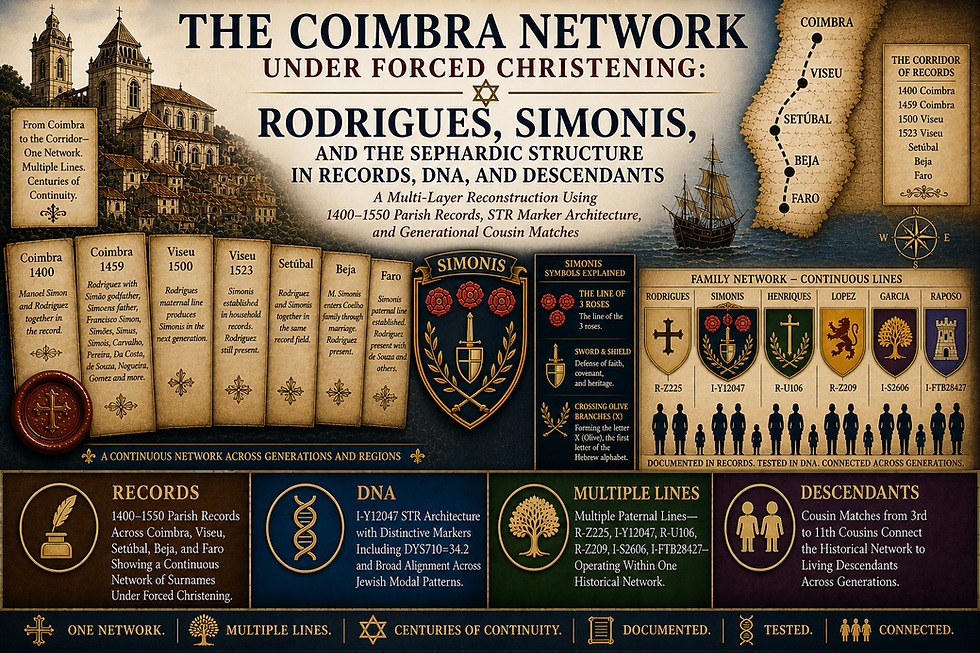
The Coimbra Network Under Forced Christening Structure
This article is not written as a surname history and it is not built to trace a single paternal line. The structure being examined here is a family-network system, visible in the parish records of Coimbra and surrounding regions from at least 1400 forward. The names Rodrigues, Simonis and its variants (Simão, Simoens, Simões, Simois), Henriques, Lopes, Garcia, and the Rapoza/Raposo root do not appear as isolated entries. They appear together, repeatedly, inside the same record environments, across multiple generations, and across multiple regions.
The records themselves are labeled as baptisms or christenings, but that label cannot be read at face value in this context. In Iberia during the 1400s and 1500s, these entries often reflect forced or coerced conversion conditions, not simple voluntary religious acts. The parish system recorded identities under pressure. Families were entering these records within a system that demanded conformity—through conversion, exile, or death. That reality matters, because it explains why names shift, recombine, and appear layered across records while still preserving deeper continuity.
The structure that emerges is not random. The same names appear in roles as fathers, mothers, godparents, and witnesses, and then reappear in different combinations across nearby regions. The repetition is not limited to a single surname. It is a network of surnames operating together inside the same historical environment.
To understand that structure, three independent layers are used and kept separate before being aligned. The first is the record layer, which shows the names, locations, relationships, and repeated environments. The second is the DNA layer, which includes Y-STR architecture, haplogroup structure, autosomal patterning, and maternal markers. The third is the cousin match layer, which places living descendants into generational positions that correspond to the historical timeline of the records.
Each layer stands on its own. The records do not require DNA to exist. The DNA does not require the records to exist. The cousin matches do not require either one to exist. The strength of the structure comes from the fact that when these three layers are aligned, they point to the same system without being forced into agreement.
This article proceeds by building from the earliest Coimbra material forward, preserving the record data as it appears, and then layering the DNA and cousin match structure over that record base. The goal is not to simplify the material, but to keep it intact so that the structure can be seen without compression.
Coimbra 1400–1401: The Foundation Records (Full Field, Not Isolated Names)
Before the 1459 cluster forms, the system is already present in Coimbra, and it is visible through the way the Simon-root appears inside a shared record field, not as a single fixed surname.
The Coimbra foundation material places the Simonis structure in a 1401 context tied to Anna Ritta, with the surrounding record field including Cruz Das Neves Machado, Simones Barattor, Barretto, Antonia, Luis Movrão Simous Lopes Nicolão Da Silva Movrão, Da Silves Machado, and Luis Sim. Sim. Es Lopes Simo de Alvera. What matters here is not just the presence of Simonis, but the way the Simon-root appears in multiple forms—Simonis, Simones, Simous, and Simo—inside the same document space, while remaining tied to the same surrounding names. Machado, Lopes, and Da Silva are already present as part of the same environment.
This is not a case of inconsistent spelling. It is a structured naming behavior. The root identity is stable, while the surface form adapts depending on how the record is written. At the same time, the surrounding surnames do not disappear. They remain in place, forming a convoy structure that repeats across entries.
That same structure is reinforced by the Manoel Simon record in Coimbra around December 1400. The record identifies Manoel Simon, with family references to Netta, Cunhas, and Maria Jorge na Toral Das Ribas. The associated names include Montro, Iozeph Iozeph Esteves, Simois, do Drigues dos Cunhas, Gonde, Toral Das Ribas, and Rodrigues.
The importance of this record is not just the presence of Simon. It is the presence of Simois and Rodrigues in the same field, tied through the same environment before the later cluster becomes dense. The Simon-root is already interacting with Rodrigues at this stage, and both are already embedded with other families.
When these two pieces are read together—the 1401 Simonis field and the 1400 Manoel Simon record—the structure becomes clear. The Simon-root is not entering Coimbra in 1459. It is already there. It is already adaptive. It is already embedded with Machado, Lopes, Da Silva, Cunhas, Toral Das Ribas, and Rodrigues.
This section establishes the base condition for everything that follows:
the 1459 cluster is not the origin of the system. It is the point where the system becomes dense enough to see clearly.
Rapoza Inside the Rodrigues Structure (Tocha, Cantanhede, Coimbra, 1400)
The next layer of the Coimbra foundation is not built from a general pattern. It comes from a specific record that places another name-root directly inside the same environment already established in Section Two.
The record is for Anna Gueirada Rodrigues Da Sette Gueirada Da Repoza, located in Tocha, Cantanhede, Coimbra, Portugal, with the birth field recorded as fevereiro de 1400. The entry identifies Jorge as the father and gives the maternal line as Rodrigues da Queirada da Rapoza Quentan, e Roche. The godfather is listed as Joze.
The surrounding names on the same record include Corge, Rodrigues Das Perci, Joze Jorge Anastario, Maricello Da Queixada Da Rapoza de Cima, Jorge Cheiroto, Gomes Carvalheiro, Manoel Ignacio de P. de P. Eloys, Cherozo, and Gomes Carvalheiro repeated again within the same entry.
This record matters because it does not place Rapoza in isolation. It places Rapoza inside a Rodrigues-linked family structure, in the same Coimbra region, at the same early timeframe where the Simon-root is already present. The maternal line explicitly carries both Rodrigues and Rapoza, while the surrounding record field reinforces that this is not an isolated family unit. Rodrigues appears again through Rodrigues Das Perci, and the repetition of Gomes Carvalheiro shows that the same convoy pattern seen in Section Two continues here as well.
The presence of Maricello Da Queixada Da Rapoza de Cima is particularly important because it shows that the Rapoza name is not a single occurrence within the record. It appears in more than one form within the same entry, confirming that it is part of the same naming environment rather than a one-off variation.
When this record is placed alongside the Coimbra foundation material from Section Two, the pattern becomes more defined. The Simon-root appears in multiple forms within a shared field of names, and now the Rapoza root is also visible inside that same type of structure, tied directly to Rodrigues.
This is the first point in the article where three elements are visibly operating together in the same region and timeframe:
the Simon-root structure,the Rodrigues family line,and the Rapoza name-root embedded inside that Rodrigues structure.
This matters later when the Raposo DNA match is introduced, because it shows that the Rapoza/Raposo name is not entering the system from outside. It is already present inside the Coimbra structure at the same early stage as the Simon-root and Rodrigues.
At this point in the build, the structure is no longer just a Simon-root environment with associated names. It is a multi-name network already operating before 1459, with Rodrigues acting as a central line, the Simon-root appearing in adaptive forms, and Rapoza embedded directly within that same family field.
The 1459 Coimbra Rodriguez Record Set (Full Entries, Full Field)
By 1459, the structure that was visible in fragments in 1400–1401 becomes dense enough that it can no longer be dismissed as coincidence. The Rodriguez entries from Coimbra in this year do not stand alone. They form a record set, and each one carries part of the structure.
The first record is for Rodriguez, male, located in Coimbra, Portugal, with the event date recorded as outubro de 1459. The extended family field identifies the godparents as Sabel, Gonçalo, Simão, and Anna Agostinha. The presence of Simão as godfather places the Simon-root directly inside the ritual structure of a Rodriguez christening. The surrounding names include Antonio, Rois Da Torre, Sirois, Rodrigues O Manço, M., Rodrigues, and Carvalho. This record shows Rodriguez operating in a field that already includes Simon-root presence and Carvalho-linked names.
The second record, also in Coimbra, Portugal, carries an event date of março de 1459. This record is for Rodriguez, male, and it identifies the father as Simoens. This is one of the strongest connections in the entire dataset because it establishes a direct paternal link between Simoens and a Rodriguez child. The spouses and children field includes Ro - Vanei, UNKNOWN, and Rodrigues listed as wife. The godparents are Affonto and Por. The surrounding names expand the field further: Thereza de Je ???????? de Je Luz, Manoessimomo, Dissua Simoens, Nasins, Yoa, Margarida Jozepha, UNKNOWN, ⌨, Gomez Marso, Manoel J., Manoel Sinos. Sinos . Matheu, and Marianna de Jezus. The presence of Dissua Simoens alongside Simoens as father shows that this is not a single occurrence of the name. It is part of a wider family field. The appearance of Gomez Marso inside this same record places the Gomez name directly inside the 1459 Coimbra environment.
The third record, again in Coimbra, carries an event date of junho de 1459. This record is for Rodriguez, female, and identifies the father as Martins Alveres, with another parent field listed as Secam. er. The godfather is João. The surrounding names include Serimo, Joao, Maria Tereza, Martins Alveres, Maria Fran. ca de Jezus, M.el Nogueira, Marianna Tereza N., Simoens Bicho, and de Souza. This record shows that Rodriguez is not tied to a single paternal structure. It appears under a different father-line, while Simoens Bicho remains present in the same environment. The Simon-root continues to appear even when the immediate father is not Simoens.
The fourth record remains part of the same Coimbra set through its 1459 birth placement, even though the later event field reflects a different registry entry. This record identifies the parents as Rodriguez (mother) and Rodriguez Bentr. A (father). The godfather is Da Silva de Verride. The surrounding names include Rodriguez Bandeira, Jozefa, Roza Freg, Samuel, Dovs, Dovs Bandeira, Roges, Francisco Simon, Simões, Da Costa, Sicora, Simus Tol, Pereira, and Simois Brune. This record is particularly important because the Simon-root appears in multiple forms within the same entry: Francisco Simon, Simões, Simus, and Simois. This reflects the same adaptive naming structure already seen in the earlier Coimbra foundation material.
When these four records are read together, they show that 1459 Coimbra is not a single event. It is a dense, repeating field where Rodriguez appears alongside multiple forms of the Simon-root, along with Carvalho, Pereira, Da Costa, de Souza, Nogueira, de Jesus forms, and Gomez. The relationships vary—godparent, father, surrounding witness—but the names remain in the same environment.
This is the point where the structure becomes undeniable. The Simon-root is not adjacent to Rodriguez by coincidence. It is embedded within the Rodriguez record field across multiple entries, in multiple roles, and in multiple forms. The surrounding convoy names remain consistent, reinforcing that this is a network, not a set of isolated records.
Emilha Simonis (1459) and the Henriques Integration
The Rodriguez record set from 1459 shows the Simon-root embedded across multiple entries. That pattern is not limited to Rodriguez records alone. It is confirmed directly by a Simonis record from the same year, placing Simonis inside the same Coimbra field with the same convoy of names.
The record identifies Emilha, listed as Simonis’s daughter, within the 1459 Coimbra environment. The surrounding names on this record include de Siquerrado, de Figueredo, Joanna Maria, Henriques, Simon, Ferreira de Carvalho, Rosa Emilia, Simois, Carvalho de Soutello, Alves Da Ferreira, Menarde, and de Souza Campos.
This record is critical because it shows that the Simonis line is not only present in Rodriguez-linked entries. It stands on its own inside the same field, surrounded by the same names. The Simon-root appears again in multiple forms within the same record—Simon, Simois, and Simonis—confirming that the adaptive naming pattern observed in the earlier Coimbra material continues into 1459.
The presence of Henriques inside this same record field is the key structural point. Henriques is not appearing later through migration or external contact. It is already present inside the Coimbra system at the same moment the Simonis structure is fully visible. This means the Simon-root and Henriques-root are operating together inside the same environment from the start of the dense record layer.
The appearance of Ferreira de Carvalho and Carvalho de Soutello reinforces that the same Carvalho-linked structure seen in the Rodriguez records is also present here. de Souza Campos aligns with the de Souza presence already visible in the Rodriguez entries. The repetition of these names across both Rodriguez and Simonis records shows that they are part of the same convoy system, not separate family clusters.
When this record is placed alongside the Rodriguez set from Section Four, the structure becomes more defined. Rodriguez entries show Simon-root names embedded through godparent, paternal, and surrounding roles. The Emilha Simonis record shows Simonis centered within the same field, surrounded by the same associated families. Together, they confirm that the Simon-root is not attached to Rodriguez as an external element. Both operate within the same system.
This is also the point where the Henriques connection becomes structural rather than observational. In your broader work, the Simon and Henriques names recombine in multiple forms—Simon Henriques, Simones Henriques, Henriques Simones—and later appear in northern registers as Henricus Martini Simonis. This record shows that the connection between these roots is not something that forms later. It is already present in the Coimbra system at the 1459 level.
At this stage of the build, the network includes:
the Simon-root in multiple adaptive forms,the Rodrigues/Rodriguez line across multiple entries,the Henriques-root inside the same record field,and the Carvalho and de Souza convoy names repeating across records.
The significance of this section is that it moves the structure from a Rodriguez-centered observation to a multi-root system, where Simonis and Henriques stand inside the same environment, supported by the same surrounding names.
Viseu 1500: The Direct Rodrigues → Simonis Bridge
The Coimbra material establishes that Rodrigues and the Simon-root operate inside the same record field. The Viseu material shows that this is not only proximity. It becomes a direct generational connection.
The record is for Es Simonis, female, mentioned in the record of Joze, identified as her son, located in Silgueiros, Viseu, Portugal, with the event recorded as outubro de 1500. The parent field identifies Rodrigues as the mother of Es Simonis. This creates a clear generational structure: a Rodrigues maternal line producing a Simonis identity in the next generation.
The family structure within the record identifies Joze as the son of Es Simonis, with Roil listed as wife. The surrounding record field includes Sinco, Rodriguez, Sinione, Dasse de, Rodriguez, do Iugual, Rodriguez do Forno, Rodriguez do Forno again, Maria, Ap, Lopes, Antonia Maria, and Manoel Roiza Ama.
This record does not present Rodrigues and Simonis as neighboring names. It places them inside the same lineage. The maternal line carries Rodrigues, and the next generation carries Simonis. At the same time, multiple Rodriguez entries appear within the same record field, reinforcing that the connection is not isolated to one branch. It exists within the same operating environment.
The presence of Lopes within the same record field is also important. Lopes has already been identified as part of the Coimbra convoy structure in earlier material, and its appearance here confirms that the same set of names continues into the Viseu region.
When this record is read alongside the 1459 Coimbra material, the structural progression becomes clear. In Coimbra, the Simon-root appears embedded within Rodriguez records through godparent roles, paternal identification, and surrounding witness fields. In Viseu, the connection moves into a direct family structure, where Rodrigues becomes the maternal origin of a Simonis line.
This is the point in the build where the argument shifts. The relationship between Rodrigues and Simonis is no longer supported only by repeated proximity. It is supported by a recorded generational transition.
At this stage, the structure now shows continuity across both time and geography. The Coimbra environment of 1459 carries forward into Viseu by 1500, and the same names—Rodrigues, Simonis, Lopes, and related forms—continue to appear together, now linked through family structure rather than only shared record space.
Viseu 1523: Simonis Stabilization with Rodriguez Still Present
The 1500 Viseu record establishes a direct Rodrigues → Simonis generational link. The 1523 Viseu material shows that this is not an isolated transition. By this point, Simonis appears as a stable household structure, and the same surrounding names—especially Rodriguez—remain present in the same record environments.
The first record identifies Simonis, male, mentioned in the record of Antonio Simonis, his son, located at Nossa Senhora da Assunção, Mortágua, Mortágua, Viseu, Portugal, with the date anchored to 1523. The family structure places Simonis as father and Antonio Simonis as son, establishing a clear paternal line under the Simonis name.
The surrounding record field includes Antonio Setenta, Curades, Gomes, Maria Roza, Mariae del de Remijo, Pimos, Esta, Valda Isares, Gomes again, Rodriguez, Mena, de Joze, Nes Abreu el : Juro de San Assores, Antonio de San Assores M. el Juro, and Martins Ribeiro.
This record shows that Simonis is now functioning as a household identity, not just a derived form from a previous generation. At the same time, Rodriguez remains present inside the same record field, confirming that the relationship seen in the 1500 bridge has not separated into independent lines. The same environment continues.
The second record from the same year identifies Simonis, male, with Antonia listed as wife and an unnamed male child, located in Viseu, Portugal, with the date anchored to 17 de setembro de 1523. The surrounding names include de Mello Da Pena Branquia, Rodriguez, Ahu, Domingas, de Castro de Ponolite, Ma, Povação, and Rodriguez Josole.
This second record reinforces the same pattern. Simonis appears again as a family unit, and Rodriguez appears again within the same record field, including the form Rodriguez Josole, which reflects the same adaptive naming behavior seen earlier in Coimbra with Simon, Simões, and Simois.
When these two records are read together, they show that the Viseu region is not just a continuation of the Coimbra structure. It is a stabilization point. The Simonis line is now established across multiple households, and the same surrounding names—Rodriguez, Gomes, and others—continue to appear in the same environments.
This confirms that the connection between Rodrigues and Simonis established in 1500 does not dissolve in the next generation. It holds, and it repeats. The names do not separate into independent clusters. They remain part of the same network, now expressed through multiple family units rather than a single transitional record.
At this stage in the structure, the progression is clear. The Coimbra environment produces a dense shared field in 1459. The Viseu 1500 record creates a direct generational link. By 1523, that link has become a stable and repeating household structure, with the same names continuing to operate together inside the same regional system.
Setúbal 1512: Rodriguez Carriam and the Southern Expansion Layer
The Viseu records show the network stabilizing after the 1500 bridge. The Setúbal record shows that the same structure is not confined to Coimbra and Viseu. It is already present further south while maintaining the same internal connections.
The record identifies Rodriguez Carriam, male, mentioned in the record of Lara, his daughter, located in Setúbal, Portugal, with the birth anchored to 1512. The family structure places Rodriguez Carriam as father and Lara as daughter, establishing a Rodriguez line operating in the Setúbal region.
The surrounding record field includes de Mattos, Herina Catherina, Lonze, Guedo, Maria Izabel Cezilia, Simonis, Soares Da Galindo, Antonia Maria, Gonçalves Da Cunha, Soares Da Nativide, Ellena Reos, de Queiroga, Stiago, Raz, Martins Chaves, and de Mattos appearing again within the same entry.
The presence of Simonis inside this record field is the key structural element. This is not a Viseu-only connection and it is not limited to the earlier Coimbra environment. The Simonis name appears within the same Setúbal record that contains a Rodriguez line, confirming that the connection between these names continues as the network expands geographically.
The composite form Rodriguez Carriam also reflects the same adaptive naming behavior already seen in earlier records. Just as Simonis appears as Simon, Simões, and Simois in Coimbra, Rodriguez appears here in a combined form, indicating that naming is still being shaped within the same system rather than fixed into rigid structures.
The repetition of de Mattos within the same record reinforces the convoy pattern. Names are not appearing once and disappearing. They repeat inside the same entries, just as seen earlier with Gomes Carvalheiro in the Coimbra records and with Simoens-related names in the 1459 cluster.
When this record is placed alongside the Viseu material, the structure becomes clearer. The same names—Rodriguez and Simonis—continue to appear together, even as the geographic location changes. The network is not breaking apart as it moves. It is carrying its internal structure with it.
This section establishes that by the early 1500s, the Coimbra–Viseu network has already extended into Setúbal, and it has done so without losing the core relationships between the names. Rodriguez remains present as a family line, Simonis remains present within the same record field, and the surrounding convoy names continue to repeat.
The movement south does not dilute the structure. It confirms that the structure is portable and persistent across regions.
Beja 1550: M. Simonis, Coelho Integration, and Rodriguez Continuity
The Setúbal record shows the network moving south while maintaining the same internal structure. The Beja record shows how that structure continues through family integration, not only through direct paternal lines.
The record identifies M. Simonis, female, mentioned in the record of S. Coelho, her son, located in São João Baptista, Moura, Beja, Portugal, with the date anchored to maio de 1550. The family structure places Coelho as husband of M. Simonis and S. Coelho as their son.
The surrounding record field includes Costello, Rodriguez, and UNKNOWN.
This record is important because it shows Simonis operating through a maternal line inside a different family structure, rather than appearing only as a direct paternal surname. The Simonis identity is still present, but it is now integrated into the Coelho household.
At the same time, Rodriguez remains present in the same record field, confirming that the connection between these names has not separated even as family structures change. The names do not diverge into unrelated groups. They continue to appear in the same environments, even when the primary family name shifts.
This section demonstrates that the network does not rely on a single type of transmission. It moves through paternal lines, as seen in earlier Simonis records, but it also persists through maternal lines, as seen here with M. Simonis. The structure holds because the names remain connected within the same record environments, regardless of how the family units are formed.
When this record is placed alongside the earlier Coimbra, Viseu, and Setúbal material, the continuity becomes clear. The same names—Simonis and Rodriguez—continue to appear together, even as the network expands and integrates into different family structures.
The Beja record confirms that the network is not only expanding geographically. It is also adapting internally, carrying the same relationships forward through different family configurations without losing the connection between the names.
Faro: Ignes Simonis and the Southern Reach of the Network
By the time the network reaches the Algarve region, it has already passed through Coimbra, Viseu, Setúbal, and Beja. The Faro material shows that the structure does not dissolve at distance. It continues to carry the same names, the same relationships, and the same internal connections.
The record identifies Simonis, male, mentioned in the record of Ignes Simonis, his daughter, located in Moncarapacho, Olhão, Faro, Portugal. The relationship is direct: Simonis is the father, and Ignes Simonis is the daughter.
The surrounding record field includes Margarida do, Manoel Rodriguez Tedintor, Domingos Lourenso de Mendosa Silva Breatriznobre, de Souza Dositio, Victor Manoel Esignes Rodriguez, and Julio.
This record shows that the Simonis line is still present as a family structure in the southernmost region of Portugal, and at the same time, Rodriguez appears again within the same record field, including both Manoel Rodriguez Tedintor and Victor Manoel Esignes Rodriguez. The repetition of Rodriguez forms within the same entry reinforces that the connection between Simonis and Rodriguez is still active at this stage.
The presence of de Souza Dositio aligns with the earlier appearance of de Souza names in the Coimbra records, showing that the same convoy elements continue to travel with the network. The longer composite name Domingos Lourenso de Mendosa Silva Breatriznobre reflects the same pattern of layered naming seen in earlier records, where multiple family elements are combined within a single identity.
The key point of this section is that the network has now extended from central Portugal into the Algarve without losing its internal structure. Simonis remains present as a paternal line, Rodriguez remains present in the same record environment, and the surrounding names continue to reflect the same adaptive naming system.
At this stage, the geographic movement is complete within Portugal. The same network that was visible in Coimbra in 1400–1459 is still intact in Faro. The names have not separated, and the structure has not collapsed.
DNA Layer: Full Jewish STR Architecture and Pattern Field
The record structure from Coimbra through Faro shows a persistent network of names operating together across time and region. The DNA layer is not used to replace that record structure. It is used to test whether the same structure appears in the genetic data, and whether it holds when read through full STR architecture rather than a simplified label.

The paternal haplogroup reads as I-Y12047, and the maternal haplogroup reads as J1c1b2. The regional pattern layer identifies a Levantine root at 90 percent, an Iberian/Sephardic corridor at 75 percent, and a Mediterranean consolidation layer at 68 percent, with a Balkan bridge at 55 percent and a North African distributed layer at 45 percent. A Northern European layer appears at 39 percent, functioning here as a compression layer over earlier preserved structure rather than a primary origin signal. The autosomal layer supporting this includes 99 zero-heterozygosity blocks, indicating preserved founder segments rather than fully diffused population mixing.
The Y-STR pattern layer defines the Simonis line through a compressed and stable marker structure. The anchor values are DYS455 equal to 8, DYS390 equal to 22, DYS385 equal to 14-14, DYS459 split value 8-9, DYS448 equal to 20, and the distinctive DYS710 equal to 34.2 micro-allele. These values are not read in isolation. They are tested across a full Jewish modal comparison field.

The top alignment reads as the I-Y12047 Simeon Cluster at 100 percent, with matched markers DYS455=8, DYS459=8-9, DYS385=14-14, DYS448=20, DYS392=11, DYS426=11, and DYS710=34.2. This establishes the primary anchor structure of the line.
That anchor does not stand alone. The same STR profile aligns at 100 percent with a J2-like Jewish pattern, carrying DYS390=22, DYS391=10, DYS392=11, DYS393=13, DYS385=14-14, DYS439=11, and DYS455=8. It aligns at 100 percent with the G-M377 Jewish founder cluster, with matched markers including DYS19=14, DYS390=22, DYS391=10, DYS392=11, DYS393=13, DYS385=14-14, and DYS459=8-9. It aligns at 100 percent with the T-L208 Jewish modal layer, again carrying the same compressed marker structure including DYS393=13, DYS390=22, and DYS439=11. The same pattern aligns at 93 percent with the J1-CMH priestly structure, maintaining the same anchor behavior across the key markers.

The presence of DYS710=34.2 is a defining part of this structure and must be preserved exactly as a fractional value. It should not be flattened to 34, because the decimal state reflects a micro-allele condition that does not commonly appear in surrounding STR environments. This detail strengthens the identification of the pattern as a preserved structure rather than a generalized match.
Below the top alignments, the comparison field expands into hundreds of additional Jewish modal rows, most of them clustering between 89 percent and 81 percent alignment. These include Sephardic and Ashkenazi reference sets across J2a branches such as L24, L25, L556, M67, M92, L70, and PF5456, along with J1 branches including L147.1 and Z18297, and additional matches across G, T, Q, R2, E1b, J2b, and L branches. The repetition of alignment across this entire field shows that the STR profile is not matching a single lineage by chance. It is sitting inside a broad Jewish STR pattern field.
The defining behavior of this structure is compression and stability. The DYS455=8 anchor, the DYS390=22 low-range value, and the DYS385=14-14 pairing remain consistent across the highest alignments and continue to hold across the wider comparison field. The DYS710=34.2 micro-allele remains intact across the top alignment layer, reinforcing that this is not a drifted or expanded STR pattern.
When this DNA layer is placed alongside the record layer, the alignment is structural rather than interpretive. The records show a network of names operating together under forced-christening conditions across Coimbra, Viseu, Setúbal, Beja, and Faro. The DNA shows a preserved STR architecture that repeatedly aligns across Jewish modal systems, supported by a wide comparison field and reinforced by autosomal founder structure.
The DNA does not replace the records. It confirms that the structure seen in the records is consistent with a preserved population pattern, with the DYS710=34.2 micro-allele acting as part of that preserved signature, rather than a random collection of surnames or a simplified haplogroup label.
Haplogroups Inside the Network: Multiple Lines, One Structure
The record layer shows Rodrigues, Simonis, Henriques, Lopes, Garcia, and the Rapoza/Raposo root operating together across Coimbra, Viseu, Setúbal, Beja, and Faro. The DNA layer shows a preserved STR structure centered on I-Y12047 with strong Jewish modal alignment. The next step is to place the other paternal lines into that same framework without forcing them into a single origin.
The Rodriguez line aligns with haplogroup R-Z225, a branch within the broader R1b-DF27 structure that is strongly represented across Portugal and Spain. The STR pattern for this branch carries values such as DYS390 at 25, DYS391 at 11, DYS392 at 13, DYS393 at 13, and DYS448 in the 18–19 range, while maintaining DYS455 at 11. This structure reflects an Iberian lineage that operates in the same geographic corridor as the Simonis line, but with a different STR architecture. The key point is that R-Z225 appears in the same regions and within the same surname environments—Rodriguez being one of the most consistent carriers—placing it inside the same historical network seen in the records.
The Lopez line aligns with haplogroup R-Z209, another Iberian branch that carries a more compressed STR profile within the R1b structure. The Lopez pattern often shows DYS437 at 14, DYS448 at 18, and DYS390 in the 23–24 range, creating a lower-range profile compared to other R1b lines. This pattern operates in the same Iberian corridor as Rodriguez and appears within the same surname environments that show up in the Coimbra and Viseu records. The Lopez line does not match the Simonis STR anchors, but it occupies the same network space and follows the same geographic and historical pathways.
The Garcia line aligns with haplogroup I-S2606, a branch within Haplogroup I that differs from the I-Y12047 Simonis line in its STR behavior. The Garcia structure shows DYS455 at 11, DYS390 in the 24–27 range, and DYS448 at 21–22, reflecting a more expanded pattern compared to the compressed Simonis anchors. Despite this difference in structure, Garcia appears within the same Iberian surname environments and connects through deeper cousin match ranges that reach further back into the timeline, tying it into the earlier layers of the same network.
The Raposo line aligns with haplogroup I-FTB28427, another branch within Haplogroup I that retains the DYS455=8 anchor, shared with the Simonis line, while showing a shift in other markers such as DYS390 at 23 and DYS385 at 13-14. This creates a profile that shares the foundational anchor but reflects a different path within the same broader structure. The presence of the Rapoza name inside the early Coimbra record and the later Raposo DNA match in central Portugal places this branch inside the same corridor as the Simonis and Rodriguez lines.
The Simonis line itself, defined by I-Y12047, remains anchored by DYS455=8, DYS390=22, DYS385=14-14, DYS459=8-9, DYS448=20, and DYS710=34.2, and is supported by the broad Jewish modal comparison field described in the previous section. This line represents a preserved STR structure that remains stable across the comparison field.
When these haplogroups are viewed together, they do not collapse into a single paternal origin. Instead, they show that multiple paternal lines were operating inside the same historical network. The Rodrigues line carries an Iberian R1b structure. The Lopez line carries a related but distinct Iberian R1b branch. The Garcia line carries a different Haplogroup I structure with expanded STR values. The Raposo line carries an I1 branch that retains part of the Simonis anchor while diverging in other markers. The Simonis line carries a compressed STR structure that aligns strongly with Jewish modal systems.
The record layer already shows these names operating together. The DNA layer shows that they represent different paternal architectures within the same population system. This is the critical point: the network is not defined by a single haplogroup. It is defined by the fact that these different haplogroups appear within the same surnames, the same regions, and the same record environments.
This section establishes that the structure seen in the records is a multi-lineage system, not a single paternal chain. The names remain connected across records, and the DNA shows that those connections persist even when the underlying paternal lines differ.
Cousin Matches: The Generational Timeline That Locks the Structure
The record layer establishes the network across Coimbra, Viseu, Setúbal, Beja, and Faro. The DNA layer shows that multiple paternal lines exist inside that same network with a preserved STR structure at its core. The cousin match layer is where those two come together and are placed into a living generational timeline.
The Garcia line extends from 4th to 11th cousin matches. That range reaches the deepest into the structure and aligns with the earliest layers of the record system, including the 1400–1401 Coimbra foundation and the 1459 cluster. The depth of the Garcia matches shows that this surname is not entering the network late. It reaches back into the same time period where the Simon-root and Rodrigues are already operating together. The extended range also shows continuity across multiple generations without breaking.
The Rodriguez line falls between 6th and 9th cousin matches, which places it directly into the core cluster and bridge phase of the network. This range aligns with the 1459 Coimbra record set and the 1500 Viseu bridge, where the relationship between Rodrigues and Simonis moves from shared record field into direct generational linkage. The Rodriguez matches sit exactly where the records show the structure tightening and repeating.
The Lopez line appears between 4th and 6th cousin matches, placing it in the later consolidation phase of the same system. By this stage, the network is already established across regions, and Lopez aligns with that later layer where the structure is no longer forming but continuing forward into stable family lines.
The Gomez line falls between half 3rd once removed through 4th and 5th cousin matches. This range places Gomez in the expansion layer of the network, between the deep foundation and the later consolidation. The importance of this placement is reinforced by the record layer itself, where Gomez Marso appears inside the March 1459 Coimbra Rodriguez record. The name is already present in the historical structure, and the cousin match range places it within the generational window where that structure is actively expanding across regions.
The Hernandez line falls within 3rd once or twice removed to 4th cousin matches, placing it in the closest generational layer of the structure. This is the forward edge of the timeline, where the network has already formed, expanded, and stabilized. Hernandez fits within the same Iberian patronymic system as Rodrigues, Lopes, and Henriques, and its placement in this closer range shows that the same underlying population structure continues into more recent generations.
The Raposo line is anchored through a documented match to Dr. Carlos Alberto Raposo, with the earliest known ancestor Francisco do Amaral Raposo, who died in 1757, located in Sebadelhe da Serra, Portugal. This match carries the haplogroup I-FTB28427. The importance of this line is not only the DNA classification, but the fact that the Rapoza root appears inside the 1400 Coimbra Rodrigues record, and the Raposo line appears later in the same central Portugal corridor. This creates a forward anchor that ties an early record name to a later descendant population.
When these match ranges are read together, they do not scatter randomly across time. They form a continuous generational spread.
The deepest layer is held by Garcia, reaching into the earliest structure. The core formation layer is held by Rodriguez, aligning with the 1459–1500 records. The expansion layer is held by Gomez, sitting between the core and the later consolidation. The later consolidation layer is held by Lopez and Hernandez, representing the continuation of the network into more recent generations. The Raposo line provides a descendant anchor that ties the early Rapoza record into the same geographic corridor in later centuries.
This distribution does not skip generations. It fills them.
The significance of this section is that the cousin matches do not need to be forced into alignment with the records. They naturally fall into the same timeline. The record layer shows when the structure exists. The cousin matches show how that structure carries forward into living descendants.
At this point, the network is no longer only historical. It is continuous.
Final Argument: The Network Holds Across Records, DNA, and Living Descendants
The structure presented in this article does not depend on a single record, a single surname, or a single genetic line. It holds because the same pattern appears across multiple independent layers that were built separately and then aligned.
The record layer begins in Coimbra before 1459, where the Simon-root already appears in multiple forms—Simonis, Simones, Simous, and Simo—inside a shared field that includes Machado, Lopes, Da Silva, and Rodrigues. The Manoel Simon record shows that Simon and Rodrigues are already operating in the same environment at the 1400 level. The Tocha record places the Rapoza root directly inside a Rodrigues family structure in that same early timeframe.
By 1459, the Coimbra records no longer show isolated entries. They show a dense record field where Rodriguez appears across multiple entries with Simão as godfather, Simoens as father, and Simon-root variants—Francisco Simon, Simões, Simus, Simois—appearing repeatedly in the same environment. Carvalho, Pereira, Da Costa, de Souza, Nogueira, and Gomez appear alongside them, forming a consistent convoy of names.
The Emilha Simonis record from the same year confirms that Simonis is not only embedded within Rodriguez records but stands within the same field independently, surrounded by the same names. The presence of Henriques in that same record field shows that the Simon-root and Henriques-root are operating together at the point where the structure becomes fully visible.
The Viseu record of 1500 moves the structure from shared environment into direct generational linkage, where a Rodrigues maternal line produces a Simonis identity in the next generation. The Viseu records of 1523 show that this is not a single transition. Simonis appears as a stable household structure, while Rodriguez remains present in the same record environments, confirming that the connection holds across generations.
The Setúbal record shows the network extending south while maintaining the same internal structure, with Rodriguez and Simonis continuing to appear together. The Beja record shows that the structure persists through maternal integration, with M. Simonis entering the Coelho family while Rodriguez remains present in the same record field. The Faro record shows that the same pattern continues at the southern edge of Portugal, with Simonis as a paternal line and Rodriguez appearing again in the same environment alongside de Souza and other convoy names.
At every stage of the record layer, the same pattern holds: the names do not separate, and the structure does not collapse. It repeats.
The DNA layer does not replace this structure. It confirms it through a different system. The Simonis line, defined by I-Y12047, carries a compressed STR architecture anchored by DYS455=8, DYS390=22, DYS385=14-14, DYS459=8-9, DYS448=20, and the DYS710=34.2 micro-allele. This structure aligns at 100 percent with the I-Y12047 Simeon cluster and also aligns at 100 percent with multiple Jewish modal systems, including J2-like, G-M377, and T-L208 patterns, while maintaining a 93 percent alignment with the J1-CMH priestly structure. Beneath these top alignments, hundreds of additional comparison rows cluster between 89 percent and 81 percent across Sephardic and Ashkenazi reference sets.
The significance of this pattern is not that the lineage shifts between haplogroups. It is that the same STR structure repeatedly fits Jewish modal systems across a wide comparison field, supported by autosomal founder structure with 99 zero-heterozygosity blocks. The DNA layer shows a preserved population pattern that matches the structure seen in the records.
At the same time, the broader network includes multiple paternal lines. Rodriguez aligns with R-Z225, Lopez aligns with R-Z209, Garcia aligns with I-S2606, and Raposo aligns with I-FTB28427. These lines do not collapse into one origin. They show that multiple paternal architectures operated inside the same historical network, just as the records show multiple surnames operating inside the same environments.
The cousin match layer then places this entire structure into a generational timeline. Garcia extends from 4th to 11th cousins, reaching into the earliest layers of the network. Rodriguez falls between 6th and 9th cousins, aligning with the 1459 Coimbra cluster and the 1500 Viseu bridge. Gomez falls between half 3rd once removed and 4th–5th cousins, aligning with the expansion phase of the network and appearing in the 1459 records themselves. Lopez falls between 4th and 6th cousins, and Hernandez falls between 3rd once or twice removed and 4th cousins, both placing them in the later consolidation phase. The Raposo match provides a documented descendant anchor in central Portugal, linking the early Rapoza record to a later population in the same corridor.
These ranges do not scatter randomly. They form a continuous spread across generations, filling the timeline from the early 1400s through later descendant populations without gaps.
The record layer shows the network in place. The DNA layer shows the structure preserved. The cousin matches show the structure continuing.
This is not a single surname story, and it is not a single paternal line. It is a multi-lineage family network that operated under forced-christening conditions, carried its structure across regions, preserved its identity through adaptive naming, and continues to appear in modern descendant matches.
The structure holds because every layer—records, DNA, and living matches—points to the same system without needing to be reduced or simplified.


Comments