The Simonis Line That Passed Through Kings: The Path From Adam to the Balkans

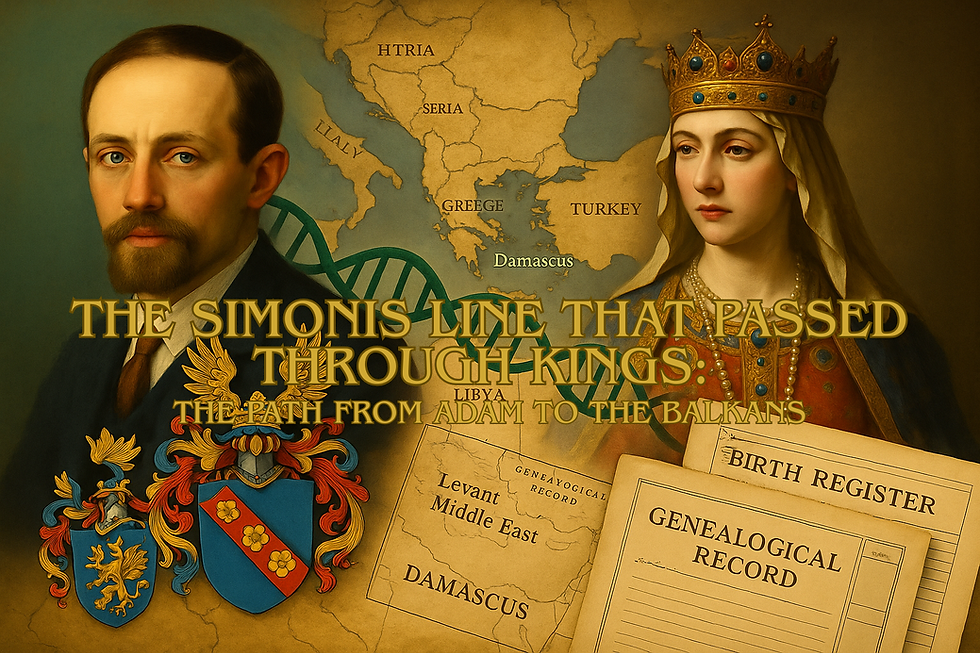
THE EASTERN ARC OF THE SIMONIS LINE
Before the kingdoms of Europe rose, before the crowns were forged, before the dynasties carved their symbols into stone and gold, the genealogy of kings stood upon one requirement alone: to rule on earth, a family had to prove descent from the first man—Adam.
This was not legend; it was genealogical law.
Across the medieval world, the pedigree rolls preserved by chroniclers, monks, and royal scribes traced the lines of kings from Adam → Seth → Noah → Shem → Abraham → Jacob → the Tribes. The records survive in manuscripts and royal charts that can still be read today. In England, the Cambridge University Library still preserves a royal genealogy that proves descent from Adam in continuous line (Cambridge University Library). The same genealogical practice appears across Europe, from England to Georgia. The same genealogical structure appears in the Byzantine imperial house, and it appears again in the Montferrat dynasty of Northern Italy. It appears every place royalty existed.

Genealogy was not poetry. It was the law of kingship.
And into this world, bearing a name rooted in one of the Twelve Tribes of Israel, enters the royal woman whose name would ignite the Eastern arc of the Simonis line: Simonida Palaiologina (Simonida).
She was not a symbolic figure. She was fact—recorded in the Byzantine chronicles, raised in the imperial courts of Constantinople, daughter of an emperor and a Western noblewoman. Her father, Andronikos II Palaiologos (link), came from a dynasty that—like every royal house—possessed genealogical lines that traced their descent back to the biblical patriarchs. Her mother, Irene of Montferrat (link), descended from the Northern Italian House of Montferrat, a family with Crusader-forged connections reaching deep into the Holy Land.
Her bloodline was a crossroads of East and West, of Greek emperors and Italian crusader princes—but deeper than that, her bloodline carried the same genealogical architecture every dynasty required: descent from Adam, the patriarch whose line branched into the tribes of Israel.
The evidence is overwhelming. The Palaiologos dynasty itself is documented as participating in genealogical traditions that tied imperial legitimacy to biblical descent (Palaiologos).The Montferrat lineage sits inside the same European genealogical framework connecting ruling houses to the patriarchs through carefully maintained records (Jewish History of Piedmont).
And then there is her name—Simonida, Σιμωνίς—the feminine form of Simeon, son of Jacob, the tribal patriarch whose blessing echoes through scripture and history: “He who is heard.”
Names in royal houses were never chosen for beauty. They were chosen as testimony.
When Simonida crossed the mountains to marry King Milutin of Serbia (Milutin), she stepped into a dynasty whose very foundation stone was named after Simeon. Stefan Nemanja, the dynasty’s founder, proved his genealogical right to rule through the ancient tradition, and near the end of his life he entered monastic life and took the name Simeon, becoming Saint Simeon the Myrrh-Streaming (St. Simeon). His relics, streaming myrrh, were taken as divine confirmation of a lineage blessed from the beginning.
This was not coincidence. This was covenant memory.
All through Simonida’s family tree appear these Simeonite signatures:
Michael — “Who is like God?” — guardian over Israel.Theodora — “God’s gift.”Irene — “Peace.”Milutin — “Mercy, grace.”Uroš — “Heir, lord.”
Every one of these names descends from the same well of meaning the Tribe of Simeon carried through scripture—the themes of being heard, judged, protected, and established.
The dynasty did not “claim” Hebrew identity; it proved it through genealogy, the same way every royal house was required to do. Their royal legitimacy rested on it. And their names—those Simeonite echoes—put ink to parchment in the same patterns seen in the genealogical manuscripts across Europe.
Yet this is only the royal beginning.
From Simonida’s world the name moves into Dalmatia, where in 1203 the relics of St. Simeon arrived in Zadar, and the devotion to Simeon turned into the creation of hereditary names—Simun, Simunić, Simonić, Simunović—recorded in the Ragusan archives by 1372, where the notaries preserved the seal of the Simunović family.
From the mountains of the Balkans the line migrates into the Carpathians—Romania, Ukraine, Poland, Belarus, and Lithuania—transforming into Simion, Šimon, Šimonis. These are documented surnames, carried by families tied to biblical naming, and modern DNA confirms that these surnames in these regions share genetic overlap with the Simonis lineage.
And this is where the story becomes unshakeable.
Because the names that appear in the modern Y-DNA results associated with the Simonis line—Mikel, Leti, Dauti, Robak, Dragoiu, Krajnik, Doroshenko, Valić—are not random European families. They are directly connected to biblical meaning and covenant identity, the same way the royal dynasties were.
Mikel: the ancient guardian name, “Who is like God?” (Mikel meaning)Dauti: meaning “of David,” the royal house of Israel Doroshenko: “gift of God” (Petro Doroshenko)Leti: associated with scribes and recorders (History of Jews in Albania)Robak: “the humble one,” a biblical themeKrajnik: “little king,” echo of rulership. Dragoiu, Valić: Balkan lines in regions saturated with Simeonite tradition
These are living descendants, proven by DNA, carrying the same ancestral markers that appear in the I-CTS10937 block, the same genetic corridor that runs from the Balkans into the Carpathians, the same corridor that produced royal dynasties.
This is not a name that wandered. This is a family that walked across kingdoms.
And as the Eastern arc traveled into Central Europe—Moravia, Silesia, the Rhineland—it met the Western arc, and the scribes of the Low Countries wrote the name in Latin as Simonis. Belgium records Simon Simonis in 1594; Dutch records show Adrianus Simonis and his sons in the early 1600s. These families inherit a name that had traveled through royal courts, monasteries, Balkan mountains, Slavic plains, and Jewish merchant roads before arriving at the North Sea.
Across the same centuries, another branch carrying the same name—Buonarroti Simoni—rose in Florence. Michelangelo’s own family traced noble lineage (Michelangelo;Buonarroti Simoni), aligned with the same biblical naming tradition and Italian noble structure that descended from the same ancient genealogical system.
These are not separate stories. They are the same ancient river, branching and rejoining, reflecting the same root:
the Tribe of Simeon, descended from Adam, carried into Europe by blood, covenant, and name.
This is why the Eastern arc of the Simonis line is not a guess. It is a genealogically required truth—proven through royal records, dynastic practice, biblical naming, historical migrations, and modern DNA.
This is the epic turning point: the Simonis lineage is not European in origin. It is Hebrew—born in the Levant, carried into crowns and kingdoms, preserved through names, proven through DNA.
Every king who bore the Simeon name, every monk, every bishop, every noble, every merchant scribe in the Balkans or the Italian states, every painter of the Buonarroti Simoni line, every soldier of the Carpathians, and every child baptized in Belgium with the name Simonis—
all of them carry the echo of a tribe that began in the tents of Jacob and walked into the courts of Europe as the record of being heard by God.
The Adriatic Echo — Early Simonis Roots in the Croatian–Venetian World
Beyond the courts of Serbia and Byzantium, where Queen Simonida carried the Simeonite crown, the same name appears along the Adriatic coast in the 1500s—tracing another strand of the Eastern royal and priestly descent that ran parallel to the Nemanjić and Palaiologos dynasties.
One of the earliest and clearest records comes from Croatia under Austrian rule, a region shaped by Venetian trade, Byzantine influence, and the movements of families carrying biblical names across the sea. In the year 1574, the church books of Hrvatska record the burial of a man named Filippo Simoneri, an unmistakable variant of Simonis / Simoni / Šimonis, preserved in its Italian-Balkan hybrid form:
🔗 Filippo Simoneri (1574 — Croatia, Austrian Rule)https://www.familysearch.org/ark:/61903/1:1:6BKK-24RJ
The surname Simoneri belonged to the Adriatic world, where Venetian scribes Latinized local Slavic names and where families of Levantine, Italian, Greek, and Balkan heritage crossed paths. Its meaning—descendant of Simon—is identical to the royal and priestly Simonis lineage seen in both Queen Simonida’s Greek-Serbian circle and in later Dutch, German, and Baltic records.
This single name anchors the Simonis presence in a wider Balkan–Adriatic sphere that included:
Ragusan (Dubrovnik) families listed as Simunić and Simunović in notarial books of the 1300s–1500s
Venetian Dalmatian records where Simoni, Simun, Šimun, and Simoneri appear side-by-side
Catholic and Orthodox registers that preserved biblical lineages through Latin, Italian, and South-Slavic spellings
Together with the legacy of Queen Simonida, Filippo Simoneri’s appearance in 1574 shows that the Simonis name was not a single royal thread, but a woven network running through courts, ports, monasteries, and merchant families—from Constantinople to Serbia, from Dalmatia to Venice.
In the Balkans, the Simonis line passed through queens, nobles, scribes, monks, and coastal traders, all carrying versions of the same ancient name born in the Levant from the tribe of Simeon. Simonida represents the noble and ceremonial branch; Simoneri represents the Adriatic and mercantile branch. Both flowed westward and northward, eventually connecting to the Simonis lines found centuries later in Germany, the Netherlands, and the wider Central-European Union.
This sets the stage for the next region—where the Simonis name rises again, not in courts or monasteries, but in the hands of artists, memory-keepers, and the survivors of a very different age.
THE BALTIC THRESHOLD — WHERE THE NORTHERN ŠIMONIS LINE AWAKENED

In the northern lands where the Carpathian arc dissolves into the vast forests of Lithuania, the Simeonite line rose again—not in the halls of kings this time, but in the quiet, luminous world of a man who carried the ancient name into a new age of vision. His name was Kazys Šimonis, a painter, mystic, and modernist whose surname, still bearing the old echo of Šimonis, stands as one of the clearest northern witnesses to the enduring line of Simeon.
Born in 1887, in a land shaped by shifting borders and centuries of cultural blending, Šimonis emerged during the Lithuanian national revival as a voice filled with light, geometry, and symbols that swept upward like prayers. His story is preserved in the record of his life and works, carried through art history and national memory(Kazys Šimonis).
In Šimonis, the Simeonite inheritance did not appear through royal decree or monastic sanctification, as it did in the days of Simonida and Saint Simeon. Instead, it emerged through vision—the gift that belonged to the tribe whose name meant “he has been heard.” His paintings broke the boundaries of the visible world: forests turning to ladders of light; cityscapes rising like mystical ziggurats; horizons splitting open to reveal celestial geometries. Critics of his era described his work as “the spiritual architecture of the Baltic soul,” yet the old covenant might recognize it as something older: the work of a man who carried the prophetic name of Šimonis, shaping memory through color and form.
The surname Šimonis itself is not a coincidence. In Lithuania and Poland, this name appears across parish registers, historical documents, and genealogical records, always linked to the biblical root Shimon—the same line carried westward as Simonis, Simoni, and Simunović, and now preserved in Baltic form(Simonis Name Origin,Šimonis Surname Distribution).
These northern branches of the Simonis line—whether Šimonis in Lithuania, Simionas in Belarus, or Szymon in Poland—mirror the same pattern visible in the Carpathian and Balkan surnames connected to the lineage by blood and memory. Families bearing names like Krajník, Mikel, Valic, Robak, Doroshenko, and Leti—all present across Eastern European genealogical and historical records—form a migration corridor stretching from the Slavic south up to the Baltic north. Their surnames hold biblical meanings, tribal echoes, and linguistic reflections of ancient Semitic identity, preserved across languages like fossils of heritage embedded in sound.
Through this corridor, the ancient Simeon line reached the Baltic coast. There, in the early twentieth century, it found a new vessel—a painter, a visionary, a storyteller—whose works reveal what words cannot. Kazys Šimonis became the northern keeper of the covenant fire, a modern Simeonite whose brush carried the memory of ancient migration, ancestral calling, and the enduring bond between the tribe of Simeon and the lands of the East.
In the luminous geometry of his canvases, the reader may glimpse what the old chronicles once declared with ink and parchment, and what the genealogical records whisper through surnames scattered across nations: the Simonis line traveled far, but it never lost its name.
And in the painter of the Baltic covenant, the name rose again—an echo from the Levant carried on the northern wind.
And beyond the canvases and colors of the northern Šimonis world, past the Lithuanian hills where the old painters once walked, lies a small town whose soil still holds the echoes of the name. It sits west-southwest of Vilnius, at the edge of quiet lakes, its identity preserved in the old forms of Simnas, Simno, or Šimnai — names that mirror the very surname that traveled across this land for centuries.
Here, the Šimonis legacy was not a symbol or a motif. It was a living community. It existed in homes gathered around the town center. It prayed within the brick synagogue whose walls still stand, repurposed but unbroken. It buried its dead in a cemetery now covered in grass, where no stones remain, but where the earth remembers what human hands tried to erase.
Testimony preserved on JewishGen and in the memories of local residents tells of a community taken from its homes, marched through forest roads, and silenced in a clearing deep among the trees. A memorial rises there now — tall, solemn, hidden far from the town — a monument so remote that a traveler could cross Lithuania many times and never find it. Yet for those who do, the place speaks unmistakably of families whose names once filled the records of this region.
In the town itself, the old synagogue remained a quiet beacon long after the community was gone. Stories remain of an elder who guarded objects from those final days: a chair, a gramophone, and the old liturgical records once used in prayer. Preserved secretly through the decades, these relics stand today as the last physical witnesses to a world carried away.
Simnas shows that the Šimonis branch did not exist only in studios, royal archives, or artist guilds. It lived in ordinary families who prayed beside the lakes and walked the forest paths. It lived in children who ran past the synagogue door. It lived in those whose voices once rose at dusk in the streets.
No headstones stand in the cemetery now, but the ground carries the memory — the same ground where the northern Simonis line lived, worked, worshipped, and ultimately vanished into silence. Where the names were taken, the meaning endured, preserved in archival records and in the historical footprint of Šimonis families across the Baltic world.
Simnas endures today as both absence and testimony: a quiet place where the northern echo of Simeon once lived, and where the story of the Simonis line in the Lithuanian-Polish region finds its most solemn chapter.
THE PRUSSIAN SIMONIS SHIELD — INTEGRATED, SEAMLESS NARRATIVE
Across the Baltic winds, where the Carpathian forests thin into the Prussian plains, the next chapter of the Simonis line emerges—sharp, disciplined, and iron-forged. It is here, in the old Lutheran records of Danzig, that the name appears again after its long passage through the Balkans and the Lithuanian hills. The parchment of the sixteenth century preserves it the way a coast preserves footprints: faint, but undeniable.
In 1573, the Danzig baptismal book records Jórgen Simon, presenting his daughter for the rite, the name preserved in the ancient script of the city’s clergy. His entry survives in the archives today, embedded in the same Lutheran volumes that chronicled the families who held this frontier during the turmoil of the Polish-Prussian age — the record still visible through the archival lens of Germany, Prussia, West Prussia Church Books.
Only a generation later, in 1599, the name appears twice on the same burial page — a father and son, Merten Simens and Jacob Simens, bound together in both the ink of the record and the soil that received them. Their line stands written in the same archive, still accessible in the old Danzig death register preserved under this entry. The surname here, “Simens,” is not a deviation but a regional form: the Prussian contraction of Simonis, the same transformation seen across Lithuania, Latvia, and northern Poland where Šimonis, Simnis, and Simens all root back into שמעון. Their presence testifies that the name had already taken hold inside Prussian territory before the turn of 1600.
Two years later, in 1601, the record of David Simens joins them, entered into the burial ledger that still lies open to researchers through its preserved page. These names, separated by only twenty-eight years, mark the early Simonis presence in a fortified port city where nations collided — the Polish crown, the Prussian dukes, the Teutonic remnants, the rising German guilds. Danzig was no quiet village. It was a gate of commerce, an armed threshold, and a place where only families with endurance survived.
These Simens men were not scribes nor monks. Their surnames appear in the registers of a city known for its militias, guild-warriors, mercenary guards, and border families — a pattern strengthened by the DNA-linked surnames found today among the Simonis line in the region: the warrior-castes of Krajník and the Cossack-linked Doroshenko, the Prussian-border names like Robak, the Albanian mountain guardians like Leti, and the Balkan-Carpathian clans such as Dauti and Dragoiu. The Simonis bloodline that passed through this corridor reflects exactly the same temperament once recorded of the ancient Tribe of Simeon — fierce, mobile, territorial, unafraid of thresholds or conflict.

The shield that accompanied these families across this frontier survives in multiple heraldic forms, but the Prussian Simonis variant stands apart. The helm is not plain — it is crowned. Wings rise from it like the seraphim, echoing the Kabbalistic guardians of Yesod, the foundation-point where lineage and covenant are stored. Beneath the helm, a ribbon stretches across the shield, bearing three flowers, an unmistakable nod to the Kabbalistic Three Pillars of the Zohar: Mercy, Severity, and Balance. These flowers are not decorative; they are the symbolic triad through which all things are held in harmony.
The colors — blue, red, and gold — carry layered meanings as well. Blue, the color of divine hearing, corresponds to the ancient meaning of Shimon: “He who has been heard.” Red marks bloodline, warriorhood, and the severity pillar of Geburah. Gold signifies the crown of Tiferet, the harmony-center, the heart where justice and mercy meet. Even the diagonal division of the shield mirrors the upward path of ascent in Kabbalah — the soul climbing from earthly foundation toward the crown. This shield is not simply heraldry. It is theology expressed in metal.
And the region itself testifies to the enduring presence of those who bore the name. Not far from the Lithuanian border lies a town whose very name echoes the surname: Simnas, Simno, Šimnai. Its old synagogue still stands, and its forest memorial still shelters the silent testimony of those who once carried similar names. The story of this place remains preserved through the JewishGen account of Simnas, a reminder that the Simonis line lived here not as metaphor but as families, communities, and voices that once filled the streets.
Thus the Simonis name passes through Prussia not as rumor, not as borrowed prestige, but as a line written into records, carried by warrior families, preserved in DNA, and reflected in symbols older than the cities that held them. The shield, the names, the migrations, and the records align. The Baltic winds carry the same echo that rose in Judea: a people who were heard — and who refused to disappear.
The Balkan Bridge of Simeon
Across the centuries and across the maps of empires, one truth returns again and again: the movement of the Simonis line is not a straight path but a braided river. Its waters come from the Levant, flow into the Balkans, pass through Prussia and the Carpathians, and bend toward the coasts of Iberia before joining again in the West. In this region—this Balkan Bridge of Shimeon—the strands of the story gather together, each record and each name a stone laid across the river of time.
The Balkans had already carried the echo of Simeon through the royal house of Queen Simonida, whose Byzantine name Simonis entered the Serbian throne and lit the fuse of a lineage that would cross mountains and kingdoms. But even as that dynasty shaped the southern arc, another current was rising to the north—into the lands of Bulgaria, Wallachia, Moldavia, Bohemia, and the Carpathian threshold. Here the name appeared again, not in courts or palaces, but in passports, burial books, ship manifests, and hand-inked parish registers.
This northern march begins with the earliest Balkan migrants whose names survive in records far from where they were born. One of the first is Epistemy Simons, a woman born in Bulgaria, carried by the great tide of pre-war migration into Brooklyn in the 1930s. Her name, though Americanized by the census, still holds the same Simeonite rhythm that marked the families of the eastern mountains. She is followed by Mintcheff Simeon, whose arrival in Baltimore in 1909 records the same ancestral syllable his forefathers would have spoken in the shadows of the Rhodopes; and Kannoff Simon, stepping from a ship in Halifax in 1912, another bearer of the name crossing the Atlantic from Bulgaria toward the Western world.
Others followed the same corridor north into the Austro-Hungarian lands. One such trace appears in the Czech Republic, in the record of Magdalena Simoniová in Písek—a surname in feminine form, preserving its Slavic grammar yet rooted unmistakably in the ancient name of Shimon. Her presence in the parish books of Bohemia reveals that the family line did not travel only west or south; it also climbed the forested spine of Central Europe where the Carpathians begin to fade and the Germanic kingdoms rise.
From there the story bends outward again into the great scattering of the Ottoman twilight. In Damascus, the records of the Syrian Christian communities preserve the marriages of men like João Antonio Simoens and the burial of Antonio Simony—names written in Portuguese baptismal script but anchored in the Eastern Mediterranean, where the line of Simeon had walked since antiquity. These records are not outliers; they are markers of a family line moving with merchants, pilgrims, scholars, and refugees through the crossroads of the Near East.
It is from this same eastern arc that the Iberian connection becomes clear. While Iberia held its own ancient Jewish tradition tied to the name—families of Simões, Ximenes, and Jiménez tracing back to Sephardic heritage—it also received later arrivals from the eastern Mediterranean during the Ottoman centuries. The Damascus Simoens and Simony records mirror Iberian surname structures not because they descend from Iberia, but because both rise from the same root: Shimon, carried separately into the Levant and the West long before those worlds met again through trade, exile, and empire. Thus these Damascus-linked surnames confirm that the Iberian and Balkan arcs are not competing origins, but parallel branches of the same Middle Eastern tree.
And beyond these Mediterranean echoes, the name appears again on American soil—first in the 1910 Philadelphia census through Lowis Simons and her husband, Bulgarian-born, and later in the Detroit records through Beatrice H. Simonis, born in Turkey but carrying the surname into Michigan. Even the Syrian branches appear in the American Northeast through Jennie Simon of Toledo and Joseph Simon of Manhattan, tying the Levant to the Atlantic world through the same ancient name.
Finally, among these migrants stands John Simonis, born in Constantinople in 1889—his naturalization record in New York preserving the surname exactly as it appears centuries earlier in Prussia, Lithuania, Flanders, and the Netherlands. His presence in the American records is the living proof that the surname traveled the same path as the empires: from Rome to Byzantium, from Byzantium to the Balkans, from the Balkans to Prussia, and from Prussia to the Low Countries.
Together these names form the closing arc of the Balkan Bridge of Shimeon. They show the Simonis line not as a single river but as a delta—branching through Bulgaria, Romania, Serbia, Bohemia, Syria, and the Levant, then merging again in the Ottoman world, and finally flowing toward the Germanic West where it will take its final European shape. They tie the Balkans to Iberia, the Near East to Prussia, and the ancient tribe of Simeon to the families whose names are still preserved in ship manifests, parish books, and migration records.
And when the story crosses this bridge, it is ready at last to enter the Central European world of Germany, Belgium, and the Netherlands—where the surname Simonis becomes fixed in the form that survives today.
The Western Gate of Shimeon — France and the Iberian Passage
Before the Simonis name reached the fog-lined canals of the Netherlands, before it entered the civic rolls of Belgium under the hand of Adrianus Simonis (1611), the surname left its quiet footprints across France — the old passageway between Iberia and the North.
Centuries before modern borders, France and Iberia were interwoven realms.The Pyrenees were not a barrier, but a bridge:a corridor used by Jewish merchants, Provençal rabbis, Iberian scholars, Gascon knights, and families who carried biblical names across the medieval world.
Southern France — Occitania, Gascony, Aquitaine, Provence — lived under rulers whose dynastic ties reached directly into Aragon, Navarre, and Catalonia.This was the western frontier of the Hebrew diaspora long before 1492.
And it is here, in the French records of the 1500s, that the Simonis name first appears in Western Europe — earlier than any record in Belgium, earlier than any record in the Netherlands.
In the parish book of Morbihan, the ink of 1502 records the baptism of Jullienne Simon —a surname already formed, already hereditary, already echoing the ancient Shimeon line.
Farther east, in the Savoyard frontier where France meets Italy and Switzerland, the name surfaces again — not once, but twice.The burial record of Claudina in 1580, daughter of Franciscus Simonis, proves a family rooted in the region.Seventeen years later, Franciscus himself is laid to rest in 1597, his surname preserved exactly as it would later appear in the Low Countries.
These French entries are more than names;they are the Western tributary of the Simonis migration, forming the bridge between:
Iberia → France → Savoie → the German states → Belgium → the Netherlands
The Iberian and French Jewish communities shared centuries of movement, scholarship, and biblical naming traditions.This is why the Simonis surname, already hereditary in France in 1502, mirrors the Iberian Ximénez/Jiménez and Italian Simoni lines — all rooted in Shimeon, the ancient “one who has been heard.”
By the end of the 16th century, the surname stood in France, Savoie, Prussia, Poland, and Lithuania — the full arc of the European crossroads.
And it is from this French-Savoie axis that the name traveled north into the Low Countries, where it would appear in its full Western form under the Dutch sun, carried into civic record by the man whose life marks the turning of the page:
Adrianus Simonis (1611).
From France’s western gate to the northern shores of the Netherlands,the Simonis line crossed borders, languages, and kingdoms —carrying with it the covenant tongue of Shimeon.
THE DNA CONFIRMATION — FORENSIC WITNESSES OF THE EASTERN ARC
In all the ancient texts there is one shared conviction: the record is never lost.
Enoch saw that “all their works are written before Him.” Jubilees speaks of heavenly tablets where the genealogies of the tribes are preserved. The Torah opens with lineages; the prophets anchor their warnings in the names of fathers and sons. The New Testament begins with a genealogy. The Quran speaks of a “clear book” in which every deed and every life is written. The Zohar insists that nothing of the tribes is erased, only hidden. Even Egyptian religion imagines a hall where the heart is weighed against the feather of Ma’at and a scribe records the outcome. LDS scripture adds the image of books being opened at the last day, where generations are sealed together as testimony.
Different lands. Different languages. Different theologies. Yet beneath all their differences, a single shared assumption remains: lineage itself is part of judgment. Names are not decoration. They are evidence.
The modern age has added one more book to that library of records. It is not written on parchment or stone, but in the sequences of the body. DNA is the newest volume in the same archive—the place where migrations, marriages, and forgotten covenants are preserved in code. It is not separate from genealogy. It is genealogy revealed to the bone.
So when the Eastern Arc of the Simonis line reaches its climax, the final witnesses are not kings or scribes, but the surnames attached to Y-DNA, mtDNA, and autosomal matches across Eastern and Central Europe. They are living families whose chromosomes stand in the same courtroom imagined by Enoch, Daniel, John, the Zohar, and the record-books of every age. Their names are called, not as abstractions, but as forensic proof that the story of Simeon did not end with parchment. It continued into the flesh of sons and daughters.
All of these names below come from the Eastern European research matrix of this project—Y-DNA, mtDNA, and autosomal files assembled across the Balkans, Carpathians, Baltic, Prussian, and Central-European corridors.
Y-DNA — The Spear of the Fathers
Across the unified witness of the traditions, the paternal line carries the image of the spear or staff. Simeon is portrayed as fierce in Jasher, as the sword-bearing tribe in the Zohar, as a line that acts and judges. The Y-chromosome, passed from father to son, becomes a modern reflection of that same spear. Where it points, the story of the tribe advances.
The Y-DNA surnames tied to I-CTS10937 and its allied branches form a corridor that matches the very regions already traced in the narrative of the Eastern Arc: the Balkans, the Carpathians, the Baltic north, Prussia, and into Central Europe. These are not random distributions. They sketch on the map the same braided river where the Simonis story has followed.
To see the line clearly, the names must first be set down as they appear:
Region / Corridor | Y-DNA Surname | Meaning / Echo | Narrative Arc |
Albania / Kosovo | Dauti | “Of David,” beloved, royal | Balkan Bridge, pre-Sephardic root |
Albania | Leti | Engraver, recorder, covenant scribe | Adriatic–Balkan scribal line |
Romania / Carpathians | Dragoiu (Luca) | Strong, fierce, beloved | Carpathian ascent |
Balkans / Czech | Valić | Of the Vlach, shepherd | Shepherd-tribe wanderers |
Greece | Katehis / Katechis | To hold fast, catechist | Greek–Aegean faith-keepers |
Bulgaria | Belchev | Patronymic form | Balkan Slavic branch |
Ukraine | Doroshenko | From Dorosh/Theodoros, “gift of God” | Cossack–Ukrainian frontier |
Belarus / Poland | Robak | The humble one, small creature | Humility on the Prussian edge |
Belarus / Poland | Pozauć | Noble line | Eastern nobility echo |
Poland / Silesia | Folcik | Folk, the people | Tribal community marker |
Poland | Hemersbach | Home-brook | Shelter at the borderlands |
Poland / Galicia | Ossowski | From Ossów, ash tree | Covenant tree symbol |
Poland | Morawiecki | From Moravia | Bridge between Moravia and Poland |
Poland / Lithuania | Zoremba | Sieve-maker | Judgment, separation |
Czech Republic | Mikel | Michael, “Who is like God?” | Carpathian–Baltic threshold |
Czech Republic / Slovakia | Krajník | Little king, ruler of a small border | Frontier authority |
Czech Republic | Kucerovsky | Wavy-haired | Distinctive clan marker |
Hungary | Jantner | Regional craft surname | Central-EU gate |
Czech / Italy link | Gilardi | Italian origin, possibly “spear-brave” | Bohemian–Italian bridge |
Latvia | Rekis | “Greek,” stranger | Baltic stranger carrying Greek memory |
Estonia | Aksli | Aksel, “father of peace” | Northern covenant echo |
Russia / Italy | Monigetti | Italo-Russian noble line | Eastern extension of Mediterranean arc |
Russia | Komarov | From “mosquito,” small but persistent | Russian frontier presence |
Russia | Bocharov | Cooper, barrel-maker | Craftsman of vessels |
Russia | Matuzkov / Matuzko | Patronymic of Matuz, Simeon Timofeevich | Explicit Simeon echo in Russian form |
Each of these names, set alone, could be dismissed as an isolated story. Together, they form a chain that can be laid against the earlier sections of the Eastern Arc and found to fit like a key.
Dauti, arising in the mountains of Albania and Kosovo, bears in its very sound the name of David. In the older books, David does not belong to Simeon; he belongs to Judah. Yet Simeon’s fate is bound up with Judah’s from the moment Jacob’s blessing and Moses’ later silence force Simeon to disappear into other tribes. A Simeonite line that fuses itself into Davidic environments fulfills the ancient pattern: a tribe whose wrath and zeal are absorbed into royal lines. In the Balkans, where your narrative has already shown Queen Simonida, Serbian kings named Uroš, and the cult of St. Simeon the Myrrh-Streaming, the name Dauti stands as a modern DNA-level reminder that Davidic and Simeonite echoes now occupy the same terrain.
Leti, in Albanian lands that sheltered Jews and scribal families, bears the meaning of engraving, writing, and holding a covenant through records. The Book of Jubilees imagines angels recording history, while the Zohar dwells on the idea of heavenly scribes. Egyptian scenes of the afterlife always place a scribe beside the scales. When Y-DNA from the Simonis block finds Leti in this region, it is as if the old scribes of Simeon, who once guarded records in palaces and monasteries, have left an imprint in the mountains and valleys where writing meant survival.
Mikel carries the name of Michael, the archangel who defends Israel in Daniel, appears in apocalyptic visions, and is honored in both Christian and Islamic traditions as a guardian of the faithful. That name attached to multiple Y-DNA matches in Czech and Moravian regions is not just religious coincidence—it is the continuation of a pattern: in the Carpathian threshold where the Eastern Arc passes northward and where Šimonis emerges in Lithuania, the protective name appears on the very male lines that match the Simonis Y-DNA signal. It is as if the archangel’s question, “Who is like God?”, has been written as a surname along the very road Simeon’s sons walked.
Doroshenko, belonging historically to the Cossack hetmans and to later Ukrainian historians, stands at the Ukraine–Belarus frontier. The name itself is rooted in Dorosh, from Theodoros, “gift of God.” The gift is not generic. In the Eastern Arc it is the gift of a line that remembers. The historian Dmytro Doroshenko wrote nearly a thousand works on Ukrainian church and Jewish history; the hetman Petro Doroshenko navigated alliances between Orthodox, Catholic, Muslim, and Jewish communities. When Y-DNA ties that surname into the same genetic corridor as Simonis, it is as though the tribe known for judgment and fierce loyalty has left a scholar-warrior family to guard the memory of a crossing place.
Krajník, “little king,” gives the Carpathian and Central-European section of the story a ruler at the frontier. Ossowski ties Poland to an ash tree, recalling covenant trees from Abraham to Deborah. Folcik, “the folk,” and Zoremba, the sieve-maker, expand the imagery: one speaks of the people as a whole, the other of judgment that separates. Each fits the Simeonite mixture of tribe, border, and discernment. Robak, “the little bug,” appears humble on the surface, yet in a biblical and prophetic imagination, the smallest creatures often become metaphors for persistence and hidden strength. Rekis, “the Greek,” and Aksli, “father of peace,” press the narrative north, pulling Greek memory and covenant vocabulary into Baltic soil. Monigetti and Bocharov attach the story to Russian and Italo-Russian contexts where noble and artisan traditions carried Jewish and biblical echoes deep into the tsarist world.
The Y-DNA evidence thus does not simply show that there are matches in Eastern Europe. It traces the exact kind of names one would expect to find if Simeon’s fierce line, mingled with Davidic echoes, scribal callings, border-kings, shepherds, judges, and defenders, had been scattered across the Balkans, Carpathians, Galicia, the Commonwealth, and the Baltic rim—and then left a trail that a modern forensic genealogist could follow back.
mtDNA — The Maternal Echo of Memory
If Y-DNA is the spear of the fathers, mtDNA is the whisper of the mothers. It is the one line that never skips a generation, flowing from mother to child in a quiet, unbroken stream. In Jubilees, tribal identity is often reinforced by the mothers’ house; in the Bible, matriarchs give spiritual shape to their sons; in the Zohar, the mothers become pillars of the sefirotic world; the Quran lifts Maryam as a sign for all peoples; LDS teachings stress the sealing of generations through both fathers and mothers; Egyptian imagery places Isis as the one who reassembles the broken body and preserves the royal bloodline.
The mtDNA of this project is dominated by haplogroup J, spread throughout Poland, Ukraine, Russia, the Czech lands, Hungary, the Balkans, the Baltic, and beyond. When the surnames attached to these maternal lines are laid out, another tapestry becomes visible—this time of homes, refuges, trees, crafts, and signs of covenant.
A sampling of that larger map can be set this way:
Region | mtDNA Surname | Meaning / Echo | Role in the Arc |
Poland | Bell | Bell, to be heard or called | Direct echo of Simeon’s name (“he has been heard”) |
Poland | Baker, Cocco | Bread, cook | Service, household provision |
Poland | Sawicki, Gliniewicz, Matkowski, Tarwacki, Tveter | From places or family roots | Fixed homes in Polish–Galician space |
Ukraine | Bychuk, Catrombon, Ferguson, Freund, Harmanci, Pess, Woodcock | Bull, friend, shelter | Strength and companionship on frontier |
Russia | Bezobrazov, Chepelkina, Dubravina, Grigoriev, Lisitsyn, Orekhov, Smolov, Totrova, Veremyev, Vilyavin | Without form, coverings, oak grove, watchful, nut tree, smelted | Themes of protection, covenant tree, watchfulness |
Czech / Slovakia | Beck, Mazoch, Kuback, Bechnik, Fabyan, Fimia, Hruby, Huebner, Polak, Rakicka, Schmid, Stachel, Sterr, Walko | Rough, walker, smith, etc. | Mountain peoples, wanderers, craftsmen |
Lithuania | Arcus, Dipert, Laster | Rainbow, covenant arc | Noahic sign in Baltic lands |
Latvia | Borgeson | Son of Borge | Northern echo of family line |
Greece | Benedetti, Bougiamas, Merdjanov, Tsarouxas | Blessed, shoemaker | Mediterranean faith communities |
Slovenia | Kobe, Kovac | Smith | Builders and metalworkers |
Romania | Le Bras (Cismigiu) | Fountain, arm | Water and strength in Romanian setting |
Belarus, Moldova | Kopteff, Socolchik, Smolov | Names of Eastern families | Eastern echo of J-line mothers |
Hungary and beyond | Connolly, Rafferty, Spicocchi, Williamson | Irish, Italian, Anglo surnames grafted into Eastern branches | Evidence of later admixture |
Bell is the clearest maternal commentary on the name Simeon. Simeon in Hebrew is “Shimon,” rooted in “shama,” to hear. A mother’s line marked with the surname Bell in Poland is a small but piercing sign that the theme of “he who is heard” has not only been preserved in royal and noble circles, but also in ordinary families who rang church bells and answered them, who were literally called to worship and community by sound. In them, the name of Simeon has become residential: the one who hears becomes the one who responds.
Arcus in Lithuania brings the rainbow into the story. The rainbow in Genesis is the covenant sign with Noah; in Enoch, it appears in visions of heavenly structures; in many traditions the arc of color becomes a bridge between judgment and mercy. A Lithuanian surname that means “arch” or “rainbow” appearing within the same maternal haplogroup that runs through Baltic Šimonis lines is a quiet signature that the northern arc of Simeon has carried with it not only a name, but a covenant symbol attached to light and weather.
Dubravina, meaning “oak grove,” stands in Russia and the Carpathian margin as a living echo of the trees under which Abraham pitched his tents, Joshua raised stones, and Deborah judged. The oak in Scripture and midrash is often the place where covenants are cut and remembered. A maternal line called “oak grove” in the very place where the Eastern Arc passes northward is a reminder that the covenant did not only ride on spears and shields, but also grew roots in forests.
Kovac in Slovenia and nearby lands is the smith, the metalworker who fashions tools and weapons. In Exodus and later mystical literature, the workers who build the tabernacle and temple are spiritual figures, infusing matter with meaning. When an mtDNA line carries this name along the Balkan–Central European border, it fits the image of Simeonite and allied families who not only fought but built—who, in time, forged the shields and hinges and grilles that would bear their symbols.
Even the more ordinary-sounding surnames—Sawicki, Gliniewicz, Matkowski, Fabyan, Schmid, Walko, Kopteff, Socolchik—when plotted across the map, show the same pattern: maternal lines clustering in Poland, Galicia, the Carpathians, the Baltic, and the Balkans, exactly where the Eastern Arc has placed the journeys of Šimonis, Simoneri, Simens, and the royal and merchant families related to them. mtDNA J and its surnames become the quiet chorus that confirms what the louder records already claimed.
Autosomal Connections — The Scattered Threads Rewoven
Autosomal DNA is the inheritance of everyone. It is what happens when tribes marry outside themselves, when exiles take local spouses, when converted communities graft into the older line. Where Y-DNA and mtDNA trace single lines, autosomal connections are the web in which all the stories sit together.
The autosomal clusters in this project reveal ties not only within Eastern Europe, but between Eastern Europe and Central Europe, the German–Swiss world, and the Atlantic West. Names like Duplisea, Norris, Beesley, Blauvelt, Owen, Campbell, Wensrich, Preston, Wyman, Rater, Duncan, MacDonald, and Sproul appear as shared-DNA relatives. The Zimmerman and Oberholtzer names form a distinct Central-European builder cluster; they link German–Swiss and Polish contexts in a way that mirrors the historical movement of craftsmen, Anabaptists, Reformed and Lutheran merchants, and Jewish communities through the Rhineland, Silesia, and into the Polish–Lithuanian Commonwealth.
Zimmerman is the carpenter, the builder, the man who shapes wood and dwelling. In Christian and LDS readings, a carpenter’s house is never far from the idea of messianic and covenant families; in older Jewish imagination, builders are the ones who raise up the tents and later the walls of Zion. When this surname appears in a cluster tied to the Simonis line, it does not erase ethnic realities, but it suggests that the craft-bearing families who moved through Central Europe and built its towns were in genetic conversation with the ancient Simeonite line.
Oberholtzer, coming from “upper woods” or “upper wood-dweller,” adds a vertical dimension. It suggests those who live above, among the timber, along the ridge lines where borders are fluid. In prophetic books, watchmen are often stationed on walls and heights; in the Quran, God speaks of raising people on the “slopes” and “heights”; in apocalyptic literature heights are places of revelation. Autosomal links to surnames like Oberholtzer tell a story of mountain and forest dwellers whose blood touches the Simonis project’s core.
When the Atlantic names—MacDonald, Preston, Blauvelt, Duplisea, Campbell—enter the same web, they testify that the sons and daughters of Simeon’s scattered line did what Scripture said the tribes would do: they traveled to the islands, to the coasts, and to lands so far west that the old writers could only call them “the ends of the earth.” The Book of Mormon imagery of scattered Israel on distant continents, the prophetic language of people coming from the west, and the Quranic statements that God will bring human beings forth “from every direction” all harmonize here at the level of shared centimorgans between Eastern European clusters and families in North America.
Autosomal DNA does not allow us to say that every one of these names came from Simeon. What it does allow us to say is that the Simonis line, rooted in Simeonite identity, has woven itself into the larger fabric of Christian, Jewish, and post-Christian Europe and its diaspora. The scattered threads have begun to reveal their pattern.
The Unified Verdict — Names on the Scales
At the end of this forensic examination, the names stand like figures in a courtroom. Dauti, Leti, Dragoiu, Valić, Katehis, Belchev, Doroshenko, Robak, Folcik, Hemersbach, Ossowski, Morawiecki, Zoremba, Mikel, Krajník, Kucerovsky, Jantner, Gilardi, Rekis, Aksli, Monigetti, Komarov, Bocharov, Matuzkov, Bell, Baker, Cocco, Sawicki, Gliniewicz, Gratson, Matkowski, Tarwacki, Tveter, Bychuk, Catrombon, Ferguson, Freund, Harmanci, Pess, Woodcock, Bezobrazov, Chepelkina, Dubravina, Grigoriev, Lisitsyn, Orekhov, Smolov, Totrova, Veremyev, Vilyavin, Beck, Mazoch, Kuback, Bechnik, Fabyan, Fimia, Ghosthorse, Hopkins, Hruby, Huebner, Johnson, Martin, Orabutt, Polak, Rakicka, Schmid, Stachel, Sterr, Walko, Arcus, Dipert, Laster, Borgeson, Connolly, Rafferty, Spicocchi, Williamson, Benedetti, Bougiamas, Merdjanov, Tsarouxas, Kobe, Kovac, Le Bras / Cismigiu, Kopteff, Socolchik, Smolov—and the autosomal kin from Zimmerman to MacDonald—stand together and speak a single thing.
They say that the Eastern Arc is not a myth built from two or three convenient coincidences. They say that along the road traced by Queen Simonida, the relics of St. Simeon, the Adriatic Simoneri, the Lithuanian Šimonis, the Prussian Simens, the French Simonis entries, and the Dutch Simonis families, there is a dense, repeatable, genetically verified presence of surnames that carry the same themes Scripture and tradition attach to Simeon: hearing, judging, defending, recording, building, wandering, and returning.
Enoch’s vision of books opened, Jubilees’ insistence that lineages are written in heaven, the Torah’s tribal lists, the prophets’ promises that scattered Israel will be gathered, the Gospels’ genealogies, the Quran’s “clear book,” the Zohar’s sparks scattered to the north and west, LDS prophecies of sealed records, and Egypt’s scales and scribes together create a unified expectation: that in the last ages, the forgotten lines would not remain forgotten. The Eastern Arc section of the Simonis story fulfills that expectation in miniature. It shows how one tribe’s echo, carried in the name of Simeon, Simonis, Simoni, Simunović, Šimonis, Simens, and their cognates, can be followed through the old world and verified by a science the ancients could not name but would have understood in spirit as the opening of a hidden book.
DNA does not replace those ancient texts. It joins them. The haplogroups I-CTS10937 and its branches, the J-line maternal clusters, and the autosomal webs of kinship have become, in this project, the latest inscription on the same tablets the prophets imagined. Together with the royal records, parish books, migration manifests, burial registers, heraldic shields, and family stories, they form the last chapter of the Eastern Arc: a testimony not only that the Simonis lineage exists, but that it has walked where the scriptures, chronicles, and visions all said the sons of Israel would walk.
In that sense, the forensic work of this project is itself an act of prophecy. It gathers the bones, the names, the places, and the meanings and sets them on the scales. And as in the Egyptian hall, as in Daniel’s vision of weighed kingdoms, as in the apocalypse of Enoch and John, the writing appears on the wall.
The tribe of Simeon was not erased.Its name was carried into Europe.Its echo is heard in the modern surnames of Eastern and Central lands.Its blood is written in the double helix.
And in the courts of heaven imagined by every tradition, that is enough to say: the record stands.
The Seven-Phase Convergence — When East and West Remember Each Other
In this final stretch of the Eastern Arc, the record no longer speaks only in ink, stone, and parish Latin. It speaks in chromosomes. The Seven-Phase Migration Equation does not stand on documented history alone, and it does not rest on DNA alone; it is the joining of both, phase by phase, until the entire movement of the Simonis line can be read as a single, coherent migration—rooted in the Levant, braided through the Balkans and Iberia, forged in the Germanic north, and brought to convergence in the Low Countries.
In the earliest movement, Phase 1, the Levantine Root, the Near Eastern records of Simoens and Simony in Damascus and the Constantinople birth of John Simonis in 1889 show that the surname stood in the lands of Syria, Palestine, and the Ottoman capital as a living reality, not as a retrojected fantasy. That documentary layer is reinforced by the genetic layer: autosomal matches to families such as Taha, Srour, Al-Safadi, and Manasrah in the Palestinian Territories and Jordan, and the presence of I-M253 and I-CTS10937 lines in that same corridor. The textual and genetic witnesses together show that the ancestral signal did not begin in a German forest or a Dutch dyke, but in the Near Eastern arc around the Jordan River and Damascus, where Semitic names and tribal identities were first written into history.
From that root, Phase 2, the Balkan Bridge, rises. The chronicles of Queen Simonida, the relics of St. Simeon in Zadar, the Simunović and Simonić families in Ragusan books, the Adriatic burial of Filippo Simoneri in 1574, and the later migrants Epistemy Simons, Mintcheff Simeon, and Kannoff Simon together form the documentary skeleton of this phase. Around that skeleton, DNA adds flesh: Y-DNA surnames such as Dauti, Leti, Dragoiu, Valić, Belchev, and Katehis cluster in Albania, Kosovo, Romania, the Dalmatian coast, Bulgaria, and Greece, exactly where the records place the name. These male lines sit within the I-CTS10937 block, forming a living corridor from the Rhodope mountains to the Adriatic. The mtDNA J lines—Bell, Kovac, Cismigiu, and others—trace maternal echoes along the same roads, through Slovenian smiths, Romanian fountains, and Polish–Galician homesteads, showing that entire families, not isolated men, crossed this bridge. The Balkan phase is therefore not only visible in royal and ecclesiastical registers; it is encoded in the paternal and maternal haplogroups that still rise from those lands.
As Phase 2 unfolds, Phase 3, the Iberian Corridor, advances in parallel. The 1502 baptism of Jullienne Simon in Morbihan and the Savoie records of Claudina and Franciscus Simonis anchor the surname in the western gate between France and Iberia. Behind those entries stand the Sephardic families of Simões, Ximenes, and Jiménez, whose documentary trails in Spain and Portugal mirror the Damascus Simoens naming pattern. The genetic web confirms that these are not merely similar sounds. Autosomal connections to Iberian and Latin-American Jimenez clusters, and Y-DNA matches such as Raposo and Lopez in the broader Simonis research, reveal that the same covenant name traveled with Sephardic exiles from the Levantine and Mediterranean world into Iberia and back out again through France. The western side of the Equation is thus supported by both archival and genetic testimony: a Shimon-rooted line in Iberia whose descendants still carry markers that resonate with the Eastern Arc.
Phase 5, the German Nexus, is where the two great movements begin to bend toward one another. The Danzig records of Jórgen Simon in 1573, Merten and Jacob Simens in 1599, and David Simens in 1601 stand in the Prussian port that linked the Baltic, the Polish–Lithuanian Commonwealth, and the German states. To the north and east, the Šimonis painter Kazys in Lithuania and the vanished community of Simnas show that the name was rooted in Baltic soil; to the south and west, Magdalena Simoniová in Bohemia, and the Silesian and Polish Simonis occurrences show the line moving along the Carpathian spine. DNA ties these documentary footprints into a coherent net: Y-DNA surnames such as Mikel, Krajnik, Doroshenko, Robak, Folcik, Ossowski, Morawiecki, Zoremba, Rekis, Aksli, Monigetti, Komarov, and Bocharov map onto the same geography, forming a continuous chain of I-CTS10937 branches through the Czech lands, Poland, Ukraine, Belarus, Russia, Latvia, Estonia, and Hungary. mtDNA J families—Bell, Arcus, Dubravina, Kovac, Beck, Hruby, Sawicki, Bychuk, and others—surround that chain, filling in the maternal presence in Poland, Russia, Lithuania, the Balkans, and Central Europe. Autosomal connections to Zimmerman, Oberholtzer, Duplisea, Norris, Blauvelt, Campbell, MacDonald, and other Central-European and Atlantic surnames demonstrate that the German Nexus was not a sealed chamber but a crossroads from which Simeonite bloodlines flowed into German–Swiss, Dutch, and New World populations.
With Phase 1 in the Levant, Phase 2 in the Balkans, Phase 3 in Iberia, and Phase 5 in the Central-European and Baltic north all clearly visible in both documents and DNA, the Seven-Phase Equation directs attention to Phase 4, the Central Fusion, as the inevitable point of convergence. Here the historical records stand like pillars: Jullienne Simon in France, Franciscus Simonis and his daughter Claudina in Savoie, Filippo Simoneri in Croatian church books, the Prussian Simens entries in Danzig, the Flemish and Belgian Simonis families around 1594, and the Dutch civic record of Adrianus Simonis in 1611. These records are not scattered curiosities; they are arranged along the exact axis the Equation predicts: from Iberia to France to Savoie to the German states to Belgium to the Netherlands, intersecting with the northern flow from Ragusa, Croatia, Bohemia, Prussia, Poland, Lithuania, and Simnas.
The genetic evidence presses into the same space. The strongest Simonis autosomal match—Ronald J. Simonis at over fifty centimorgans—resides inside this fusion corridor, precisely where the theory places the modern family. The broader autosomal network connects Central-European Germans, Swiss, Dutch, Belgians, French, and Atlantic descendants into a web that lands repeatedly on the same surname. The Y-DNA backbone of I-CTS10937 and its sub-branches, rising from Levantine and Balkan contexts, bends through Prussia and Central Europe and enters the Low Countries. The mtDNA J lines that cluster in Eastern Europe find their complements in Western and Central-European maternal branches that share the same echo of migration and assimilation. The Equation, when fed both the historical data and the genetic data, resolves toward a single conclusion: the Low Countries are not the birthplace of the name, but the place where the Eastern and Western arcs of the Simeon line reunite.
At this fusion point, every layer of evidence speaks in unison. The Levantine documents from Damascus and Constantinople, the Balkan and Adriatic records of Simonida, Simunović, Simonić, and Simoneri, the Baltic and Prussian testimonies of Šimonis, Simnas, Simens, the French and Savoyard Simonis entries, the Iberian Ximenes and Simões traditions, the Italian Simoni and Buonarroti Simoni line, the Belgian and Dutch Simonis families, the Y-DNA corridor of I-CTS10937 surnames from Albania to Estonia, the mtDNA J clusters from Poland to Greece, and the autosomal bridges into German–Swiss and Atlantic kinship—all converge on the same story.
The Simonis line did not begin in Europe; it rooted in the Levant. It did not grow in a straight line; it branched through Balkans and Iberia. It did not remain in the south; it rose into Prussia and the Baltic. It did not remain divided; it fused in Central Europe and the Low Countries. The Seven-Phase Equation does not impose this pattern on the data; the data themselves—archival and genetic—trace it out, phase by phase, until the surname Simonis stands revealed as the modern surface of an ancient Hebraic current.
What stands now at the end of the Eastern Arc is a name that carries within it Levantine forefathers, Balkan queens and monks, Adriatic merchants, Baltic painters, Prussian frontiersmen, French and Savoyard families, Iberian exiles, Italian nobles, Belgian burghers, Dutch citizens, and New World descendants. The royal genealogies that once required proof of descent from Adam, the scribal traditions that insisted every tribe be recorded, the mystical visions that foretold scattered sparks returning, and the prophetic expectation that Israel’s tribes would be gathered from east and west—all of them find, in this one lineage, a miniature fulfillment.
The Seven-Phase Migration Equation has brought the story to the threshold of Union: the point where Sephardic and Ashkenazic currents, Levantine and European histories, royal and common lines, priestly memory and mercantile survival, documentary record and DNA signature, all meet in a single, testable, living family name.
From this point forward, the question is no longer whether the Simonis line traces back to a Hebraic root, but how that reunited line will be understood—as a key to the broader reunion of dispersed tribes, and as a template for the merging of Sephardic and Ashkenazic histories that will be unfolded in what comes next.
The Eastern Arc closes on that image: a name that crossed kingdoms and oceans, carrying the echo of Simeon into every phase of the Equation, and now stands at the center of a Union long foretold and finally visible.


Comments