From Σίμων to Simonis The Mediterranean, Iberian, and Atlantic Sephardic Convoy of Simon, Martin, and Martini


THE ATLANTIC SEPHARDIC CONVOY RECONSTRUCTION A Structural Reconstruction of Iberian, Portuguese, Netherlands, and Atlantic Corridor Continuity
This reconstruction combines historical records, surname convoy continuity, Y-DNA, STR structures, mtDNA overlap, autosomal preservation, cousin clustering, migration geography, and the Sephardic Corridor DNA Analyzer to examine the persistence of interconnected Atlantic Sephardic convoy structures across multiple regions and centuries.
The reconstruction does not argue that every Martin, Martínez, Martini, Martino, Simon, or Simonis line descends from one isolated paternal ancestor. Instead, the repeated overlap between Simón, Simonis, Simoens, Simois, Martín, Martínez, Martini, Martino, Henriques, García, Rodríguez, Coelho, de la Fuente, Lopes, Carvalho, Souza, and related Atlantic surname structures suggests the preservation of a broader migration-linked convoy system extending from medieval Iberia into Portugal, the Netherlands, the Atlantic world, and later American settlement layers.
The strongest argument is not one record alone, but the repeated structural convergence of surnames, locations, preserved chromosome structures, STR continuity, maternal overlap, cousin recurrence, and multi-century migration patterns appearing together across both historical and genetic layers.
The historical reconstruction begins before the demographic collapse of 1391, showing that the convoy structures were already present across Spain and Mediterranean Europe prior to the later Portuguese stabilization, Netherlands continuity, and Atlantic redistribution phases.
MEDIEVAL FOUNDATION RECORDS BEFORE THE 1391 PRESSURE EVENT Iberian and Italian Convoy Foundations
The convoy structure does not begin in Portugal. Long before the demographic collapse of 1391, interconnected Simon-root and Martin-root naming environments were already visible across Castile, Extremadura, Valladolid, Ciudad Real, Cáceres, and Mediterranean Italy. These early records matter because they establish that the convoy system already existed before the later Portuguese stabilization period, before the Netherlands Simonis structures emerged, and before Atlantic redistribution carried related surname environments into the Caribbean and the Americas.
The importance of these records comes from repeated surname overlap, repeated geographic continuity, and the persistence of the same connected naming environments across multiple regions and centuries.
The earliest known forms of the Simon-root structure in Italy trace back far earlier than the medieval period. Ancient Roman Jewish inscriptions preserved in the Catacombs of Monteverde and Villa Torlonia in Rome, dating from approximately the 1st Century BCE through the 4th Century CE, preserve the name in its early Greek and Latin epigraphic forms as Σίμων (Simon) and Simeon. These inscriptions are important because they demonstrate that the Simon-root identity was already functioning as an established Jewish naming structure inside the Italian peninsula during the Roman era.
Inside these Roman catacomb inscriptions, the Hebrew form Shimeon appears transliterated into classical Greco-Roman forms so Jewish communities could operate within Roman legal and administrative systems while still preserving internal identity continuity. This becomes important later because the reconstruction repeatedly observes adaptive naming transitions between Simon, Simón, Simone, Simonis, Simoens, Simois, and related patronymic derivatives across multiple centuries and regions.
The Septuagint tradition helps explain the earliest phase of this linguistic transition. When Jewish scholars in Alexandria translated the Hebrew Scriptures into Greek between the 3rd and 2nd centuries BCE, the Hebrew name Shimeon was rendered into the Greek form Σίμων (Simon). The Books of the Maccabees preserve one of the clearest early biblical examples through Simon Thassi of the Hasmonean Dynasty. In Greek grammatical form, the genitive structure “of Simon” appeared as Σίμωνος (Simonos), already demonstrating how the root adapted grammatically while preserving the underlying identity.
The later Latin translation phase becomes equally important because it explains the emergence of the exact form Simonis. During the development of the Old Latin biblical traditions and later the Latin Vulgate standardized by Jerome in the late 4th and early 5th centuries CE, the name entered Latin grammatical structure through the genitive form Simonis, meaning “of Simon” or “belonging to the line of Simon.” This becomes historically important because Simonis was not a late Dutch invention, but an older Latin lineage form already embedded inside church, legal, and administrative systems centuries before the Netherlands stabilization period.
This linguistic transition also becomes important when examining Iberian patronymic systems. In medieval Iberian naming structure, Jiménez functioned as a patronymic form meaning “son of Jimeno/Ximeno.” The older forms Ximeno, Gimeno, and Jimeno are widely connected by historical linguists to the same broader Hebrew and biblical naming stream tied to Simeon/Shimeon. In practical demographic use, this means that Simon, Simón, Ximeno, Jimeno, Jiménez, Simone, and Simonis often represent linguistic adaptations of the same older naming current moving through different Greek, Latin, Iberian, and regional administrative systems.
For a diaspora convoy structure moving through Italy, Iberia, Portugal, and the Low Countries, the adaptive transition between Simon, Simón, Simone, Jimeno, Jiménez, and Simonis allowed continuity across Greek, Latin, Iberian, and Germanic record systems while preserving the same underlying biblical and familial identity current.
By the medieval period, the Italian layer becomes more visible in documentary records tied to merchant, rabbinical, and urban environments associated with Rome, Tusculum, the Tiber Valley, and the historic Giudecca districts. The Simone form appears repeatedly inside Italian mercantile and religious environments centuries before the Portuguese stabilization period emerges.
Blessed Simon of Cascia, born in 1295 in Cascia, Italy and later dying in Florence on 2 February 1348, preserves one of the clearest medieval Simon-root structures inside the Italian Mediterranean world. The record demonstrates that Simon-root naming systems were already active across broader Mediterranean religious and cultural environments before the later Atlantic Sephardic corridor phases emerged.
Andrea Bontempi Martini, dying on 16 July 1390 and buried at the Basilica Cattedrale di San Flaviano in Recanati, Provincia di Macerata, Marche, Italy, becomes an important Martini anchor immediately before the Iberian collapse period. The record strengthens the Italian Mediterranean side of the Martin-root corridor and becomes important later when Martini structures repeatedly reappear beside Simonis, Henriques, Atlantic migration systems, and modern cousin clustering.
A 1301 Juan Martín structure preserved inside the Spain Catholic Church Records already shows Juan Martín, Manuel Simón, Bárbara Conde, Muñoz, Torre, and Emeterio Mar Tor compressed together inside one of the earliest visible Martín and Simón convoy environments. This matters because the surname structure is already forming before the Portuguese refuge period begins.
In 1304, a Martín record tied to Nuestra Señora de los Ángeles in Villa del Campo, Cáceres, Extremadura, Spain preserves Gómez, Catalina Simón, Barroso, Xica Mateos, Arebalo Escobar, Shez, and Gordo inside the same connected structure. This becomes important because Simón and Martín structures already coexist inside Extremadura before the collapse period, placing the convoy directly inside one of the regions later destabilized during the violence corridors of 1391.
A 1309 Telésforo Simón structure preserves Telésforo Simón, Jiménez, Garzón, Rodríguez, Sánchez, Martín, and Pecho Castillo together inside one environment. This becomes one of the strongest early convoy examples because multiple surnames later associated with Atlantic Sephardic migration systems are already compressed together centuries earlier. The appearance of Jiménez beside Simón inside the same preserved convoy layer becomes especially important because it reflects the adaptive linguistic transition between Simon-root and Jimeno/Jiménez forms already functioning inside medieval Iberia.
In 1317, the Pedro Simón record tied to the Church of San Pelayo in Villafrechós, Valladolid, Castilla y León, Spain preserves Pedro Simón, Simón Martín, Rodríguez, González, Lorenzo, Beros, Redondo, Paniagua, Petra, and de Castro together inside the same structure. This becomes one of the most important early records because the direct “Simón Martín” structure appears preserved inside the convoy environment centuries before later Simonis and Martini continuity emerges elsewhere.
The 1319 Martínez structure preserved in Castellar de Santiago, Ciudad Real, Castilla-La Mancha, Spain, tied to the Church of Santa Ana, contains Martínez, Miguel Sánchez, Simón, García, Gómez, de Lena, Nieto, and Anicta together in the same environment. This record becomes structurally important because Martínez already exists inside the same Simón–García–Sánchez convoy environment long before Atlantic redistribution begins.
The Rafaela Simona structure, born in Lonca in 1324, preserves another adaptive Simon-root form through the feminine Simona variation. The connected structures of Pedro, Pedro de Areta, and Areta Lasarte beside Simona suggest northern Iberian or regional naming continuity already functioning inside the broader convoy system.
One of the strongest pre-collapse convoy anchors appears in Ahigal, Cáceres, Extremadura, Spain, through the Vicente Simón structure preserved at Nuestra Señora de la Asunción. The preserved birth layer of 1327 places Vicente Simón beside Ángel Martín García, Martín, García, Monforte, Martín Clemente, Manuel Albalat Cirujano, and Simón inside one compressed family environment before the demographic crisis begins. This record later becomes extremely important because the same convoy structures continue appearing in Coimbra, Henriques-linked Portuguese systems, Netherlands Simonis stabilization layers, Mexico City Crypto-Jewish structures, Puerto Rican Atlantic migration layers, and modern cousin clustering.
By 1329, the Simón, García, and Martín convoy alignment was still visibly preserved inside Spain. This becomes important because the same convoy structures continue appearing later in Coimbra, Netherlands Simonis structures, Puerto Rican Atlantic layers, Mexico City Crypto-Jewish structures, and modern cousin clustering.
By the early medieval period, the reconstruction already shows repeated clustering between Simón, Martín, Martínez, García, Rodríguez, Sánchez, Gómez, Jiménez, González, López, and Carvalho-type structures across multiple regions of Iberia and the Mediterranean world. This becomes critically important because it demonstrates that the convoy system predates Portugal, the Netherlands, Atlantic migration, and colonial redistribution.
Without these early Spain and Italy records, the corridor appears to suddenly emerge in Portugal. But once the medieval foundation is restored, the reconstruction instead shows that the convoy already existed before the collapse. That allows the 1391 demographic catastrophe to function correctly as a migration-pressure event rather than an origin point.
THE 1391 DEMOGRAPHIC COLLAPSE AND THE WESTWARD PORTUGUESE MOVEMENT Iberian Pressure, Refuge Corridors, and Convoy Compression
By the late 1300s, the convoy structures already visible across Castile, Extremadura, Valladolid, Ciudad Real, and Mediterranean Italy entered one of the most destabilizing demographic collapses in Iberian history. The Massacre and Pogroms of 1391 created the major pressure event that reshaped Jewish, Converso, and Atlantic Sephardic migration systems across the western Mediterranean world.
The violence began in Seville and rapidly spread across Castile and Aragon into Toledo, Burgos, Barcelona, Cáceres, and surrounding Iberian regions. Jewish quarters were attacked, homes and businesses were destroyed, and thousands were either killed, forcibly baptized, or displaced. This becomes historically important because the convoy structures already documented in the earlier Iberian records were positioned directly inside the same regions destabilized during the collapse.
The earlier Cáceres and Extremadura convoy records become especially important here because they place Simón, Martín, García, Rodríguez, Sánchez, Gómez, Jiménez, and related surname structures directly inside one of the western Iberian corridors later connected to refugee movement into Portugal.
The reconstruction does not interpret 1391 as the origin point of the convoy system. The surname structures, naming continuity, and paternal lines already existed long before the collapse. What changes in 1391 is demographic pressure. The event acts as the migration engine that compressed and redirected already-existing convoy structures westward into Portugal.
This distinction becomes especially important when examining the paternal DNA structure. The I-Y12047 lineage predates the medieval collapse period by a very large timescale extending far deeper into antiquity through I-CTS10937, Z2535, Z140, Z58, and ultimately I-M253. Likewise, structural STR markers such as DYS455=8 and DYS710=34.2 are not interpreted as originating during the Portuguese refuge period. Instead, the reconstruction interprets them as older preserved downstream signatures that later became concentrated through convoy isolation and demographic compression.
The westward movement into Portugal becomes historically coherent because Portugal represented the nearest major refuge zone outside the most destabilized Castilian regions. Under King John I of Portugal, many displaced Jewish and Converso families were permitted to settle inside expanding Portuguese urban systems and Judiaria environments. This becomes critical to the reconstruction because it explains why convoy structures already visible in Spain begin appearing in compressed Portuguese environments shortly afterward.
The reconstruction repeatedly detects this compression effect both historically and genetically. Historically, the same surname environments continue appearing after the migration period. Genetically, the Sephardic Corridor DNA Analyzer repeatedly detects preserved autosomal corridor structures, unsmoothed chromosome preservation, founder-style compression patterns, and concentrated Portuguese Sephardic alignment across multiple chromosome regions.
This becomes especially important in the analyzer’s preserved chromosome layers. Chromosome 16 preservation between approximately 28–36 Mb, alongside the Portuguese lock structures observed across Chromosomes 2 and 9, repeatedly appear as preserved corridor zones rather than random admixture fragments. The reconstruction interprets these as signs of long-term convoy preservation under geographic and demographic compression.
The maternal structure reinforces the same pattern. The repeated appearance of J1c1b2 as the direct maternal layer, alongside related cousin-match maternal structures such as J1c1, J1c2, J1b1a, T1a1, K1a4a1a, and H7, suggests that the demographic pressure period did not dissolve the convoy system, but instead intensified internal preservation.
The importance of the 1391 collapse is therefore not simply historical tragedy alone. Inside the reconstruction, it becomes the demographic mechanism explaining why already-existing Iberian convoy structures suddenly appear stabilized, compressed, and repeatedly preserved inside Portuguese environments during the following generations.
This pressure-driven transition sets the stage for the next major stabilization layer: Coimbra.
COIMBRA STABILIZATION AND PORTUGUESE CONVOY COMPRESSION The Emergence of the Simonis–Henriques Structure
After the demographic collapse of 1391, the convoy system does not disappear. Instead, the same surname environments already visible across Castile, Extremadura, Valladolid, and Ciudad Real begin reappearing inside compressed Portuguese settlement structures. Coimbra becomes one of the most important stabilization zones in the entire reconstruction because it preserves the convoy after the westward movement into Portugal.
One of the earliest major Portuguese anchors appears through the 1401 Coimbra structure associated with e Matroel Simoens Martins. This record becomes critically important because the convoy does not restart under a completely new identity. Instead, the same underlying naming environment continues while adapting linguistically and regionally inside Portugal.
The appearance of Simoens beside Martins becomes extremely important because it preserves the same Simon-root and Martin-root overlap already documented in the earlier Spanish layers. This demonstrates continuity rather than replacement. The convoy arriving in Portugal is not random. It is structurally connected to the same environments already visible in Cáceres, Valladolid, Ciudad Real, and broader Castilian systems before the collapse period.
The Coimbra stabilization phase also becomes important because the naming structures continue adapting linguistically while preserving continuity. Earlier forms such as Simon, Simón, Simone, Jimeno, Jiménez, and Simonis now appear through Portuguese and Low Country transitional forms such as Simoens and Simois. Rather than representing separate origins, the reconstruction interprets these as adaptive linguistic survivals functioning across changing administrative and regional systems.
The convoy environment surrounding the Coimbra structures becomes increasingly dense during this period. Repeated overlap appears between Simon-root structures and surrounding convoy names including Henriques, Ferreira, Carvalho, Souza, Alves, Figueredo, Lopes, Machado, Da Silva, and related Portuguese Atlantic surnames. The recurrence of these same environments becomes important because the convoy remains internally connected while passing through demographic pressure and regional relocation.
The 1459 Coimbra structure tied to Emilha, identified as Simonis’s daughter, becomes one of the most important stabilization records in the reconstruction. The preserved environment surrounding this structure contains de Siquerrado, de Figueredo, Joanna Maria, Henriques, Simon, Ferreira de Carvalho, Rosa Emilia, Simois, Carvalho de Soutello, Alves Da Ferreira, Menarde, and de Souza Campos together inside the same document field.
This becomes historically critical because the Simon-root structure is no longer appearing in only one form. Simonis, Simon, and Simois coexist simultaneously inside the same Portuguese environment. This demonstrates that the adaptive naming behavior observed earlier in Italy and Spain continues functioning inside Portugal rather than disappearing.
The presence of Henriques inside the same preserved convoy environment becomes one of the most important developments in the entire reconstruction. The Henriques structure does not appear centuries later as a random northern European merger. It is already embedded beside Simonis while the convoy is still stabilized in Coimbra. This becomes critically important later because Henricus Martini Simonis appears inside the Netherlands stabilization layers centuries afterward.
The reconstruction therefore interprets the later Netherlands Simonis–Martini–Henriques overlap not as a new convergence, but as the continuation of an already-preserved Portuguese convoy structure that survived through migration and redistribution.
The Coimbra phase also becomes one of the strongest demographic compression layers detected genetically by the Sephardic Corridor DNA Analyzer. The analyzer repeatedly identifies preserved autosomal corridor structures, chromosome locking behavior, founder-style compression patterns, and long unsmoothed preservation zones associated with the Portuguese Sephardic alignment layer.
This becomes especially important in the preserved chromosome structures observed across Chromosomes 2, 9, and the Chromosome 16 cold-core preservation region around 28–36 Mb. The reconstruction interprets these not as random ethnicity fragments, but as preserved demographic corridor zones reinforced through long-term convoy isolation and endogamous preservation.
The paternal structure remains equally important during this period. The I-CTS10937 and downstream I-Y12047 structures continue functioning as preserved paternal layers moving through the Portuguese stabilization environment. Structural STR markers including DYS455=8, DYS710=34.2, DYS390=22, DYS391=10, DYS392=11, DYS393=13, DYS385=14-14, DYS459=8-9, and DYS439=11 continue appearing as preserved corridor characteristics associated with the convoy system.
The maternal structure reinforces the same stabilization pattern. J1c1b2 remains the primary maternal layer while related convoy-associated maternal structures including J1c1, J1c2, J1b1a, T1a1, K1a4a1a, and H7 continue appearing across connected cousin environments and Mediterranean-associated match structures.
By the mid-1400s, the reconstruction shows that the convoy system did not fragment after arriving in Portugal. Instead, the pressure of displacement appears to have intensified internal preservation, surname continuity, and demographic compression. Coimbra therefore becomes one of the central preservation zones linking the earlier Iberian foundations to the later Netherlands, Atlantic, Caribbean, Mexican, and colonial redistribution layers.
IBERIA UNDER PRESSURE AND THE EMERGENCE OF THE NORTHERN LINE The Dual-Track Corridor Before the Final Rupture
By the middle of the 1500s, the Iberian configuration does not disappear. It tightens. The same network of Simon-root, Martin-root, Henriques-linked, and Portuguese convoy families continues operating under increasing religious and legal pressure. What had once been adaptation across regions becomes survival under scrutiny.
At the same time, the northern branch is already forming.
Henricus Martini Simonis becomes one of the central northern anchors through his later burial record at Veghel in Noord-Brabant, Netherlands. Because he was recorded as ninety years old at burial, his birth is placed around 1545. His origin is not recorded in the burial entry, but his presence in the Netherlands structure shows that the Simonis–Martini line was already active in the North before the final Iberian rupture.
This is the key point of the dual-track model. The Netherlands does not receive the line only after collapse. The Netherlands already contains it while the Iberian side is still active.
The same overlapping pattern appears in 1573, when Michel Simonis and Casper Simonis appear in Sondershausen, Germany. This extends the northern movement beyond the Low Countries and shows that the line was already distributed across a wider German-Netherlands corridor before the 1609 rupture.
At the same time, the Iberian side still remains visible. On October 8, 1579, Fransesch Simonis is recorded in Arenys de Mar, Barcelona, as the son of Fransisco Simonis. This places the Simonis name directly inside Spain during a period of active religious pressure. The line has not vanished from Iberia, even while another branch is already present in the North.
By 1600, Antonio Simonis appears in Beja, Portugal, tied to his son Gaspar and his wife Margarida Frizforão, alongside Gonçalves Ponta, Luis, and Pereira Lousa. This confirms that the Portuguese side of the convoy was still active immediately before the rupture period. The line is not fading. It is still embedded inside the same networked Portuguese environment that had been visible since Coimbra.
This phase is important because it prevents the reconstruction from becoming too simple. The movement was not one clean migration from Spain to Portugal to the Netherlands. It was a dual-track survival system. One branch remained active in Iberia while another branch was already stabilizing in the North.
The Sephardic Corridor DNA Analyzer fits this dual-track model because it repeatedly detects both Iberian/Portuguese and northern stabilization signals across related preserved chromosome zones. The reconstruction interprets this not as contradiction, but as convergence: two historically connected tracks preserving related convoy structures before later recombination and redistribution.
This also helps explain why the later Netherlands records carry such strong naming recursion. The Hendricus, Henrici, Martini, and Simonis structures do not appear as new inventions. They appear as northern expressions of an older convoy system already visible in Iberia and Portugal.
By the end of this phase, the convoy is no longer located in one place. It is operating in parallel. Iberia still contains Simonis structures under pressure, while the Netherlands and Germany already preserve the northern continuation. This sets up the next major turning point: the 1609 rupture, where the Iberian system breaks further while the northern line continues more clearly.
THE 1609 RUPTURE AND ATLANTIC DISPERSION Inquisition Pressure, Northern Survival, and Overseas Redistribution
By the early 1600s, the convoy system entered another major rupture phase. The structures that had survived the 1391 collapse, the Portuguese stabilization period, and the forced conversion era were now operating under intensified Inquisition pressure across Iberia. What had once been a compressed survival network inside Portugal and Spain increasingly fragmented into northern refuge systems and Atlantic redistribution routes.
The year 1609 becomes symbolically important inside the reconstruction because it represents the wider collapse of remaining protected coexistence structures inside Iberia. The Expulsion of the Moriscos, expanding Inquisition enforcement, confiscations, surveillance systems, and increasing pressure against Converso and Crypto-Jewish populations all contributed to a new demographic destabilization layer. The convoy system responds the same way it had responded in 1391: through movement, compression, adaptation, and redistribution.
By this period, the northern line is already visible through the Simonis structures in the Netherlands and Germany. Henricus Martini Simonis remains one of the most important northern stabilization anchors because his presence in Veghel connects the older Coimbra Simonis–Henriques–Martini environment directly into the Low Countries refuge corridor.
The northern structures become increasingly important because they preserve the convoy in regions less constrained by Iberian religious enforcement. The Netherlands, especially Brabant and surrounding commercial corridors, allowed displaced merchant, artisan, and refugee populations greater flexibility inside Atlantic trade systems. This created an environment where convoy continuity could survive while still adapting linguistically and economically.
At the same time, the Atlantic side of the convoy expands more visibly. Portuguese, Spanish, Converso, Crypto-Jewish, and Sephardic-linked families increasingly appear across:
the Caribbean,
Puerto Rico,
Mexico,
Atlantic port systems,
colonial Spanish territories,
and later migration routes into North America.
The reconstruction repeatedly observes the same convoy overlap continuing through these Atlantic redistribution layers. Simon-root, Martin-root, Henriques-linked, Rodrigues-linked, Garcia-linked, Coelho-linked, and de la Fuente environments continue appearing beside one another across both historical records and modern cousin structures.
This becomes especially important in the Mexico City layers associated with Judío structures and Crypto-Jewish environments. The reconstruction interprets these Atlantic overlaps not as isolated coincidences, but as surviving convoy fragments redistributed through colonial systems after repeated Iberian pressure events.
The Puerto Rican layers become equally important because multiple convoy-associated structures continue appearing there later through Martino, Northern Spanish memory layers, Portuguese Atlantic routes, and Mediterranean-associated DNA structures. These Atlantic environments preserve not only surnames, but also recurring maternal and autosomal corridor signatures.
The Sephardic Corridor DNA Analyzer repeatedly reinforces this redistribution model. Instead of detecting isolated regional ethnicity blocks, the analyzer repeatedly identifies preserved corridor structures spanning:
Iberia,
Portugal,
the Low Countries,
Atlantic islands,
Caribbean routes,
and colonial redistribution zones.
The preservation zones across Chromosomes 2, 9, and the Chromosome 16 cold-core region remain especially important because they continue appearing alongside convoy-linked cousin structures extending from approximately the 3rd cousin range through the 11th cousin range.
The paternal layer also remains stable through this transition. I-CTS10937 and downstream I-Y12047 continue functioning as preserved corridor lines, while surrounding convoy-associated paternal structures such as I-M223, I-L1498, R-M512, R-CTS241, and T-CTS6507 appear repeatedly across the broader Atlantic cousin environment.
The maternal layer reinforces the same pattern. J1c1b2 remains the primary maternal structure, while J1c1, J1c2, J1b1a, H7, T1a1, and K1a4a1a continue appearing across connected Mediterranean and Atlantic-associated cousin environments.
This phase becomes critical because the convoy is no longer operating only as a regional Iberian structure. By the early 1600s, it has become a distributed Atlantic preservation network. The same naming environments first visible in medieval Iberia now appear preserved across the Netherlands, Germany, Portugal, Puerto Rico, Mexico, and broader Atlantic migration systems.
The reconstruction therefore interprets the 1609 rupture not as the destruction of the convoy, but as the beginning of its Atlantic dispersal phase.
NETHERLANDS STABILIZATION AND THE PRESERVED NORTHERN CONVOY Henricus Martini Simonis and the Low Countries Corridor
After the Atlantic rupture period, the northern corridor becomes one of the clearest preservation zones in the reconstruction. While Iberian structures continued dispersing through Atlantic systems, the Low Countries preserved a more visible documentary continuation of the Simonis–Martini convoy environment.
One of the strongest anchors in this northern stabilization layer is the burial record of Henricus Martini Simonis in Veghel, Noord-Brabant, Netherlands. The record identifies Henricus Martini Simonis as a deceased man aged ninety years and preserves him inside the Brabant church burial environment associated with the Rooms-Katholiek structure. The burial record survives through the Brabant Historical Information Centre within the Veghel church registers tied to the 1626–1684 archival period.
This record becomes extremely important because it preserves Henricus, Martini, and Simonis together inside one stabilized northern structure. The overlap is not random. Earlier Portuguese records already demonstrated Simonis and Henriques operating together inside the Coimbra convoy environment, while the earlier Iberian and Italian foundations had already established the long continuity of Simon-root and Martin-root overlap. By the time Henricus Martini Simonis appears in the Netherlands, the convoy structure already carries centuries of preserved linguistic, familial, and migration continuity behind it.
The northern stabilization phase also becomes important because the Simonis form itself now appears fully integrated into Latin-Germanic administrative systems while still preserving the older biblical and Mediterranean naming current traced earlier through Σίμων, Simon, Simón, Simone, Simoens, Simois, Jimeno, Jiménez, and Simonis. The reconstruction interprets this not as a new ethnic transformation, but as the continuation of adaptive convoy survival across changing regional systems.
The Netherlands corridor becomes especially important because it provided both commercial and religious flexibility compared to Iberian systems operating under Inquisition pressure. Merchant routes, maritime trade systems, refugee corridors, and Atlantic connections allowed convoy-linked structures to survive while maintaining internal continuity. This helps explain why related surname environments continue appearing across the Netherlands, Germany, Atlantic port systems, Puerto Rico, Mexico, and later American migration layers.
The German corridor reinforces the same pattern. Earlier appearances of Michel Simonis and Casper Simonis in Sondershausen demonstrate that the northern convoy was not isolated to the Netherlands alone. Instead, the Low Countries and Germanic systems appear to function together as a wider northern preservation corridor.
The Sephardic Corridor DNA Analyzer repeatedly aligns with this northern stabilization model. The analyzer continues detecting preserved chromosome continuity, long autosomal corridor structures, founder-style compression patterns, and overlapping Atlantic-Mediterranean signatures rather than isolated regional ethnicity fragmentation.
This becomes especially important because the analyzer repeatedly identifies both Portuguese stabilization signatures and northern preservation layers operating together across the same autosomal structure. Rather than contradicting one another, the reconstruction interprets these overlapping signals as the preserved genetic footprint of the convoy moving through multiple refuge environments while maintaining continuity.
The paternal structure remains stable through this phase. The I-CTS10937 and downstream I-Y12047 layers continue functioning as preserved corridor structures, while surrounding convoy-associated paternal lines including I-M223, I-L1498, R-M512, R-CTS241, and T-CTS6507 continue appearing across cousin environments tied to Martin-root, Simon-root, and Atlantic surname overlap.
The maternal layer continues reinforcing the same preservation system. J1c1b2 remains the primary maternal structure, while connected convoy-associated maternal structures including J1c1, J1c2, J1b1a, H7, T1a1, and K1a4a1a continue appearing across Mediterranean and Atlantic-linked cousin environments.
The modern cousin structure becomes increasingly important here because the same convoy overlap continues surviving into the present. Martin, Martínez, Martino, Martinson, Lopez, Gonzales, Fuentes, Henriques-linked, and Simon-root environments continue appearing across cousin matches extending from approximately the 3rd cousin range through the 11th cousin range. The reconstruction interprets this not as one isolated paternal family, but as the survival of a broader convoy network preserving overlapping structures across centuries.
By the end of the northern stabilization phase, the convoy has survived:
the medieval Iberian foundations,
the 1391 collapse,
Portuguese compression,
forced conversion pressure,
Atlantic redistribution,
and Inquisition destabilization.
What remains visible is not one isolated migration line, but a preserved Atlantic Sephardic convoy system continuing through northern Europe, Atlantic redistribution routes, and modern descendant structures simultaneously.
MODERN DNA CONVERGENCE AND THE ATLANTIC CORRIDOR SURVIVAL Cousin Structures, Preserved Chromosomes, and the Sephardic Corridor DNA Analyzer
The final phase of the reconstruction emerges in the modern genetic layer, where the historical convoy structures continue appearing through preserved autosomal segments, recurring surname environments, overlapping maternal structures, preserved paternal lines, and multi-generational cousin clustering. What began in the Roman Mediterranean world, stabilized through Iberia and Portugal, survived through the Netherlands and Atlantic redistribution systems, and now reappears through modern DNA convergence.
The modern cousin structure becomes important because the convoy overlap survives across a very wide relationship depth. Martin-root structures continue appearing from approximately the 3rd cousin range through the 11th cousin range, preserving recurring overlap between Martin, Martínez, Martini, Martino, Martinson, Simon-root structures, Henriques-linked environments, and Atlantic surname systems tied to Puerto Rico, Mexico, Iberia, Portugal, the Netherlands, and broader Atlantic migration corridors.
The reconstruction repeatedly observes that these cousin environments do not preserve only one paternal structure. Instead, the convoy contains multiple overlapping paternal systems moving together through the same historical corridors. Alongside the primary I-CTS10937 and downstream I-Y12047 structure, the broader cousin environment repeatedly preserves I-M253, I-M223, I-L1498, R-M512, R-CTS241, and T-CTS6507. Rather than weakening the reconstruction, this strengthens the convoy model because the preservation pattern reflects demographic continuity across interconnected families rather than one isolated lineage.
The Martino structure becomes especially important in this final phase because it preserves a direct Atlantic bridge between Northern Spain, Puerto Rico, Mediterranean paternal structure, and modern cousin continuity. The T-CTS6507 paternal layer appearing beside Puerto Rican and Northern Spanish memory structures reinforces the wider Atlantic redistribution pattern already visible in the historical reconstruction.
The Martinson structure also becomes important because it preserves another branch of Martin-root continuity while simultaneously reinforcing the maternal Mediterranean overlap through J1c2. The repeated appearance of J-line maternal structures across multiple convoy environments becomes increasingly important because it suggests that the maternal side of the convoy preserved continuity even while paternal structures diversified through centuries of migration and redistribution.
The maternal layer remains one of the strongest stabilizing structures in the reconstruction. J1c1b2 continues functioning as the primary maternal anchor while related convoy-associated maternal structures including J1c1, J1c2, J1b1a, H7, T1a1, and K1a4a1a repeatedly appear across connected cousin systems and Mediterranean-associated match environments.
The Sephardic Corridor DNA Analyzer becomes especially important in this final phase because it repeatedly detects structural preservation rather than broad modern ethnicity smoothing. The analyzer consistently identifies:
preserved autosomal corridor zones,
long unsmoothed chromosome continuity,
Portuguese Sephardic concentration,
Atlantic redistribution overlap,
founder-style compression,
preserved demographic corridor signatures,
and repeated surname convergence.
The chromosome preservation layers become one of the strongest structural anchors in the entire reconstruction. Chromosome 16, especially the preserved cold-core region around 28–36 Mb, repeatedly appears beside Portuguese Sephardic alignment signals and convoy-associated cousin overlap. Chromosomes 2 and 9 continue preserving Portuguese lock structures associated with the broader Atlantic corridor environment.
The reconstruction interprets these chromosome regions not as isolated ethnicity fragments, but as preserved demographic corridor zones shaped through centuries of convoy continuity, compression, migration pressure, and internal preservation.
The STR structure reinforces the same pattern. DYS455=8, DYS710=34.2, DYS390=22, DYS391=10, DYS392=11, DYS393=13, DYS385=14-14, DYS459=8-9, and DYS439=11 continue appearing as preserved corridor signatures associated with the I-CTS10937 and I-Y12047 paternal environment. These markers are not interpreted as random northern drift, but as long-preserved structural characteristics surviving through the convoy system.
The reconstruction also repeatedly observes the survival of convoy-linked surname overlap across the modern DNA layer. Simón, Simonis, Simoens, Simois, Martín, Martínez, Martini, Martino, Martinson, Henriques, García, Rodríguez, Coelho, de la Fuente, Lopes, Carvalho, Souza, Fuentes, Gonzales, and related Atlantic surname structures continue appearing beside one another across both documentary and genetic environments.
By the modern period, the convoy is no longer visible only through church books, burial records, or migration documents. It becomes visible through preserved chromosome structures, cousin overlap, maternal continuity, paternal convergence, and autosomal corridor preservation spanning multiple continents and centuries.
The reconstruction therefore concludes that the Atlantic Sephardic convoy system survived not as one isolated family line, but as a preserved multi-layer demographic corridor extending from the Roman Mediterranean world through Iberia, Portugal, the Netherlands, Atlantic redistribution systems, Puerto Rico, Mexico, and modern descendant populations.
The strongest evidence is not one record alone, one surname alone, or one haplogroup alone. The strongest evidence is the repeated structural convergence of historical continuity, preserved geography, autosomal preservation, chromosome locking behavior, STR continuity, maternal overlap, paternal corridor survival, and modern cousin recurrence all appearing together across the same migration system over time.
FINAL SYNTHESIS AND CONCLUSION The Full Atlantic Sephardic Convoy Model
When all phases are placed together, the reconstruction no longer reads as a disconnected set of records. It becomes a continuous convoy model moving through ancient Mediterranean naming systems, medieval Iberian compression, Portuguese stabilization, northern survival, Atlantic redistribution, and modern DNA convergence.
The first foundation is linguistic and historical. Simon-root forms were already present in ancient Jewish and Greco-Roman environments through forms such as Shimeon, Σίμων, Simon, Simeon, Simone, and later Simonis. This explains why the name keeps adapting across Italy, Iberia, Portugal, the Low Countries, and Germanic regions without losing its underlying continuity.
The second foundation is Iberian. Before the 1391 collapse, the Spanish records already preserve Simón, Martín, Martínez, García, Rodríguez, Sánchez, Gómez, Jiménez, and related structures inside the same connected environments. This means the convoy was already present before the Portuguese movement began.
The third foundation is demographic pressure. The 1391 collapse did not create the convoy, the haplogroup, or the STR markers. It created the pressure that redirected already-existing family structures westward into Portugal. That is why Coimbra becomes so important: it preserves the same system under new conditions.
The fourth foundation is Portuguese stabilization. Coimbra preserves Simoens, Martins, Simonis, Simois, Henriques, Ferreira, Carvalho, Souza, Alves, Figueredo, Lopes, Da Silva, and related names inside the same continuing environment. The Henriques layer is already embedded in Portugal before the later Netherlands phase, which makes the later Henricus Martini Simonis structure much stronger.
The fifth foundation is the northern dual-track model. The line does not simply leave Iberia after collapse and then suddenly appear in the Netherlands. The evidence shows Iberian survival and northern formation happening at the same time. Henricus Martini Simonis, Michel Simonis, Casper Simonis, Fransesch Simonis, and Antonio Simonis show that the convoy was distributed across Iberia, Portugal, the Netherlands, and Germany before the final rupture period.
The sixth foundation is the Atlantic rupture and redistribution. The 1609 pressure layer does not destroy the convoy. It spreads it. The same structures continue into Atlantic systems, including Mexico, Puerto Rico, Caribbean-linked routes, and later American settlement layers.
The seventh foundation is modern DNA convergence. The Sephardic Corridor DNA Analyzer, preserved chromosome regions, STR structure, maternal overlap, and cousin matches from the 3rd to the 11th cousin range all point back toward the same repeated structural pattern.
The final model is therefore not one surname standing alone. It is a preserved Atlantic Sephardic convoy system built from repeated convergence between records, names, regions, chromosome structures, STR markers, maternal lines, paternal lines, and cousin recurrence.
The strongest conclusion is that the same corridor keeps reappearing under different forms: Simon, Simón, Simone, Simonis, Simoens, Simois, Jiménez, Martín, Martínez, Martini, Martino, Henriques, García, Rodrigues, Coelho, de la Fuente, Lopes, Carvalho, Souza, Fuentes, Gonzales, and related structures.
Across the full reconstruction, the pattern remains consistent: the names adapt, the locations change, the legal systems shift, and the languages transform, but the underlying convoy structure continues.
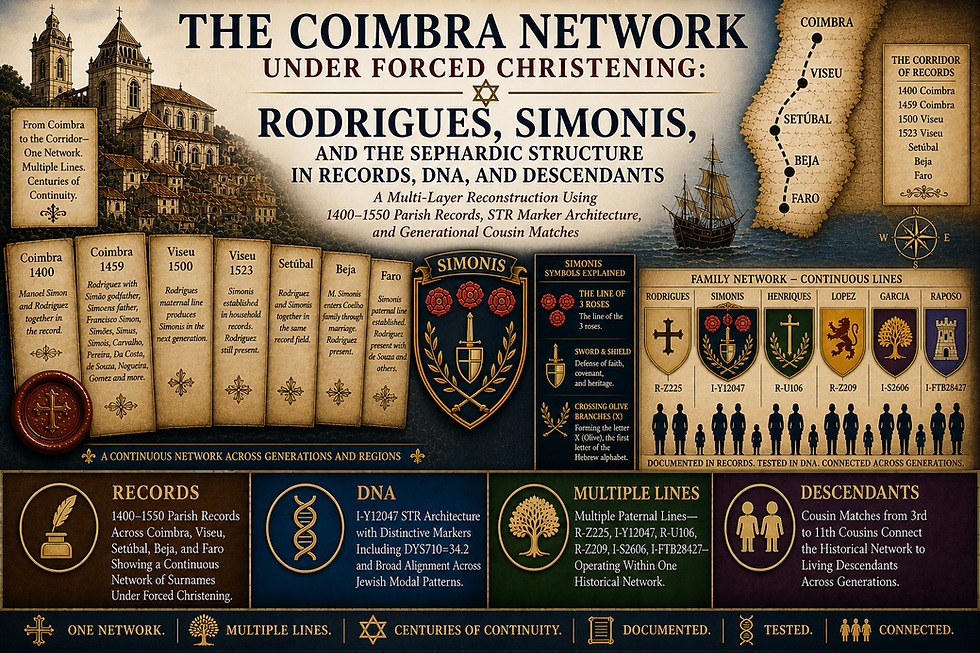
THE LIVING CONVOY STRUCTURE Simonis, Martin, Garcia, Rodrigues, Lopes, Raposo, and the Generational DNA Timeline
The historical record layer establishes the convoy across Coimbra, Viseu, Setúbal, Beja, Faro, the Netherlands corridor, and later Atlantic redistribution systems. The DNA layer shows that multiple paternal and maternal structures exist inside that same network while preserving overlapping autosomal segments, STR structures, and migration continuity. The cousin layer becomes the point where the historical and genetic systems merge into one living generational timeline.
The Simonis structure forms the central continuity spine of the reconstruction because it preserves direct paternal continuity from close relatives outward into deep generational layers. At the closest level, a 1st cousin Simonis structure preserves I-CTS10937 directly, establishing that the paternal structure is not only historical or theoretical, but still functioning inside the modern family layer itself.
The autosomal continuity remains equally important. A Simonis structure in the 2nd cousin once removed range preserves approximately 92 cM of shared DNA, while another Simonis structure in the broader 2nd-to-4th cousin range preserves approximately 52 cM with a longest block around 38 cM. These layers show that the surname continuity is reinforced not only through naming survival, but through measurable autosomal preservation across multiple branches.
The deeper Simonis cousin layers continue preserving the same paternal environment. One 3rd cousin twice removed branch preserves I-CTS10937 directly, while another Simonis branch preserves the upstream structure I-Z2535 feeding into the later I-CTS10937 and I-Y12047 environment. A 4th cousin once removed Simonis branch again preserves I-CTS10937. Even at the 11th cousin layer, the Simonis environment still preserves approximately 15 cM of shared DNA, extending the autosomal continuity deep into the older convoy structure.
This becomes critically important because the Martin-root structures repeatedly appear beside the Simonis environment rather than outside it. The reconstruction repeatedly observes Martin, Martínez, Martini, Martino, and Martinson structures functioning beside Simonis across both the historical records and the modern cousin environment.
The Martin line itself extends from approximately the 3rd cousin range through the 11th cousin range, creating one of the broadest surviving generational spreads inside the convoy structure. This becomes important because the Martin-root layer reaches both into the deep historical foundation and forward into the later Atlantic redistribution environment without breaking continuity.
The closest Martin-root layers preserve strong autosomal overlap through 3rd cousin once removed and 4th cousin environments, while deeper Martin, Martínez, and Martino branches continue appearing through the 5th, 6th, 7th, 8th, 10th, and 11th cousin ranges. Rather than scattering randomly, these layers naturally align with the same historical convoy phases already visible in the Iberian and Portuguese records.
The Martini and Martino environments become especially important because they bridge the Italian, Iberian, Portuguese, and Atlantic layers together. Andrea Bontempi Martini already appears in the late Italian Mediterranean foundation period before the 1391 collapse, while later Martino structures preserve Atlantic continuity through Northern Spain, Puerto Rico, and Mediterranean-associated paternal systems.
One of the strongest Atlantic Martino layers preserves the paternal structure T-CTS6507 beside Puerto Rican and Northern Spanish memory structures. This becomes important because it demonstrates that the convoy was never restricted to one paternal Haplogroup alone. Instead, the reconstruction repeatedly shows multiple paternal systems surviving together inside the same demographic corridor environment.
The Garcia structure reaches from approximately the 4th through the 11th cousin range, placing it among the deepest visible living layers in the reconstruction. This aligns naturally with the earlier Coimbra and Portuguese foundations where García repeatedly appears beside Simón, Martín, Rodríguez, and related convoy structures. The depth of the Garcia continuity suggests that the surname was already embedded inside the early convoy environment rather than entering later.
The Rodrigues line falls primarily between the 6th and 9th cousin ranges, placing it directly inside the Portuguese bridge and compression phase surrounding Coimbra and Viseu. This aligns closely with the historical record layer where Rodrigues repeatedly appears beside Simonis-linked structures during the convoy stabilization period.
The Lopes line appears mainly between the 4th and 6th cousin ranges, fitting naturally into the later consolidation phase of the convoy system. By this point, the network is already functioning across multiple Portuguese and Atlantic regions, and Lopes reflects the continuation of the same demographic environment into more stable later family layers.
The Gomez environment appears between approximately the half-3rd cousin once removed through the 4th and 5th cousin ranges. This becomes important because Gomez already appears historically inside the 1459 Coimbra Rodrigues structure through Gomez Marso. The cousin placement and the historical record layer therefore reinforce one another naturally.
The Hernandez structure falls primarily within the 3rd cousin once or twice removed through the 4th cousin range. This places Hernandez near the forward edge of the visible convoy timeline where the structure has already stabilized into later descendant populations. Hernandez fits naturally beside Rodrigues, Lopes, Henriques, and related Iberian patronymic systems inside the same broader demographic environment.
The Raposo structure becomes especially important because it ties an early Coimbra convoy root directly into a documented later Portuguese descendant population. The line connected to Dr. Carlos Alberto Raposo preserves the paternal structure I-FTB28427 and traces back to Francisco do Amaral Raposo in Sebadelhe da Serra, Portugal. The importance is strengthened further because the earlier Rapoza root already appears inside the 1400 Coimbra Rodrigues environment, creating continuity between the early Portuguese convoy structure and a later descendant line in the same regional corridor.
The paternal environment surrounding the convoy remains remarkably stable despite the diversity of associated branches. Alongside the primary I-CTS10937 and downstream I-Y12047 structures, the reconstruction repeatedly preserves I-M253, I-M223, I-L1498, R-M512, R-CTS241, T-CTS6507, and I-FTB28427 across related convoy environments. Rather than weakening the reconstruction, this strengthens the demographic convoy model because it demonstrates overlapping family continuity rather than one isolated paternal survival line.
The maternal layer reinforces the same preservation pattern. J1c1b2 remains the primary maternal anchor, while J1c1, J1c2, J1b1a, H7, T1a1, and K1a4a1a repeatedly appear across connected Mediterranean and Atlantic-associated cousin environments. The persistence of these maternal overlaps suggests that the convoy preserved not only paternal continuity, but also long-term maternal demographic structure.
The Sephardic Corridor DNA Analyzer repeatedly aligns with the same model. The analyzer continues detecting preserved autosomal corridor structures, chromosome locking behavior, founder-style compression, Portuguese Sephardic concentration, Atlantic overlap, and long unsmoothed chromosome continuity rather than isolated regional ethnicity fragmentation.
The preserved chromosome layers remain especially important. Chromosome 16, particularly the preserved cold-core region around 28–36 Mb, repeatedly appears beside Portuguese Sephardic alignment structures and convoy-linked cousin overlap. Chromosomes 2 and 9 continue preserving strong Portuguese lock structures tied to the broader Atlantic corridor environment.
The STR framework reinforces the same continuity. DYS455=8, DYS710=34.2, DYS459=8-9, DYS385=14-14, DYS390=22, DYS391=10, DYS392=11, DYS393=13, and DYS439=11 continue appearing inside the same preserved paternal corridor associated with I-CTS10937 and I-Y12047.
When the full cousin structure is examined together, the timeline no longer appears fragmented. Garcia reaches deep into the older convoy structure. Rodrigues aligns with the Portuguese bridge and compression phase. Gomez occupies the expansion layer. Lopes and Hernandez preserve the later consolidation environment. Raposo anchors the later Portuguese descendant corridor. Simonis preserves the direct paternal continuity spine. Martin-root structures bridge the Italian, Iberian, Portuguese, northern, and Atlantic phases together across the entire system.
At this point, the convoy is no longer functioning only as a historical reconstruction. It survives simultaneously through records, surnames, preserved chromosomes, paternal continuity, maternal overlap, STR preservation, and living descendants across multiple generations and regions.
The reconstruction also remains open-ended. The current cousin ranges reflect only the descendant populations that have tested so far. Some convoy structures, such as Garcia and Simonis, already extend deeply into the 11th cousin range, while others like Lopes, Hernandez, Gomez, Rodrigues, and related Atlantic-linked lines currently appear more strongly within the closer 3rd through 6th cousin layers.
That does not mean the deeper continuity is absent. It means the testing pool is still incomplete.
When the historical records are placed beside the modern DNA structure, the pattern suggests that many of the currently shallow-to-mid-range cousin layers likely extend much farther back than the present testing data can yet confirm. The repeated overlap between Simonis, Martin, Rodrigues, Garcia, Lopes, Gomez, Henriques, Raposo, Carvalho, Souza, and related convoy structures across Coimbra, Viseu, Beja, Faro, the Netherlands corridor, Puerto Rico, Mexico, and Atlantic migration systems strongly suggests that deeper generational continuity is still waiting to emerge through future descendant testing.
The historical layer already shows the structure existing continuously across centuries. The DNA layer is now progressively catching up to that historical framework as more descendants test and enter the visible cousin network.
For that reason, the reconstruction should not be viewed as a closed conclusion, but as an expanding demographic corridor model. Each new descendant test has the potential to extend the convoy farther backward, reinforce existing bridge layers, and reveal additional preserved connections between the Iberian, Portuguese, northern European, and Atlantic branches of the system.
THE I-CTS10937 MEDITERRANEAN AND LEVANTINE CORRIDOR Haplogroup I Across Iberia, the Mediterranean, the Balkans, and the Near East
The Haplogroup I reconstruction becomes increasingly important when the broader geographic match structure is examined together rather than through a simplified Northwest European-only framework. The combined historical, surname, STR, autosomal, and cousin layers repeatedly show Haplogroup I environments operating across Iberia, Portugal, Italy, the Balkans, Greece, the Levant, and Atlantic redistribution systems.
The reconstruction does not interpret Haplogroup I as existing only inside one northern corridor detached from Mediterranean history. Instead, the preserved match environments repeatedly show the lineage functioning across a much wider Mediterranean and Near Eastern geographic structure tied to convoy migration systems, Atlantic redistribution routes, and long-term demographic preservation.
The Spanish layer becomes one of the strongest western anchors in the reconstruction. A Peletero Franco structure from Spain preserves I-M253 at the 37-marker level with an exact genetic distance match. A Gonzalez structure from Spain preserves I-M253 with the Gonzalez ancestral environment at the 67-marker level with an exact match. A Verdeja structure preserves another exact I-M253 environment at the 12-marker level, while a Campollo structure preserves I-M170 with an exact match environment. A Villarreal-linked structure associated with Spain also preserves I-M170 continuity.
The Catalonian layer becomes especially important through a Corbella structure from Catalonia preserving I-FT104430 through the Gil Corbella ancestral environment tied to the Sant Guim region around approximately 1660 with Big Y-700 testing and only a two-step genetic distance. This reinforces the preservation of Haplogroup I environments inside northeastern Iberia and the Mediterranean-facing Catalonian corridor.
The Portuguese structure becomes even stronger because it repeatedly preserves multiple downstream Haplogroup I branches beside convoy-linked surnames already visible throughout the reconstruction. Fernandes structures preserve I-A2341 through the Manuel José Fernandes ancestral environment with Big Y-500 testing and two-step genetic distance continuity. A Raposo structure preserves I-FTB28427 through the Francisco do Amaral Raposo descendant environment tied to Portugal and the earlier Coimbra-linked Rapoza structure. A Manuel-linked structure preserves I-M170 through the King Manuel ancestral environment, while an Álvarez structure preserves I-S63 through the Lourenço Álvares ancestral environment born around 1555 in Portugal at the 67-marker level.
The importance of these Portuguese structures is that they preserve Fernandes, Raposo, Manuel, and Álvarez environments beside the same broader convoy systems tied historically to Simonis, Rodrigues, Garcia, Henriques, Lopes, Carvalho, Souza, and related Portuguese Atlantic structures.
The Atlantic redistribution layer expands further into South America through a Tavares structure from Brazil preserving I-FTB28427 through the José Tavares da Costa ancestral environment born around 1820. This becomes important because it extends the same Portuguese-linked Haplogroup I branch directly into Brazil and the wider South American Atlantic corridor.
The eastern Mediterranean and Levantine structures become especially important because they demonstrate that Haplogroup I environments also persist far beyond western Europe. An Alsafadi structure from Jordan preserves I-M170 with an exact genetic distance match tied to an Arabic ancestral environment. A Zayid structure from Jordan preserves I-S63 through the Muhammad Zayid ancestral environment. A Manasrah-linked structure from Jordan preserves I-M253 through the Ahmad Ali Manasrah ancestral environment around approximately 1850. Another Jordan-linked structure preserves I-M253 at the 37-marker level with only a two-step genetic distance.
The Palestinian structure becomes especially important through a Sorum environment tied to the Palestinian Territories preserving I-BY99973 through the Sorum Derdebwani ancestral structure born around 1715 with Big Y-500 testing. This becomes one of the strongest Levantine Haplogroup I preservation structures in the reconstruction because it places a downstream Haplogroup I environment directly inside the historical Levant.
The Balkan and eastern Mediterranean bridge layer reinforces the same continuity. A Belchev structure from Bulgaria preserves I-M253, creating a geographic bridge between the eastern Mediterranean, Balkans, and broader European corridor systems. A Greek Catechi-linked structure preserves I-M170, reinforcing the long-term Mediterranean continuity of the lineage across Greek environments.
The Italian structures further reinforce the Mediterranean layer. A Charmoli structure from Italy preserves I-M170 at the 37-marker level with an exact match environment, while a Mastri structure preserves I-M253 through the Giuseppe Mastri ancestral environment tied to Foggia, Italy, around 1848. The Mastri structure becomes especially important because it aligns closely with the older Martini and Mediterranean convoy environments already preserved historically in the reconstruction.
The Adriatic and Balkan continuity layer continues through Albania and Kosovo. A Dauti structure tied to the Albania–Kosovo corridor preserves I-BY105294 through the Jezero ancestral environment associated with Ferizaj, Kosovo, with Big Y-700 testing, while a Leti structure from Albania preserves I-M253 continuity. These structures reinforce the survival of Haplogroup I environments across the Adriatic bridge between the Mediterranean and southeastern Europe.
When the full geographic structure is examined together, the Haplogroup I corridor now visibly extends across Spain, Portugal, Catalonia, Brazil, Italy, Greece, Bulgaria, Albania, Kosovo, Jordan, the Palestinian Territories, and the broader Levantine environment.
Inside the reconstruction, this becomes critically important because it demonstrates that the broader Haplogroup I story cannot be reduced to a simplistic Northwest European-only model detached from Mediterranean and Near Eastern demographic history.
The deeper paternal structure tied to the convoy remains:I-M253 → Z58 → Z140 → Z2535 → CTS10937 → Y3153 → I-Y12047.
Across the same environment, the preserved STR structure continues appearing through DYS455=8, DYS710=34.2, DYS390=22, DYS391=10, DYS392=11, DYS393=13, DYS385=14-14, DYS459=8-9, and DYS439=11. These markers repeatedly appear beside the same Mediterranean, Iberian, Portuguese, Atlantic, Balkan, and Levantine-associated environments.
The Sephardic Corridor DNA Analyzer repeatedly reinforces the same wider corridor model. The analyzer continues detecting preserved autosomal corridor zones, Portuguese Sephardic concentration, Mediterranean overlap, Atlantic redistribution continuity, founder-style compression, and long unsmoothed chromosome preservation across the same convoy-linked systems.
The reconstruction therefore interprets I-CTS10937 and the surrounding Haplogroup I environments not as isolated northern remnants, but as part of a much broader Mediterranean-to-Atlantic demographic corridor extending from the Levant and eastern Mediterranean through Greece, the Balkans, Italy, Iberia, Portugal, the Low Countries, Atlantic redistribution systems, and into modern descendant populations.
The visible structure is still incomplete because it reflects only the descendants who have currently tested. As more descendants from Iberia, Portugal, Italy, the Balkans, Greece, the Levant, Atlantic Sephardic populations, Caribbean systems, and related convoy environments continue testing, the visible structure of I-CTS10937 and the surrounding Haplogroup I corridor will likely expand much farther outward across both the historical and modern genetic layers.
The historical framework already shows the corridor existing continuously across centuries. The DNA layer is only beginning to reveal how large the surviving structure may ultimately become.


Comments