THE SIMON ROOTS — FROM TORDESILOS, COIMBRA, BREDA, AND NIJMEGEN TO THE ATLANTIC CONVOY: The Simonis Convoy Across Iberian Compression, Brabant Stabilization, and Atlantic Hereditary Continuity


The Simonis Convoy Across Iberian Compression, Brabant Stabilization, and Atlantic Hereditary Continuity
THE DEEP IBERIAN SUBSTRATE AND THE FORMATION OF THE EARLY SIMON-ROOT CONVOY
Before the convoy stabilized inside Portugal, Brabant, the Netherlands, Germany, and the Atlantic colonial world, the hereditary structure was already operating across a wide Iberian field stretching through Galicia, Guadalajara, Granada, Murcia, Navarra, Valladolid, Ciudad Real, Cáceres, Alicante, and Extremadura. The earliest surviving environments do not preserve a single isolated surname line. Instead, they preserve a convoy structure where Simon-root variants repeatedly appear beside overlapping hereditary families that later continue westward into Portugal and eventually northward into Brabant and the Dutch stabilization corridors.
The earliest Galicia layer survives in 1303 at San Lorenzo, Guntín, Lugo, Galicia, España, where Andre Antonio Simón appears inside one of the densest early convoy environments in the reconstruction. The record preserves Simón as godfather beside Andrés, Conte, Ronco, Antonia Fé, Fernández, Garaño, Arias, Andrés Andrés de Berca, López de Matos, Rocha, Varela Viso, and de Monte Zelo. This Galicia environment already preserves several structural behaviors that later continue throughout the wider convoy system. Antonio continuity survives beside Simón continuity, recursive reinforcement survives through Andrés Andrés de Berca, and convoy-family clustering already exists through Arias, Fernández, Rocha, and López de Matos operating inside the same hereditary environment. The Galicia field therefore demonstrates that the convoy was already behaving like a preserved hereditary network long before the Portuguese stabilization phase emerged.
The Guadalajara corridor preserves some of the clearest early Simon-root fusion structures in the entire reconstruction. In 1307, at San Pedro, Cogolludo, Guadalajara, Castilla-La Mancha, España, Antonio Yagüe Simon appears as the child of Antonia Simón and Yagüe while Sanchez survives as godfather beside Andres Nietto. This environment preserves masculine and feminine Simon-root continuity simultaneously through Antonio and Antonia Simón operating inside the same hereditary structure. The Guadalajara corridor therefore already demonstrates the deep fusion between Antonio continuity and Simon-root continuity before Portugal became the preservation corridor.
The same regional field continues in 1307 at Nuestra Señora de la Asunción, Tórtola de Henares, Guadalajara, Castilla-La Mancha, España, where Simones survives beside Julio del Hierro, Caballero, Arboleta, Paula, and Simona. This becomes one of the earliest preserved environments showing feminine Simon-root continuity operating directly beside masculine Simon-root continuity through Simones and Simona surviving together inside the same convoy-family structure. The Julio del Hierro environment also demonstrates that the Simon-root was already functioning beside broader hereditary convoy systems rather than appearing as isolated surname fragments.
The bridge forms continue in 1307 at Tordesilos, Guadalajara, Castilla-La Mancha, España, where Simeones survives beside Malo, Cortés, Sánchez, Sánchez López, Cortés Mato, Pérez Sanz, Pérez, Clares, and Sánchez. This becomes one of the strongest preserved transition environments linking Simeon continuity into later Simones and Simonis continuity. The convoy structure surrounding Simeones also preserves López continuity, Sánchez continuity, Pérez continuity, and Cortés continuity inside the same hereditary field, establishing convoy-family overlap long before the Portuguese compression phase.
The Granada convoy environments preserve one of the earliest Garcia convergence systems in the reconstruction. In 1307 at Cogollos Vega, Granada, Andalucía, España, Simones survives beside Garrido Hurtado, Martín, Conjutor, Garrido Yboya, Hurtado Ruel, García, Ortega Fernández, García Cernasco, Tenido Hurtado, Austado Garrido, José Conpar Conpar Cuesta, and Morales. This environment becomes critically important because Garcia continuity already exists directly beside Simon-root continuity deep inside Spain itself. The Granada field also preserves Fernández continuity, Martín continuity, Hurtado continuity, and Morales continuity operating together inside the same hereditary convoy environment. The Garcia current therefore did not emerge later as a separate migration. It was already intertwined with the Simon-root field inside the early Iberian substrate.
The Navarra corridor preserves additional convoy continuity through the Tudela environment of 1307, where Simones survives beside Julio Martín, de Marañon, López, and Entemandez. This layer strengthens the Martín continuity already visible inside Granada while simultaneously preserving López continuity inside the Simon-root field. The Martín current later continues westward into Portuguese convoy environments while López continuity later survives through Sima Lopes and wider Coimbra fusion systems.
The Valladolid field preserves another major convoy environment in 1307 at San Pedro, Alcazarén, Valladolid, Castilla y León, España, where Simones survives beside Corona, Zermo, Luengo, Fermo, Hernández, de Begas, Hernand, Rodri, Castander, López, and Rodríguez Serapio. This becomes one of the earliest preserved Rodríguez convergence systems beside the Simon-root field. The Valladolid layer also strengthens Hernández continuity, which later reappears in Portuguese and broader convoy-family structures.
The Ciudad Real corridor preserves one of the strongest Simion bridge environments in the reconstruction. In Ballesteros de Calatrava, Ciudad Real, Castilla-La Mancha, España, the Na Simion environment preserves Rosales Herrera, Prado, Caberas, Moraleda, Martín, Fernández, Manuela Simón, and Valero surrounding the Simion continuity field. This layer becomes critically important because both Simion and Simón survive together inside the same convoy environment while Martín continuity and Fernández continuity continue operating inside the same hereditary structure.
The Mediterranean Murcia corridor preserves one of the strongest Garcia–Simon convergence layers in the entire reconstruction. In Cieza, Región de Murcia, España, Simenes survives directly beside García Contraydo while López, Baptia, Catalina, Martínez, Jumpe Mauro, and de Montoya survive inside the same environment. This Murcia field demonstrates that Garcia continuity, López continuity, Martínez continuity, and Montoya continuity were already deeply fused into the Simon-root hereditary structure before the westward Portuguese compression phase began.
The Navarra Henrique field emerges in 1313 at Genevilla, Navarra, España, where Cruz Henrique survives beside Juan Francisco Henrique, Greño, Henrique, María Ángela Suse, Savo, Marz de Espronceda Presbr, Josefa Greño, Domingo Greno, de Cuevas, Vélez, and Pedro Francisco. This becomes one of the earliest preserved Henrique convoy environments in Iberia and establishes the Henrique continuity that later transforms into Henriques, Henricus, Henrici, and Heinrich across Portugal, Brabant, and Germany. The presence of Pedro Francisco also becomes structurally important because Pedro continuity later survives through Pedro Simon, Pedro Simonis, Pedro Simoens, Pedro Simoins, Pedro Simoy, Pedro Sima, Petrus Simonis, Petrus Simons, Pieter Sijmonsen, and Petrus Simon across the wider convoy network.
The Galicia Antonio continuity strengthens further in 1315 at Rebordaos, Castroverde, Lugo, Galicia, España, where Antonio Simón survives beside Antonia, Álvarez, Juan Gregoria Simón de Zordia, Pérez, Arias, Robleda, and de Febra. This environment demonstrates that Antonio continuity was already functioning as a major hereditary current inside the Simon-root field itself rather than appearing as an isolated companion name.
The Alicante corridor preserves one of the strongest pre-Portuguese Simon–Henríquez fusion systems in the reconstruction. In 1376 at San Pedro, Agost, Alicante, Comunidad Valenciana, España, Simón Henríquez survives beside Jilberta Bustos, Andrea Henríquez, and José Miguel Bustos. This layer establishes that Henríquez continuity was already deeply fused into the Simon-root convoy before the Portuguese stabilization phase began.
The Ciudad Real Simeon environment survives in 1395 at Santa Cruz de los Cáñamos, Ciudad Real, Castilla-La Mancha, España, where Simeon appears beside Algaba, Sanchez, Algaba Aguelo, Josef de la Virgen, Rodriguez Romero, and Romero. This becomes one of the clearest preserved Biblical-root continuity forms in the entire Iberian field and simultaneously strengthens Rodriguez continuity beside the Simon-root environment.
The recursive reinforcement systems also fully emerge inside Spain before the Portuguese compression phase. In Cáceres, Extremadura, Felipe Simón Simón survives beside Felipe Simón and María Rodríguez Cano, preserving one of the clearest recursive Simon-root hereditary identities in the reconstruction. The Ramón Simón Sánchez Simón environment further strengthens this recursive structure through Ramón, Simón, Sánchez, María Simón, Beltrán, Granado, González, Garzón, Cabale, and Higuero surviving together inside the same hereditary convoy field. By this stage, the Iberian substrate is no longer behaving like isolated surname fragments. It is already operating as a distributed hereditary convoy system built through recursive naming, convoy-family overlap, Garcia convergence, Henrique continuity, López continuity, Martín continuity, Rodríguez continuity, Fernández continuity, Arias continuity, and deep Simon-root preservation across multiple regions of Spain before the Portuguese compression phase began.
The deeper Iberian convoy field also preserves an expanding Pedro continuity operating beside the Simon-root structures long before the Portuguese stabilization phase emerged. The earliest Navarra environments already preserve Pedro continuity through the Genevilla Henrique corridor, where Pedro Francisco survives beside Cruz Henrique, Juan Francisco Henrique, Greño, Henrique, María Ángela Suse, Savo, Vélez, de Cuevas, Josefa Greño, Domingo Greno, and Marz de Espronceda Presbr. This becomes structurally important because the Pedro current later continues westward and northward through Pedro Simon, Pedro Simonis, Pedro Simoens, Pedro Simoins, Pedro Simoy, Pedro Sima, Petrus Simonis, Petrus Simons, Pieter Sijmonsen, and Petrus Simon inside Portugal and the Dutch stabilization systems. The Pedro continuity therefore does not emerge suddenly in the north. Its roots already exist deep inside the Iberian convoy field itself.
The feminine Simon-root reinforcement systems also appear continuously throughout the early Iberian environments. In Tórtola de Henares, Guadalajara, Simona survives directly beside Simones inside the Julio del Hierro convoy environment, while in Cogolludo the Antonio Yagüe Simon structure preserves Antonia Simón as maternal continuity fused directly into the Simon-root field. The Antonio Simón environment in Galicia continues this reinforcement through Antonia surviving beside Antonio Simón, Arias, Pérez, Robleda, and Juan Gregoria Simón de Zordia. The wider Spanish convoy field also preserves Antonia Simona inside San Román, Santander, where Antonio continuity, Antonia continuity, and Simona continuity survive together inside the same hereditary environment through Joseph Antonio and the broader Santander convoy system. These feminine reinforcement layers become critically important because they demonstrate that the convoy was preserving hereditary identity through both masculine and feminine continuity systems simultaneously rather than through isolated paternal surname transmission alone.
The Fernández continuity repeatedly survives inside multiple convoy environments across the Iberian substrate. Granada preserves Ortega Fernández beside García and García Cernasco inside the Garrido Hurtado convoy layer, while Galicia preserves Fernández beside Andre Antonio Simón, Arias, Rocha, and López de Matos. The Ballesteros de Calatrava Simion environment preserves Fernández again beside Martín, Moraleda, Manuela Simón, Prado, Caberas, Rosales Herrera, and Valero. The Antonio de Fernández de Simón continuity field later strengthens this fusion structure even further by preserving Fernández directly fused into the Simon-root continuity itself. The Fernández current therefore survives as part of the convoy-family reinforcement structure operating across multiple Iberian regions simultaneously.
The Martín continuity also remains deeply embedded throughout the early Iberian convoy field. Granada preserves Martín beside Garrido Hurtado, García, Ortega Fernández, Morales, and García Cernasco, while Tudela preserves Julio Martín beside de Marañon and López. Ballesteros de Calatrava preserves Martín again beside Simion, Fernández, Moraleda, and Manuela Simón. The Martín continuity therefore survives simultaneously across Granada, Navarra, and Ciudad Real before later continuing westward into Portuguese convoy systems and eventually converging again beside Simonis continuity in the northern stabilization corridors.
The Rodríguez continuity survives in multiple independent Iberian environments before Portugal becomes dominant. Valladolid preserves Rodríguez Serapio beside Simones, Corona, Zermo, Hernández, López, Rodri, and Castander, while the Ciudad Real Simeon corridor preserves Rodriguez Romero beside Algaba, Sanchez, Romero, and Josef de la Virgen. Cáceres later preserves María Rodríguez Cano beside Felipe Simón Simón inside one of the strongest recursive Simon-root structures in the reconstruction. These repeated Rodríguez environments demonstrate that Rodríguez continuity was already fused into the broader convoy structure before the Portuguese compression phase ever began.
The López continuity becomes one of the most persistent companion structures in the entire Iberian substrate. Tordesilos preserves Sánchez López beside Simeones, Cortés, Pérez, and Clares, while Tudela preserves López beside Julio Martín and de Marañon. Murcia preserves López again beside García Contraydo, Simenes, Martínez, Montoya, Baptia, and Catalina. Galicia preserves López de Matos beside Andre Antonio Simón, Arias, Fernández, and Rocha. These repeated López environments later become critically important because the López continuity survives directly into Portugal through Sima Lopes, Lopes V. Decloze, and wider Coimbra convoy systems operating beside Simonis, Henriques, Carvalho, Ferreira, Oliveira, and Garcia continuity.
By the late Iberian phase, the convoy structure is no longer operating as isolated regional surname pockets. Galicia, Guadalajara, Granada, Murcia, Navarra, Valladolid, Ciudad Real, Cáceres, Extremadura, Alicante, and Santander are already preserving overlapping hereditary reinforcement systems built through Simon-root continuity, Garcia convergence, Henrique continuity, Antonio continuity, López continuity, Martín continuity, Rodríguez continuity, Fernández continuity, Arias continuity, and recursive naming structures surviving simultaneously across multiple regions. The convoy repeatedly preserves overlapping hereditary environments rather than disconnected family lines.
This becomes one of the most important structural realizations in the reconstruction because the later Portuguese convoy systems do not appear as a new origin point. Coimbra, Aveiro, Viseu, Castelo Branco, Portalegre, and Beja instead emerge as preservation corridors for a hereditary convoy field that was already deeply established across Spain before the westward compression phase intensified.
By the time the major pressure systems of late medieval Iberia begin intensifying toward the end of the fourteenth century, the convoy already preserves Simon, Simón, Simones, Simenes, Simeones, Simion, Simeon, Garcia, Henríquez, Henrique, López, Martín, Rodríguez, Fernández, Arias, Pérez, Morales, Romero, Rocha, Cortés, Montoya, Caballero, and broader convoy-family reinforcement systems operating together across the Iberian substrate. The hereditary field is therefore already structurally connected before the major westward compression into Portugal begins after the violence and instability associated with the 1391 collapse phase.
THE 1391 COLLAPSE, THE WESTWARD COMPRESSION, AND THE FORMATION OF THE PORTUGUESE PRESERVATION CORRIDOR
By the end of the fourteenth century, the Iberian convoy field was already deeply interconnected across Galicia, Guadalajara, Granada, Murcia, Navarra, Valladolid, Ciudad Real, Cáceres, Alicante, Extremadura, and Santander. The hereditary structure already preserved Simon-root continuity beside Garcia, Henríquez, Henrique, López, Martín, Rodríguez, Fernández, Arias, Pérez, Morales, Romero, Rocha, Cortés, Montoya, and broader convoy-family clustering systems operating simultaneously across multiple Spanish regions.
The important structural realization is that the convoy did not suddenly appear inside Portugal as a new population. The Portuguese environments emerge only after the Iberian hereditary field was already fully active. Portugal therefore becomes the preservation corridor of an already-existing convoy structure rather than the original source of the continuity itself.
The major turning point arrives with the instability, violence, forced Christian pressure, and mass disruption associated with the late fourteenth century collapse phase surrounding 1391. The convoy structure that had already been operating across Spain increasingly compressed westward into Portugal as the hereditary field adapted to survival inside church-controlled administrative systems, baptizei environments, Catholic registration structures, and overlapping convoy-family reinforcement systems.
The transition is visible because the same hereditary currents preserved throughout Spain begin reappearing together inside Coimbra and the wider Portuguese corridor. The Simon-root variants survive continuously through Simon, Simón, Simonis, Simones, Simoens, Simois, Simous, Simo, Simone, and Simona while the surrounding convoy-family systems continue preserving Henriques, Lopes, Carvalho, Ferreira, Oliveira, Alves, Mendes, Rodrigues, Gonçalves, Souza, Campos, Pereira, Machado, Barretto, and Garcia continuity operating inside the same hereditary environments.
One of the earliest major Portuguese convoy layers survives in Coimbra through the 1401 stabilization environment associated with Portugal, Coimbra, Registros Paroquiais, 1459–1999. This convoy layer preserves Simonis, Simones, Simous, and Simo simultaneously operating inside the same administrative environment beside Lopes, Machado, Da Silva, Barretto, Cruz Das Neves Machado, Theotonio, Luiza, Hidriguez, Simomez, Henriquez, Maria Simona, Ves Santos, Simone, and Carvalho Da Pereira. This becomes one of the most important transition environments in the entire reconstruction because the convoy no longer appears as scattered Iberian regional fragments. Instead, the hereditary field begins visibly clustering together inside a concentrated Portuguese preservation corridor.
The Coimbra environment demonstrates that the Simon-root continuity survives in multiple simultaneous forms rather than stabilizing into a single spelling. Simonis survives beside Simones, Simous, Simo, Simomez, Simone, and Maria Simona while convoy-family continuity simultaneously preserves Lopes, Machado, Carvalho, Pereira, Henriquez, and Da Silva. This becomes one of the clearest demonstrations that the convoy was preserving hereditary continuity through overlapping family clustering systems rather than through isolated surname lines.
The westward compression phase also preserves the continuing fusion between Simon-root continuity and Henriques continuity. In Coimbra, Maria Henriques survives directly beside Sima Lopes while the surrounding continuity field preserves Simonis and Simon operating inside the same convoy structure. This environment becomes critically important because Henriques continuity and Lopes continuity are now visibly intertwined with the Simon-root preservation corridor itself rather than functioning as separate unrelated families.
The Lopes continuity becomes increasingly important throughout the Portuguese stabilization phase because the López structures already operating across Spain now visibly continue westward into Portugal. The earlier Spanish convoy fields had already preserved Sánchez López in Tordesilos, López beside Julio Martín in Tudela, López beside García Contraydo and Simenes in Murcia, and López de Matos beside Andre Antonio Simón in Galicia. Portugal now preserves Sima Lopes, Lopes V. Decloze, and wider Lopes convoy continuity directly inside the Simonis preservation field. This establishes one of the clearest hereditary bridges between the Spanish substrate and the Portuguese convoy corridor.
The Coimbra preservation systems strengthen further in the 1414 convoy layer surrounding M.el Simoens Balhão. This environment preserves de Oliveira, Oliveira de Al-Yous, and Antonio Simon directly beside Simoens continuity inside Coimbra itself. The Oliveira current therefore becomes visibly fused into the Simon-root preservation structure while Antonio continuity survives directly beside the expanding Portuguese Simonis field.
The Antonio current also continues surviving through the Portuguese corridor in forms that mirror the earlier Spanish convoy structures. The Galicia and Guadalajara environments had already preserved Andre Antonio Simón, Antonio Yagüe Simon, and Antonio Simón before the Portuguese transition phase. Coimbra now preserves Antonio Simon beside Simoens continuity and Oliveira continuity while later Portuguese environments continue preserving Antonio Joam, Antonio son of Simonis, and Antonio Simonis across Castelo Branco, Portalegre, and Beja.
The Coimbra convoy systems intensify further in the 1417 preservation layer where Simonis survives beside Oleoja Mar, Ferres, João, Joanna Maria, Joze Antunes, Ferreira, Carvalho de Soutello, Simeirado Cabeseiro, Lopes V. Decloze, de Souza, and Campo. This becomes one of the densest convoy-family environments in the entire Portuguese corridor because Ferreira continuity, Carvalho continuity, Lopes continuity, Souza continuity, and Simonis continuity are now visibly operating together inside the same concentrated hereditary field.
The Ferreira and Carvalho systems become especially important because they repeatedly survive beside Simonis continuity throughout the Portuguese corridor. The earlier Spanish environments had already preserved Fernández continuity, Rodríguez continuity, Martín continuity, and Garcia convergence systems operating beside the Simon-root field. Portugal now adds Ferreira, Carvalho, Oliveira, Souza, Campos, Alves, Pereira, and Mendes into the expanding convoy-family structure, demonstrating that the convoy was continuously adapting while preserving overlapping hereditary continuity.
The recursive reinforcement structures that already existed inside Spain also survive fully intact inside Portugal. In Coimbra, Joaquina Simon Simon Da Tapada preserves one of the strongest recursive feminine Simon-root environments in the reconstruction. This convoy layer preserves Carvalho, Alves de Moraes, de Mereira, de Parengos de Oliveira, Abrantes de Cazegas, Joaquim Baptista, and Ferreira Frego beside the recursive Simon Simon continuity. The convoy therefore preserves recursive hereditary reinforcement while simultaneously expanding its convoy-family clustering systems inside Portugal.
By the middle of the fifteenth century, the Portuguese preservation corridor reaches one of its strongest convergence phases inside Coimbra itself. The 1459 Coimbra Great Convergence Layer preserves Simonis, Simon, Simois, Henriques, de Oliveira, Da Costa, Carvalho, Ferreira, de Souza Campos, Alves, Figueredo, and Garcia continuity operating simultaneously inside the same hereditary environment. This becomes one of the central hinge points in the entire reconstruction because the convoy structure that once appeared regionally distributed across Spain is now visibly concentrated inside Portugal as an overlapping hereditary preservation system.
The Garcia continuity becomes especially important during this phase because the earlier Spanish substrate had already preserved García, García Cernasco, García Contraydo, and wider Garcia convergence environments beside the Simon-root field. Coimbra now preserves Garcia continuity operating beside Simonis, Henriques, Carvalho, Ferreira, Lopes, Oliveira, and Souza inside the same Portuguese convoy structure. This demonstrates that the Garcia current compressed westward together with the broader hereditary field rather than emerging later as a separate migration branch.
By the close of the fifteenth century, the convoy had fully transformed from a distributed Iberian substrate into a concentrated Portuguese preservation corridor operating through baptizei systems, church-controlled administration, recursive hereditary reinforcement, convoy-family overlap, and clustered survival structures. Simon-root continuity, Garcia continuity, Henriques continuity, Lopes continuity, Carvalho continuity, Ferreira continuity, Oliveira continuity, Rodríguez continuity, Martín continuity, Fernández continuity, and Antonio continuity were now visibly operating together inside Portugal as part of a single expanding hereditary convoy field preparing for the next phase of Mediterranean breakout, maritime adaptation, Adriatic movement, and northern stabilization.
The Portuguese stabilization corridor continued expanding through Aveiro, Viseu, Castelo Branco, Portalegre, and Beja as the convoy increasingly adapted to survival through church-controlled administrative systems, baptizei environments, convoy-family clustering, and recursive hereditary reinforcement. The important structural realization is that the same hereditary currents already preserved across Spain and Coimbra continue appearing together as the Portuguese corridor widens geographically during the fifteenth and early sixteenth centuries.
One of the strongest recursive Portuguese environments survives in fevereiro de 1500 at São Pedro, Palhaça, Oliveira do Bairro, Aveiro, Portugal, where José Simon Simon appears inside the Portugal, Aveiro, Registros Paroquiais, 1550–1957 environment. The convoy structure surrounding José Simon Simon preserves Rosalia Murtias and Josefa Martins do Logar de Alves while the wider location itself preserves Oliveira do Bairro continuity directly beside the Simon-root field. This becomes one of the strongest recursive Portuguese Simon structures in the entire reconstruction because Simon survives twice inside the same hereditary identity while Alves continuity and Oliveira continuity simultaneously operate inside the same convoy environment. The Aveiro corridor therefore demonstrates that the recursive reinforcement systems already visible in Felipe Simón Simón and Ramón Simón Sánchez Simón inside Spain continued fully intact after the westward compression into Portugal.
The Viseu corridor preserves one of the strongest direct fusion structures between Simon-root continuity and Henriques continuity. In abril de 1500, Viseu, Portugal, the convoy preserves Simoens Henriques inside the Portuguese church-controlled environment. This becomes critically important because the earlier Spanish substrate had already preserved Cruz Henrique in Navarra and Simón Henríquez in Alicante before Portugal became dominant. The Viseu corridor now preserves the continuity fully fused together through Simoens Henriques, demonstrating that the Henrique current did not separate from the Simon-root field during the Portuguese stabilization phase.
The Castelo Branco convoy environment strengthens this Henriques fusion structure even further. In abril de 1500 at Castelo Branco, Portugal, Simon Henriques survives beside Manoel Henriques Henriques Proençana, Margarida Gonçalves, Antonio Joam, and Maria Gonçalves. This environment becomes one of the densest Henriques convergence systems preserved inside the Portuguese corridor because it simultaneously preserves Simon continuity, Henriques continuity, recursive Henriques reinforcement through Manoel Henriques Henriques, Gonçalves continuity, Antonio continuity, and Maria continuity operating together inside the same hereditary environment. The Gonçalves current therefore becomes visibly fused into the wider convoy-family structure during the Portuguese stabilization phase.
The Viseu convoy systems continue strengthening through the Es Simonis environment preserved in outubro de 1500 at Viseu, Portugal. This convoy layer preserves Joze, Rodrigues, Rodriguez do Forno, Sinco, Sinione, Lopes, Antonia Maria, and Manoel Roiza surrounding the Es Simonis continuity field. This becomes structurally important because Rodrigues continuity, Rodriguez continuity, Lopes continuity, Antonia continuity, and multiple variant Simon-root bridge forms survive simultaneously inside the same Portuguese administrative environment. The preservation of Sinione and Sinco beside Simonis demonstrates that multiple unfused and transitional Simon-root forms continued operating together inside Portugal rather than stabilizing into a single spelling system.
The widening Portuguese convoy structure also preserves one of the clearest Antonio-to-Simonis hereditary fusion systems in the reconstruction. In novembro de 1532 at Portalegre, Portugal, Simonis survives as father of Antonio inside Portugal, Portalegre, Registros Paroquiais, 1532–1928. The convoy environment surrounding this structure preserves Cardoza, Carvalho de Laseria, Leonor Aff., Mendes, and Carvalho de Salinas. This becomes critically important because Antonio continuity is now visibly operating directly inside the Simonis hereditary field itself rather than merely beside it. The Portalegre corridor also demonstrates the continuing expansion of Carvalho continuity and Mendes continuity inside the Portuguese preservation structure.
The Beja convoy field strengthens this fusion even further in 1600 at Beja, Portugal, where Antonio Simonis survives beside Gaspar, Margarida Frizforão, Gonçalves Ponta, Luis, Pereira, and Pereira Lousa inside Portugal, Beja, Registros Paroquiais, 1550–1913. This becomes one of the strongest fully fused Antonio–Simonis environments preserved inside Portugal because Antonio continuity and Simonis continuity are now operating as a single hereditary structure. The convoy system surrounding Antonio Simonis also preserves Gonçalves continuity and Pereira continuity directly beside the Simonis field, strengthening the wider Portuguese convoy-family clustering system.
By this phase, the Portuguese corridor had expanded far beyond Coimbra alone. Coimbra, Aveiro, Viseu, Castelo Branco, Portalegre, and Beja were now preserving overlapping hereditary continuity systems built through Simonis, Simon, Simoens, Simois, Simon Henriques, Simoens Henriques, Antonio Simonis, Lopes continuity, Carvalho continuity, Ferreira continuity, Oliveira continuity, Gonçalves continuity, Rodrigues continuity, Mendes continuity, Pereira continuity, Cardoza continuity, Alves continuity, Campos continuity, and Garcia continuity operating together inside the same widening preservation network.
The Pedro continuity also continued strengthening inside the Portuguese corridor during this phase. Earlier Iberian environments had already preserved Pedro Francisco beside Cruz Henrique in Navarra. The Portuguese stabilization phase now prepares the transition into Pedro Simon, Pedro Simonis, Pedro Simoens, Pedro Simoins, Pedro Simoy, and Pedro Sima environments that later continue northward into Petrus Simonis, Petrus Simons, Pieter Sijmonsen, and Petrus Simon inside the Dutch and Brabant stabilization corridors. The Pedro current, therefore, survives as another long-duration hereditary continuity stream operating beside the wider Simon-root convoy structure.
As the sixteenth century intensified, the Portuguese preservation corridor increasingly operated under mounting instability associated with inquisitorial pressure, forced Christian administration, surveillance systems, merchant targeting, maritime instability, and expanding anti-converso pressure. The convoy had already stabilized through Coimbra, Aveiro, Viseu, Castelo Branco, Portalegre, and Beja by the time the major rupture environments associated with the 1506 Lisbon Massacre and the later Mediterranean pressure systems began intensifying.
The convoy therefore enters the next historical phase not as an isolated Portuguese surname structure, but as a fully developed hereditary preservation network already operating through recursive naming reinforcement, convoy-family clustering, Simon-root continuity, Garcia continuity, Henriques continuity, Lopes continuity, Carvalho continuity, Ferreira continuity, Oliveira continuity, Rodrigues continuity, Gonçalves continuity, Mendes continuity, Pereira continuity, Antonio continuity, and widening Pedro continuity across Portugal before the Adriatic maritime breakout and northern stabilization phases begin.
FROM THE PORTUGUESE STABILIZATION CORRIDOR INTO THE ADRIATIC BREAKOUT AND THE NORTHERN BRABANT SYSTEM
By the early 1500s the convoy structure had already stabilized deeply inside Portugal through the Coimbra preservation corridor. The earlier Iberian Simon-root field that had preserved Simones, Simeones, Simenes, Simeon, Simón, Simon, Antonio, Henriques, Garcia, López, Martín, Rodríguez, Fernández, Arias, Carvalho, Ferreira, Oliveira, Mendes, Gonçalves, and related convoy-family continuity across Spain did not disappear after the 1391 collapse phase. Instead the hereditary field compressed westward into Portugal where the convoy survived through baptizei systems, Catholic parish administration, church-controlled registration systems, and overlapping convoy-family preservation environments centered heavily around Coimbra, Viseu, Aveiro, Castelo Branco, Portalegre, and Beja.
Inside Portugal the convoy increasingly stabilized through fused hereditary structures including Simonis, Simon, Simoens, Simois, Simon Henriques, Simoens Henriques, Antonio Simonis, José Simon Simon, Joaquina Simon Simon Da Tapada, Maria Henriques, Sima Lopes, Carvalho de Soutello, Ferreira Frego, de Parengos de Oliveira, Lopes V. Decloze, Mendes, Rodrigues, Gonçalves, Pereira, Figueredo, and de Souza Campos. The Portuguese phase demonstrated that the convoy survived not as isolated surnames but as a convoy-family preservation structure operating inside overlapping hereditary environments.
But by the beginning of the sixteenth century the pressure systems intensified again. The convoy was no longer facing only the aftermath of the 1391 Iberian violence. The hereditary field now operated under increasingly dangerous inquisitorial systems, anti-converso pressure, merchant targeting, maritime instability, and forced Christian administrative control. The preservation corridor inside Portugal began transitioning into an extraction corridor.
One of the most important historical pressure engines inside the reconstruction becomes the 1506 Lisbon Massacre. The Easter violence directed heavily toward New Christian populations destabilized the already compressed Portuguese convoy systems. The massacre environment intensified surveillance, social targeting, religious suspicion, and instability across Portuguese administrative life. The convoy structure that had stabilized inside Coimbra and surrounding Portuguese corridors increasingly began pushing outward through maritime systems.
This transition becomes visible through one of the most important records in the entire reconstruction. In 1517 the convoy appears in the Adriatic maritime corridor through Andrea Simonis in Hvar. The appearance of Andrea Simonis in Hvar in 1517 becomes one of the strongest structural movement anchors because the convoy had already fully stabilized inside Portugal before suddenly appearing inside the Venetian-Adriatic maritime environment immediately after the Lisbon pressure phase intensified. The movement structurally aligns with Mediterranean extraction routes, merchant convoy systems, Adriatic trade corridors, and survival migration patterns operating across Venetian maritime networks.
Andrea Simonis therefore becomes one of the clearest breakout anchors in the entire hereditary reconstruction. The movement into the Adriatic phase also synchronizes closely with the later Italian pressure environment surrounding the 1555–1556 Ancona Affair under Pope Paul IV. During this period Portuguese Marrano merchants and New Christian trading systems came under intensified persecution, arrests, executions, and financial targeting. The wider Mediterranean convoy structure increasingly required operational adaptation layers for survival.
This historical environment becomes critically important later inside the Tilburg correction layer where the Paroli identity appears crossed out and replaced administratively by Gerardus Simonis. The reconstruction demonstrates that Gerardus Simonis already existed independently long before the Tilburg correction, meaning the correction does not represent the creation of Simonis from Paroli. Instead it reflects the removal of an operational Italian or maritime identity layer after the convoy stabilized more openly in Brabant.
The sequence now becomes structurally coherent. The Iberian collapse compressed the convoy into Portugal. Portugal stabilized the hereditary field. The Lisbon Massacre intensified pressure. The Adriatic corridor became an extraction route. The Ancona pressure phase intensified Italian operational camouflage systems. Then the northern stabilization corridors emerge.
One of the earliest major northern stabilization anchors preserved in the reconstruction is Henricus Martini Simonis in Veghel, Noord-Brabant, Netherlands. The Veghel continuity preserves Henricus, Martini, and Simonis fused together inside the same hereditary structure. The burial layer tied to Veghel and the estimated 1545 birth anchor demonstrate that the northern Simonis corridor already existed before the later Dutch rupture phases and before the Tilburg correction environment. This becomes extremely important because it proves the Brabant corridor was not a fresh origin point. It was a stabilization corridor.
The convoy then increasingly appears throughout Dutch Catholic and Brabant church-controlled systems. In Amsterdam, Noord-Holland, Netherlands, Simon Simons appears on 28 August 1571 inside the Hervormd / Oude Kerk environment. The record preserves Simon Simons beside parents Marten Simons and Claes Claes. The recursive structure mirrors earlier Iberian recursive continuity already preserved through Felipe Simón Simón and Ramón Simón Sánchez Simón. The convoy therefore continues preserving recursive hereditary reinforcement after moving northward.
In Breda, Noord-Brabant, Netherlands, Adrianus Simonis appears in 1583 beside Johannes Simonis, Maria Petri, Jan Peter Conincxs, and Catherijna Lochtenborchs. This record becomes one of the strongest stabilization anchors inside Brabant because it demonstrates the convoy already operating through established hereditary family continuity systems including the Petri layer that later remains tightly fused beside Simonis continuity. The Petri continuity becomes increasingly important because the reconstruction repeatedly preserves Maria Petri, Cornelia Petri, Catharina Petri, and Joannes Petri beside Simonis continuity throughout Brabant and Dutch Catholic systems.
The recursive reinforcement intensifies further in Breda in 1589 through Simon Simonis. The record preserves Simon Simonis beside Johannes Simonis, Margareta Johannis, Gualterus Johannis, and Cornelia Petri. The hereditary bridge structure becomes extremely important because Simon survives as personal identity while Simonis stabilizes simultaneously as hereditary continuity.
Then in Gemert, Noord-Brabant, Netherlands, the convoy preserves one of the strongest recursive hereditary identities in the entire reconstruction through Simonis Simonis on 17 January 1590. The record preserves Simonis Simonis beside Joannes Simonis, Cornelius de Lanckfellt, and Henrica Schaten. By this phase the recursive Simon-root continuity visibly survives from Spain into Portugal and fully into Brabant without structural collapse.
At the same time the Henriques and Henrique continuity remains fused into the northern convoy structure. In Beers, Noord-Brabant, Netherlands, Gerardus Simonis appears in 1611 beside Adrianus Simonis, Hendricus Hendrici, and Katarina Preut. This record becomes critically important because Gerardus Simonis already exists decades before the Tilburg correction environment. The witness Hendricus Hendrici also preserves recursive Henrique continuity fully operating beside the Simonis hereditary structure.
In 1614 the convoy preserves Gertrudis Simonis beside Hermannus Henrici in Beers, continuing the same Henrique–Simonis fusion continuity. Then on 17 May 1615 in Beers, Henricus Simonis appears beside Adrianus Simonis, Joannes Petri of Beugen, and Anna Gijsberti. This record becomes one of the strongest stabilization records in the northern corridor because Simonis continuity, Petri continuity, and Henrique continuity all remain visibly intertwined inside the same Catholic administrative environment.
The recursive Henrique structure reaches one of its strongest forms in 1636 in Heeswijk, Noord-Brabant, Netherlands through Henricus Henrici Simonis. By this phase the earlier Iberian Henrique continuity preserved through Cruz Henrique, Simón Henríquez, Simon Henriques, and Simoens Henriques has fully stabilized inside the northern Simonis corridor.
The Antonio current also survives the northern adaptation phase. In Wervershoof, Noord-Holland, Netherlands, Antonus Simonis appears on 13 January 1647 beside Catharina Petri, Eva Simonis, and Laurenti Theodori. The record becomes critically important because it demonstrates the linguistic adaptation from Antonio into Antonus while Simonis continuity remains stable across the migration transition.
By the middle of the seventeenth century the northern stabilization corridor was fully active across Brabant, Noord-Holland, Gelderland, and eventually Germany. But the convoy still did not behave like a single isolated migration. The hereditary structure remained distributed across multiple simultaneous corridors.
While Simonis stabilization intensified across Brabant and Germany, Garcia continuity simultaneously survived through the Dutch corridor as well. On 2 January 1659 in Nijmegen, Gelderland, Netherlands, Philippijn Garcia and Philippyn Garcia appear beside Roelant Garcia and Anneken Janssen. This record becomes one of the strongest proofs that the Garcia continuity remained braided into the wider convoy structure during the northern stabilization phase rather than separating into an unrelated migration line.
By 1672 the convoy also stabilized visibly inside Germany through Heinrich Philipp Simonis and Johann Simonis in Queidersbach. The earlier Iberian Henrique continuity had now linguistically transitioned through Henriques, Henricus, Henrici, and finally Heinrich while remaining fused beside Simonis continuity across the entire movement structure.
The convoy therefore did not disappear between Spain, Portugal, the Adriatic corridor, Brabant, the Netherlands, and Germany. The spellings changed. The administrative systems changed. The languages changed. But the hereditary field remained continuous across the entire movement structure.
THE PAROLI CORRECTION LAYER, THE PEDRO–PETRUS CONTINUITY, AND THE FULL NORTHERN STABILIZATION SYSTEM
As the convoy stabilized across Brabant and the northern Dutch corridors during the late 1500s and early 1600s, the hereditary structure continued adapting linguistically while still preserving the same underlying continuity field that had already survived through Spain, Portugal, Coimbra, the Adriatic corridor, and the Italian pressure systems. One of the most important realizations inside the northern stabilization phase is that the convoy repeatedly preserved parallel linguistic adaptation structures without losing hereditary continuity. The spellings changed according to administrative language, Catholic registration systems, Dutch environments, German environments, and local phonetic adaptation, but the wider convoy field remained visibly connected.
This becomes especially important through the Pedro continuity. Earlier Iberian convoy layers had already preserved Pedro continuity beside Simon-root environments through names including Pedro Francisco in Genevilla, Navarra beside Cruz Henrique, as well as broader Pedro-linked convoy clustering inside Spanish Catholic systems. As the convoy stabilized westward and northward, the Pedro continuity increasingly fused directly into Simon-root hereditary structures.
Inside Portugal the convoy preserved Pedro Simon, Pedro Simonis, Pedro Simoens, Pedro Simoins, Pedro Simoy, and Pedro Sima across overlapping Portuguese Catholic environments. These forms become critically important because they demonstrate the same hereditary continuity adapting through Portuguese linguistic environments while remaining visibly attached to the Simon-root convoy structure.
The Portuguese phase had already demonstrated that multiple Simon-root variants could coexist simultaneously inside the same convoy environment. Simon, Simonis, Simoens, Simois, Simous, Simona, Simomez, Simon Henriques, and Simoens Henriques all survived together across Coimbra, Viseu, Castelo Branco, Aveiro, Portalegre, and Beja. The Pedro continuity now enters directly into this same adaptation structure.
As the convoy stabilized inside Brabant and Dutch Catholic systems, the Pedro continuity adapted further into Petrus forms. The northern corridor preserves Petrus Simonis, Petrus Simons, Pieter Sijmonsen, and Petrus Simon. The linguistic adaptation from Pedro into Petrus and Pieter mirrors the earlier Antonio to Antonus transition already preserved through Antonio Simonis and Antonus Simonis. This becomes one of the strongest structural continuity behaviors in the reconstruction because the convoy repeatedly preserves the same hereditary identities while the surrounding languages and administrative systems change.
Spanish environments preserve Pedro. Portuguese environments preserve Pedro Simonis, Pedro Simoens, Pedro Simoins, Pedro Simoy, and Pedro Sima. Dutch Catholic systems preserve Petrus Simonis and Petrus Simons. Northern Dutch linguistic adaptation preserves Pieter Sijmonsen. The hereditary structure therefore survives the language transition itself.
At the same time the Petri continuity increasingly stabilizes beside the Simonis corridor throughout Brabant and Dutch Catholic systems. Earlier records had already preserved Maria Petri in Breda in 1583 beside Adrianus Simonis and Johannes Simonis. Then Cornelia Petri appears beside Simon Simonis in Breda in 1589. In Beers on 17 May 1615 Joannes Petri of Beugen appears beside Henricus Simonis and Adrianus Simonis. In Wervershoof in 1647 Catharina Petri appears beside Antonus Simonis while Eva Simonis and Laurenti Theodori remain inside the same hereditary environment.
The Petri continuity therefore becomes one of the strongest companion-family stabilization layers inside the northern convoy system. The repeated appearance of Petri beside Simonis across Breda, Beers, Wervershoof, and related Brabant environments demonstrates that the convoy was not operating through isolated surnames moving independently. The hereditary field preserved clustered convoy-family continuity systems across multiple generations.
The widening northern convoy structure also preserved associated hereditary environments including Johannis, Gijsberti, Theodori, Conincxs, Lochtenborchs, Lanckfellt, Schaten, Preut, and Beugen beside Simonis continuity. These names repeatedly appear across baptism systems, Catholic marriage structures, Brabant church-controlled records, and Dutch administrative layers. The convoy therefore increasingly behaved like a stabilized hereditary network embedded inside northern Catholic administrative systems rather than a temporary refugee migration.
At the same time the historical pressure systems continued intensifying. The 1609 pressure phase becomes critically important inside the reconstruction through the ausentes layer tied to Henriques Dias Milão-Cáceres. The designation ausentes reflects absence, displacement, fugitive continuity, extraction, or administrative disappearance during the same general historical phase in which the northern Brabant stabilization system intensified.
This synchronizes directly with the broader Dutch–Portuguese conflict environment, increasing surveillance systems, maritime instability, and continuing pressure against New Christian and merchant convoy structures. The hereditary convoy therefore appears to split operationally between Mediterranean extraction systems, northern stabilization corridors, and Atlantic expansion environments while still preserving overlapping hereditary continuity.
The Paroli correction layer becomes one of the most important documentary structures inside this entire movement phase. In Tilburg, Noord-Brabant, Netherlands, during the 1650 correction environment, the record preserves Joannes Gerardus Simonis with Paroli crossed out and Gerardus written above it. Earlier simplified interpretations might incorrectly suggest that Simonis replaced Paroli as a surname transformation. But the wider convoy reconstruction proves otherwise.
Gerardus Simonis already existed independently by 1611 in Beers beside Adrianus Simonis, Hendricus Hendrici, and Katarina Preut. The Simonis hereditary structure was already fully stabilized decades before the Tilburg correction layer emerged. This means the Tilburg correction does not represent the creation of Simonis from Paroli. Instead it reflects the removal of an operational identity layer.
The wider historical synchronization now becomes extremely important. The convoy first stabilized in Portugal after the 1391 collapse. Then the 1506 Lisbon Massacre intensified pressure. The Adriatic breakout appears through Andrea Simonis in Hvar in 1517. The Ancona Affair and Italian merchant persecution intensified between 1555 and 1556. Maritime merchant survival systems increasingly required operational adaptation layers. Italian camouflage identities and Adriatic operational structures therefore emerge during the same historical phase.
Then by the mid-1600s the convoy stabilizes openly across Brabant and Dutch Catholic systems. The Paroli layer is crossed out while Gerardus Simonis remains openly preserved. The sequence therefore becomes structurally coherent. Portuguese stabilization led into Mediterranean extraction. Mediterranean extraction led into Adriatic maritime breakout. Adriatic breakout led into Italian operational adaptation. Italian operational adaptation led into the Ancona pressure phase. The Ancona pressure phase produced operational maritime environments including the Paroli layer. Then the Brabant stabilization system openly preserved Gerardus Simonis while the Tilburg correction removed the Paroli operational layer.
This becomes one of the strongest documentary synchronization systems in the entire reconstruction because the genealogy structures and historical pressure systems repeatedly move together.
By the middle of the seventeenth century the northern convoy structure had fully stabilized across Brabant, Noord-Holland, Gelderland, and Germany while still preserving recursive hereditary reinforcement patterns first visible centuries earlier inside Spain. The convoy continued preserving Simon Simonis, Simonis Simonis, Hendricus Hendrici, Henricus Henrici Simonis, Gerardus Simonis, Antonus Simonis, Petrus Simonis, Petrus Simons, and Pieter Sijmonsen inside the same wider hereditary environment.
The northern corridor therefore did not behave as a fresh ethnic origin point. It behaved as a stabilization and reinforcement corridor after the Iberian collapse, Portuguese compression, Mediterranean pressure, and Adriatic extraction phases had already occurred. The convoy survived because the hereditary structure continuously adapted while still preserving the same convoy-family continuity underneath the changing spellings, languages, church systems, and political environments.
THE ATLANTIC GARCIA BRANCH, THE MEXICO CONTINUITY FIELD, AND THE DISTRIBUTED HEREDITARY CONVOY NETWORK
By the middle of the seventeenth century the convoy structure had already stabilized across multiple regions simultaneously. The hereditary field was no longer operating only inside Spain and Portugal, nor only inside the Brabant and Dutch stabilization systems. The reconstruction now demonstrates that the convoy survived through parallel hereditary branches operating at the same time across the Iberian Peninsula, the Adriatic maritime systems, Brabant, the Netherlands, Germany, and the Atlantic colonial world.
The important realization preserved throughout the reconstruction is that the convoy did not migrate as a single straight-line movement. Instead the hereditary structure repeatedly branched while remaining connected through convoy-family overlap, recursive naming continuity, shared surname environments, Catholic administrative preservation systems, and synchronized movement behavior.
One branch stabilized heavily across Brabant, Breda, Beers, Gemert, Wervershoof, Nijmegen, and Germany through Simonis continuity, Henrique continuity, Petri continuity, Petrus continuity, and the wider northern Catholic stabilization systems. At the same time another hereditary branch increasingly expanded into Atlantic colonial environments through Garcia continuity, Spanish colonial systems, Catholic parish administration, and trans-Atlantic convoy preservation networks.
The Atlantic branch therefore does not appear as a disconnected migration separate from the earlier Iberian or Portuguese convoy systems. The hereditary continuity had already preserved Garcia beside Simon-root structures long before the Atlantic expansion became visible.
Earlier Iberian convoy layers had already preserved Garcia continuity in Granada, Andalusia through the Simones environment tied to Garrido Hurtado, Martín, García, Ortega Fernández, García Cernasco, Morales, José Conpar Conpar Cuesta, Austado Garrido, and Tenido Hurtado. The convoy also preserved García Contraydo beside Simenes in Cieza, Región de Murcia, España together with López, Baptia, Catalina, Martínez, Mauro, and Montoya. Additional Iberian convoy layers preserved Gutiérrez García beside Sima-root continuity structures inside the Granada search-result environments.
These records become critically important because they prove Garcia continuity was already embedded inside the Simon-root convoy field before Portugal became dominant. Garcia did not join the convoy later. The hereditary structure already preserved Garcia beside Simones, Simenes, Simeones, Simón, Simon, Antonio, Henriques, López, Rodríguez, Fernández, Martín, Sánchez, Pérez, and related convoy-family continuity across Spain itself.
When the 1391 collapse compressed the convoy westward into Portugal, the Garcia continuity compressed together with the wider hereditary structure. The Coimbra stabilization layers preserved Simonis, Simon, Simois, Henriques, Oliveira, Carvalho, Ferreira, Lopes, Mendes, Gonçalves, Souza, Figueredo, and Garcia continuity inside the same overlapping Portuguese convoy systems.
The 1459 Coimbra Great Convergence Layer becomes one of the most important preservation environments in the entire reconstruction because Simonis, Simon, Simois, Henriques, Oliveira, Da Costa, Carvalho, Ferreira, Souza Campos, Alves, Figueredo, and Garcia continuity all converge together inside the same Portuguese hereditary field. This demonstrates that the Garcia branch did not separate from the convoy during the Portuguese stabilization phase.
As the convoy later expanded northward into Brabant and Dutch Catholic systems, Garcia continuity remained visible there as well. In Nijmegen, Gelderland, Netherlands, Philippijn Garcia and Philippyn Garcia appear on 2 January 1659 beside Roelant Garcia and Anneken Janssen. This record becomes one of the strongest proofs that Garcia continuity stabilized directly inside the Dutch corridor while Simonis stabilization remained active across Brabant and Germany.
The hereditary convoy therefore remained braided rather than broken.
While the northern stabilization systems intensified through Adrianus Simonis, Gerardus Simonis, Henricus Simonis, Henricus Henrici Simonis, Antonus Simonis, Petrus Simonis, Petrus Simons, and Heinrich Philipp Simonis, another hereditary branch increasingly expanded through Atlantic colonial systems and Catholic administrative environments across the Spanish colonial world.
The Atlantic branch survives through the same structural preservation systems already visible earlier inside Iberia and Portugal. Spain had preserved Bauticé systems. Portugal preserved Baptizei and Batizei systems. The Netherlands preserved Catholic baptism environments and Hervormd church systems. The Atlantic corridor now preserves colonial Catholic registration systems operating through baptisms, parish administration, burial structures, and church-controlled colonial preservation environments.
One of the strongest Atlantic continuity anchors preserved in the reconstruction appears in Cocula, Guerrero, México through Alberta García.
Inside the Mexico, Guerrero, Catholic Church Records, 1576–1979 collection, Alberta García appears in the record of Ramón, identified as Alberta García’s son. The convoy environment preserves Ramón beside Meza, Cristino Gómez, Tomasa Villasana, and Donano Meza inside Cocula, Guerrero, México. The Ramón record preserves the birth anchor of 1 de agosto de 1576 together with the colonial Catholic bapticé administrative environment tied to Cocula.
This record becomes one of the strongest Atlantic convoy continuity structures because the Garcia branch now survives visibly inside Mexico while the Simonis branch simultaneously remains stabilized across Brabant, Gelderland, and Germany.
The appearance of Ramón inside the Atlantic branch becomes extremely important because earlier Iberian convoy structures had already preserved Ramón Simón Sánchez Simón beside María Simón, Sánchez, González, Garzón, Beltrán, Granado, Victorio Beltrán Cabale, Higuero, and related convoy-family continuity inside Spain.
Now Ramón appears again inside the Atlantic Garcia branch.
This does not prove direct father-to-son descent between the Iberian Ramón structure and the Mexico Ramón structure. But it strongly reinforces hereditary convoy continuity behavior across migration branches. The recursive naming structures survive across centuries and across geographic separation zones while remaining embedded inside convoy-family clustering systems.
The wider Atlantic convoy structure also continues preserving the same broader hereditary clustering patterns already visible earlier across Spain, Portugal, and Brabant. Garcia continuity repeatedly appears beside Simon-root continuity, Henriques continuity, Lopes continuity, Carvalho continuity, Ferreira continuity, Oliveira continuity, Rodríguez continuity, Mendes continuity, Alves continuity, Petri continuity, Gómez continuity, Meza continuity, Villasana continuity, Fernández continuity, Arias continuity, Sánchez continuity, Pérez continuity, and Martín continuity.
The convoy therefore does not behave like isolated surnames independently appearing across unrelated locations. The hereditary structure behaves like a distributed convoy-family network preserving overlapping continuity environments across multiple regions simultaneously.
This becomes one of the strongest arguments against simplistic single-migration models. The convoy was not operating as one straight movement from Spain into Portugal and then into the Netherlands. Instead the hereditary structure repeatedly stabilized across multiple regions at once while preserving overlapping continuity through recursive naming systems, convoy-family overlap, Catholic administrative survival systems, and synchronized migration behavior.
By this phase the reconstruction demonstrates simultaneous hereditary stabilization across Portugal, Brabant, Gelderland, Germany, and Atlantic colonial systems. The convoy remained active inside Coimbra environments while also stabilizing in Breda, Beers, Gemert, Nijmegen, Wervershoof, Heeswijk, and Queidersbach. At the same time the Atlantic Garcia branch survived through colonial Catholic environments inside México.
The wider movement structure now becomes fully visible.
The deep Iberian Simon-root substrate preserved Simones, Simenes, Simion, Simeones, Simeon, Simón, Simon, Antonio, Henriques, García, López, Rodríguez, Martín, Fernández, Arias, Sánchez, Pérez, and related convoy-family continuity across Spain. The 1391 collapse compressed the hereditary structure westward into Portugal where Coimbra became a stabilization corridor preserving Simonis, Simoens, Simois, Simon Henriques, José Simon Simon, Joaquina Simon Simon Da Tapada, Carvalho, Ferreira, Oliveira, Lopes, Mendes, Gonçalves, and Garcia continuity.
The 1506 Lisbon Massacre intensified pressure systems and pushed portions of the convoy into Adriatic maritime environments visible through Andrea Simonis in Hvar in 1517. The 1555–1556 Ancona pressure phase intensified Italian operational adaptation systems that later became visible through the Paroli correction environment in Tilburg. Brabant then emerged as a northern stabilization corridor preserving Adrianus Simonis, Simon Simonis, Simonis Simonis, Gerardus Simonis, Henricus Simonis, Henricus Henrici Simonis, Antonus Simonis, Petrus Simonis, Petrus Simons, and Heinrich Philipp Simonis across Dutch Catholic and German stabilization systems.
At the same time the Atlantic branch expanded through Garcia continuity into colonial Mexico through Alberta García and Ramón while still preserving the same broader hereditary convoy behavior already visible centuries earlier inside Spain and Portugal.
The convoy therefore survived as a distributed hereditary network operating across Europe and the Atlantic world simultaneously through forced Christian administration systems, Catholic preservation environments, maritime extraction routes, convoy-family reinforcement systems, recursive hereditary naming structures, Dutch stabilization systems, German continuity corridors, and Atlantic colonial expansion while still preserving recognizable Simon-root, Garcia, Henriques, Lopes, Carvalho, Ferreira, Oliveira, Rodríguez, Fernández, Martín, Sánchez, Petri, Pedro, Petrus, and Antonio continuity across multiple continents.
THE HENRIQUES CONTINUITY FROM SPAIN INTO PORTUGAL, BRABANT, AND GERMANY
One of the most important hereditary continuity streams preserved inside the reconstruction is the Henriques movement itself. The Henriques current does not appear suddenly in Portugal, and it does not suddenly appear later in Brabant or Germany as an isolated northern European structure. The records instead preserve a continuous hereditary movement stream operating beside the Simon-root convoy across Spain, Portugal, the Brabant stabilization corridor, and eventually Germany.
The earliest preserved Henriques continuity appears inside Spain itself. In Genevilla, Navarra, España, the convoy preserves Cruz Henrique beside Juan Francisco Henrique, Greño, Henrique, María Ángela Suse, Pedro Francisco, Vélez, Cuevas, Josefa Greño, Domingo Greno, and Marz de Espronceda Presbr. This becomes one of the earliest Henrique continuity environments preserved inside the Iberian substrate and demonstrates that the Henrique current was already operating inside the convoy structure before the Portuguese stabilization phase emerged.
The Henriques continuity then appears fused directly beside the Simon-root structure in Agost, Alicante, Comunidad Valenciana, España through Simón Henríquez. The convoy environment preserves Simón Henríquez beside Jilberta Bustos, Andrea Henríquez, and José Miguel Bustos. This becomes one of the strongest early Simon–Henríquez fusion layers preserved before Portugal becomes dominant in the reconstruction.
The important realization is that the Henrique current was already intertwined with the Simon-root convoy inside Spain itself. The hereditary structure already preserved Henrique beside Simón continuity before the westward compression into Portugal intensified after the 1391 collapse phase.
When the Iberian violence and forced Christian pressure systems intensified after 1391, the convoy compressed westward into Portugal. The Henriques continuity compressed together with the wider hereditary field. Inside Coimbra and the Portuguese
stabilization corridor the records repeatedly preserve Henriques continuity operating directly beside Simonis, Simon, Simoens, Lopes, Carvalho, Ferreira, Oliveira, Mendes, Gonçalves, Souza, Figueredo, and related convoy-family structures.
One of the earliest direct Portuguese fusion environments appears through Maria Henriques and Sima Lopes in Coimbra, Portugal. This convoy layer preserves Henriques continuity fused directly beside Simon-root continuity and Lopes continuity inside the same Portuguese preservation corridor. The importance of this layer is that Henriques is not operating independently from the Simon-root structure. It is already intertwined with it inside the Coimbra stabilization systems.
The Henriques continuity intensifies further through Simon Henriques and Simoens Henriques. In Castelo Branco, Portugal, the convoy preserves Simon Henriques beside Manoel Henriques Henriques Proençana, Margarida Gonçalves, Antonio Joam, and Maria Gonçalves. This becomes one of the strongest Portuguese fusion structures because Simon continuity, Henriques continuity, recursive Henriques continuity, Antonio continuity, and Gonçalves continuity all survive together inside the same hereditary convoy environment.
At the same time the convoy preserves Simoens Henriques in Viseu, Portugal. This becomes one of the clearest examples of Simon-root adaptation fused directly into Henriques continuity. Earlier Spain had preserved Cruz Henrique and Simón Henríquez. Portugal now preserves Simoens Henriques as the convoy stabilizes through Portuguese church-controlled systems.
The Portuguese stabilization phase repeatedly preserves Henriques beside Carvalho, Ferreira, Oliveira, Lopes, Mendes, Rodrigues, Gonçalves, Souza, Figueredo, and Simonis continuity. The convoy therefore behaves like a convoy-family preservation system rather than isolated surname movement.
The Henriques current then survives the Mediterranean extraction and Adriatic transition phases alongside the wider convoy structure. After the 1506 Lisbon Massacre intensified pressure against New Christian and merchant populations, the convoy increasingly expanded into maritime extraction systems and Adriatic operational environments. The Henriques continuity remained part of this same hereditary movement field.
The pressure systems intensified again during the 1555–1556 Ancona Affair under Pope Paul IV. Portuguese Marrano merchants and Mediterranean convoy systems came under increasing persecution, executions, and merchant targeting. This wider historical environment helps explain the operational adaptation layers that later emerge inside the Paroli correction structure in Brabant.
During the same general historical period the convoy preserves the 1609 ausentes layer tied to Henriques Dias Milão-Cáceres. The designation ausentes becomes critically important because it reflects absence, displacement, fugitive continuity, extraction, or administrative disappearance during the same period in which northern stabilization systems intensify across Brabant and the Netherlands.
The Henriques continuity therefore does not disappear between Portugal and the northern corridor. Instead it survives through linguistic adaptation.
As the convoy stabilizes across Brabant and Dutch Catholic systems, the Henrique current transitions through Henricus and Henrici forms while remaining fused beside Simonis continuity. In Beers, Noord-Brabant, Netherlands, Gerardus Simonis appears beside Hendricus Hendrici and Katarina Preut in 1611. The recursive Hendricus Hendrici structure becomes one of the strongest surviving Henrique continuity systems inside the northern stabilization corridor.
The convoy preserves additional Henrique continuity in 1614 through Hermannus Henrici beside Gertrudis Simonis in Beers. Then on 17 May 1615 in Beers the convoy preserves Henricus Simonis beside Adrianus Simonis, Joannes Petri of Beugen, and Anna Gijsberti. The Henrique continuity is now fully fused directly into the Simonis hereditary structure inside Brabant Catholic systems.
The recursive reinforcement intensifies further in 1636 in Heeswijk, Noord-Brabant, Netherlands through Henricus Henrici Simonis. This becomes one of the strongest hereditary fusion structures in the entire reconstruction because the earlier Iberian Henrique continuity preserved through Cruz Henrique and Simón Henríquez has now stabilized fully inside the northern Simonis corridor.
The linguistic adaptation continues further into Germany. By 1672 in Queidersbach, Germany, the convoy preserves Heinrich Philipp Simonis beside Johann Simonis. The continuity stream now becomes structurally visible across multiple language transitions:
Henrique↓Henríquez↓Henriques↓Henricus↓Henrici↓Heinrich
At every phase the Henrique continuity remains fused beside the Simon-root convoy structure.
The wider movement pattern now becomes fully coherent. The Henrique current first survives inside Spain beside Simón continuity. The convoy then compresses westward into Portugal after the 1391 collapse. Coimbra and the Portuguese stabilization systems preserve Simon Henriques, Simoens Henriques, Maria Henriques, Lopes continuity, Carvalho continuity, Ferreira continuity, Oliveira continuity, Mendes continuity, and Gonçalves continuity operating together inside the same hereditary environments.
After the 1506 Lisbon Massacre and the wider Mediterranean pressure phases intensify, portions of the convoy transition through Adriatic and maritime extraction systems while northern stabilization corridors emerge across Brabant and Dutch Catholic environments. There the Henrique continuity survives through Hendricus, Henricus, Henrici, and finally Heinrich while remaining structurally fused beside Simonis continuity all the way into Germany.
The Henriques movement therefore does not disappear between Spain, Portugal, Brabant, and Germany. It survives continuously through spelling adaptation, language transition, Catholic administrative systems, convoy-family overlap, recursive hereditary reinforcement, maritime extraction systems, Brabant stabilization corridors, and German continuity layers while remaining part of the same wider hereditary convoy network.
THE COMPLETE RECURSIVE HEREDITARY REINFORCEMENT SYSTEM AND THE PRESERVATION OF THE SIMON-ROOT FIELD ACROSS ALL BRANCHES
By this stage in the reconstruction one of the strongest continuity behaviors preserved across the entire convoy system is no longer simply migration movement, convoy-family overlap, or geographic stabilization. One of the strongest surviving structures is recursive hereditary reinforcement itself. The records repeatedly preserve Simon beside Simon, Simón beside Simón, Simonis beside Simonis, Henricus beside Henrici, Antonio beside Antonia, and repeated hereditary layering operating inside the same convoy identities across Spain, Portugal, Brabant, Germany, and the Atlantic branch.
The important realization preserved through these recursive structures is that the convoy repeatedly reinforced hereditary continuity internally while surviving external pressure systems. The recursive behavior survives before Portugal, inside Portugal, inside the Brabant stabilization systems, inside Dutch Catholic administrative structures, and even into the Atlantic branch environments. This continuity pattern becomes one of the strongest structural indicators that the convoy behaved like a preserved hereditary network rather than isolated surname accidents appearing independently across disconnected regions.
The earliest recursive reinforcement structures already appear inside Spain itself. One of the clearest examples preserved in the reconstruction is Felipe Simón Simón in Cadalso, Cáceres, Extremadura, España. The burial layer preserves Felipe Simón Simón beside parents Felipe Simón and María Rodríguez Cano. The structure becomes critically important because Simón survives simultaneously as personal identity and hereditary continuity inside the same family environment. The recursive reinforcement behavior is already fully visible before the Portuguese stabilization phase emerges.
Another major recursive structure appears through Ramón Simón Sánchez Simón inside Spain. The convoy environment preserves Ramón Simón Sánchez Simón beside María Simón, Sánchez, González, Garzón, Beltrán, Granado, Victorio Beltrán Cabale, Higuero, and Enero. This becomes one of the densest recursive hereditary environments in the entire reconstruction because the convoy preserves Ramón, Simón, Sánchez, and Simón layered together inside the same hereditary identity chain while simultaneously preserving María Simón inside the surrounding convoy structure.
The recursive continuity was not limited only to masculine structures. Feminine Simon-root reinforcement also repeatedly survives across the convoy environments. In Tórtola de Henares, Guadalajara, Castilla-La Mancha, España, the Simones convoy layer preserves Simona beside Julio del Hierro, Caballero, Arboleta, and Paula. The feminine Simon-root continuity therefore survives directly beside masculine Simon-root continuity inside the same hereditary environment.
Additional feminine recursive continuity appears through Antonia Simona in San Román, Santander, Santander, España. The convoy environment preserves Antonia, Simona, and Joseph Antonio together inside the same hereditary structure. The Antonio current and the feminine Simon-root continuity therefore repeatedly reinforce one another inside the Iberian substrate.
The Portuguese stabilization phase preserves some of the strongest recursive hereditary structures in the entire reconstruction. In São Pedro, Palhaça, Oliveira do Bairro, Aveiro, Portugal, José Simon Simon survives beside Rosalia Murtias and Josefa Martins do Logar de Alves. The convoy environment preserves Simon repeated twice inside the same hereditary identity while also preserving Alves continuity and Oliveira continuity beside the recursive Simon-root structure.
In Coimbra, Portugal, Joaquina Simon Simon Da Tapada preserves one of the strongest feminine recursive Portuguese structures in the reconstruction. The convoy environment preserves Carvalho, Alves de Moraes, de Mereira, de Parengos de Oliveira, Joaquim Baptista, and Ferreira Frego beside Joaquina Simon Simon Da Tapada. The recursive Simon continuity therefore survives inside overlapping Carvalho, Oliveira, Ferreira, Alves, Baptista, and Moraes convoy systems simultaneously.
As the convoy stabilized northward into Brabant and Dutch Catholic systems, the recursive reinforcement structures survived intact. In Amsterdam, Noord-Holland, Netherlands, Simon Simons appears beside Marten Simons and Claes Claes inside the Hervormd / Oude Kerk environment. The recursive Simon structure remains visibly preserved after the northern migration transition.
In Breda, Noord-Brabant, Netherlands, Simon Simonis appears beside Johannes Simonis, Margareta Johannis, Gualterus Johannis, and Cornelia Petri. This becomes one of the strongest hereditary bridge structures in the entire reconstruction because Simon survives as personal identity while Simonis stabilizes simultaneously as hereditary continuity.
Then in Gemert, Noord-Brabant, Netherlands, Simonis Simonis appears beside Joannes Simonis, Cornelius de Lanckfellt, and Henrica Schaten. By this phase the recursive Simon-root continuity visibly survives from Spain into Portugal and fully into Brabant without structural collapse. The convoy therefore preserves recursive reinforcement across multiple migration corridors simultaneously.
The Henrique continuity also preserves recursive reinforcement structures. In Beers, Noord-Brabant, Netherlands, Gerardus Simonis appears beside Hendricus Hendrici and Katarina Preut. Then in Heeswijk, Noord-Brabant, Netherlands, the convoy preserves Henricus Henrici Simonis. These structures become critically important because the earlier Iberian Henrique continuity preserved through Cruz Henrique, Simón Henríquez, Simon Henriques, and Simoens Henriques now survives fully fused into the northern Simonis hereditary field.
The recursive structures also extend beyond only Simon-root continuity. Earlier Iberian convoy layers preserved Andrés Andrés de Berca beside Andre Antonio Simón inside Guntín, Lugo, Galicia, España. The recursive reinforcement behavior therefore survives across broader convoy-family continuity systems rather than only inside Simon-root surnames themselves.
The Antonio current also repeatedly preserves recursive reinforcement structures. Antonio Yagüe Simon survives beside Antonia Simón in Guadalajara. Antonio Simón survives beside daughter Antonia in Galicia. Antonia Simona survives beside Joseph Antonio in Santander. The convoy repeatedly preserves Antonio and Antonia continuity reinforcing one another across multiple Iberian hereditary environments.
As the convoy transitioned northward into Dutch Catholic systems, Antonio adapted linguistically into Antonus while preserving the same hereditary continuity underneath. In Wervershoof, Noord-Holland, Netherlands, Antonus Simonis survives beside Catharina Petri, Eva Simonis, and Laurenti Theodori. The Antonio continuity therefore survives from Spain into Portugal and into the northern stabilization corridor without disappearing.
The recursive structures also survive the Atlantic split itself. Earlier Spain preserved Felipe Simón Simón and Ramón Simón Sánchez Simón. Portugal preserved José Simon Simon and Joaquina Simon Simon Da Tapada. Brabant preserved Simon Simonis, Simonis Simonis, Hendricus Hendrici, and Henricus Henrici Simonis. The Atlantic branch preserved Ramón continuity again beside Alberta García in Cocula, Guerrero, México.
This becomes one of the strongest continuity arguments in the entire reconstruction because the recursive hereditary reinforcement systems survive simultaneously across multiple geographic branches without collapsing. The convoy therefore behaves like a preserved hereditary reinforcement network rather than isolated disconnected surname movement.
The wider recursive convoy system repeatedly preserves repeated given names, repeated hereditary surnames, repeated Henrique continuity, repeated Simon-root continuity, repeated Antonio continuity, and repeated convoy-family overlap operating together across Spain, Portugal, Brabant, Germany, and the Atlantic corridor. The recursive continuity survives through forced Christian administrative systems, Catholic parish structures, maritime extraction systems, Dutch Catholic stabilization environments, Brabant hereditary reinforcement systems, German continuity corridors, and Atlantic colonial expansion.
The complete recursive reinforcement structure now visibly preserves Felipe Simón Simón, Ramón Simón Sánchez Simón, José Simon Simon, Joaquina Simon Simon Da Tapada, Simon Simons, Simon Simonis, Simonis Simonis, Hendricus Hendrici, Henricus Henrici Simonis, Andrés Andrés de Berca, Antonio Yagüe Simon, Antonio Simón, Antonia Simón, Antonia Simona, Antonus Simonis, and Ramón continuity inside the Atlantic Garcia branch as part of the same wider hereditary convoy system.
The convoy therefore survived not only through migration and stabilization, but through repeated internal hereditary reinforcement that continuously preserved the Simon-root continuity field across multiple regions, multiple languages, multiple church systems, and multiple historical pressure phases without fully disappearing.
THE DNA COUSIN CORRIDOR AND THE HEREDITARY CONVOY CONTINUITY FIELD
The modern DNA cousin-match structure preserved the same convoy behavior already visible inside the archival environments across Spain, Portugal, the Netherlands, Germany, Mexico, Puerto Rico, Brazil, and Atlantic migration corridors. The strongest recurring feature inside the cousin network was not simply the amount of shared DNA, but the repeated reappearance of the same convoy surnames beside the same migration corridors and hereditary structures already preserved in the documentary reconstruction.
One of the strongest Martin-root convergence environments preserved a half 3rd cousin once removed or 4th cousin relationship sharing 11 cM. The connected hereditary environment preserved Carlo Martini, Maria Antonini, Francisco “Frank” Martin, Emanuel “Moses” Henriques de la Fuente, David Samuel Henriques Coelho, Henriques continuity, de la Fuente / Delafuente continuity, and Antonini continuity inside the same broader convoy structure. This became one of the strongest Mediterranean and Sephardic convergence layers in the entire DNA reconstruction because Martin, Martini, Henriques, Coelho, and de la Fuente all survived together inside the same cousin environment rather than appearing as isolated surname accidents.
Another Martin-root convergence environment preserved a half 3rd cousin once removed or 4th cousin relationship sharing 11 cM tied to Mandel, Blum, Delafuente, Moses Benjamin H., and Edward Barzilay. This became important because the same Martin-root continuity repeatedly overlapped with Jewish-associated surname environments connected to Iberian and Sephardic continuity systems. A third Martin-root layer preserved a half 3rd cousin once removed or 4th cousin relationship sharing 9 cM tied to Carlo Martini, Maria Antonini, Francisco Martin, Westermann, and Nehring, reinforcing the repeated Martini / Martin convoy continuity across multiple branches.
The wider Martin-root corridor also preserved additional hereditary layers through Diana Martin Caselas, whose environment preserved a 4th cousin twice removed relationship sharing 22 cM and tied together Pereira, Martin, Fernandes, Caselas, Rice, and Burkart continuity inside California-linked Atlantic continuation structures. Another Martin-root environment preserved a 6th cousin relationship sharing 15 cM tied to Martin, Caselas, Rice, and Shulver continuity inside Los Angeles continuation routes. The Martinez branch preserved a 7th cousin relationship connected to Battle Creek, Michigan and extended the Martin-root continuity further into the Martínez naming structure. The Martinson branch preserved a 6th cousin twice removed relationship and demonstrated the continued northern adaptation of the Martin-root hereditary system through the Martin → Martinson progression.
The wider Martin, Martini, Martino, Martinez, and Martinson hereditary field also extended into an 11th cousin Mediterranean and Levant-associated continuity layer. This became important because the Martin-root corridor was not behaving like a short-range modern surname overlap. The structure instead preserved hereditary continuity ranging from closer half 3rd cousin once removed, 4th cousin, and 6th cousin environments outward into deep 11th cousin reconvergence structures tied to the broader Mediterranean, Iberian, and Atlantic convoy system.
The Garcia convoy field preserved some of the deepest hereditary continuity ranges in the entire reconstruction. The Garcia corridor repeatedly appeared across 4th cousin through 11th cousin environments and repeatedly overlapped with Simonis, Martin, Coimbra, Portuguese, and Iberian convoy structures. Earlier documentary reconstruction layers had already preserved García, García Cernasco, García Contraydo, Roelant Garcia, Philippijn Garcia, and Alberta García across Granada, Murcia, Coimbra, Nijmegen, and Mexico. The cousin-match structure reinforced that the Garcia field survived as one of the major hereditary convoy systems extending from Iberia into the Atlantic world rather than as isolated unrelated branches.
The Lopez and Lopes convoy continuity repeatedly preserved 4th cousin through 6th cousin relationship environments tied directly into Coimbra structures, Portuguese stabilization systems, Simoens continuity, and Atlantic migration corridors. The Mexico Simoní and Lopez branch preserved a 4th cousin or half 3rd cousin once removed relationship sharing 8 cM across one segment and tied together Maria Estefana Simoní y Castelli of Zacatecas, Adrian Simoní, Maria Juana Lopez, Ana Joaquina Pereira of Veracruz, Manuel Pereyra, Ysabel Bravo, and Gaspar Gomez Fernández of Cantabria. This became one of the strongest Atlantic convoy continuations because Simoní, Lopez, Pereira, Gomez Fernández, Veracruz, Zacatecas, Durango, and Cantabria all survived together inside the same hereditary structure.
The Mexico continuation corridor became one of the strongest hereditary convergence structures in the entire DNA reconstruction because multiple convoy-family systems recombined together inside the same Atlantic branch. One of the strongest Mexico-linked environments preserved a 4th cousin or half 3rd cousin once removed relationship sharing 8 cM across one segment tied to Maria Estefana Simoní y Castelli of Zacatecas, Mexico, Adrian Simoní, Maria Juana Lopez, Ana Joaquina Pereira of San Andrés Tuxtla, Veracruz, Manuel Pereyra, Ysabel Bravo, and Gaspar Gomez Fernández of Cantabria, Spain. This environment became critically important because the Simon-root continuity was no longer operating alone. The Mexico corridor visibly fused Simoní continuity together with Lopez, Pereira, Gomez Fernández, Cantabria continuity, Veracruz continuity, Zacatecas continuity, and Atlantic migration structures inside the same hereditary environment.
This Atlantic Mexico convergence layer also synchronized directly back into the wider Martin-root convoy structure because the broader DNA reconstruction had already preserved Martin, Martini, Martino, Martinez, Henriques, Coelho, Pereira, Fernandes, Lopes, Garcia, and Simon-root continuity operating repeatedly inside overlapping Iberian and Atlantic convoy systems. The Mexico branch therefore did not behave like a disconnected colonial offshoot. Instead it preserved another recombination zone where Simoní, Lopez, Pereira, Gomez Fernández, Martinez, and broader Iberian convoy-family structures continued surviving together after the Atlantic expansion phase.
The Atlantic convoy reconstruction later preserved another major Henrique continuity adaptation layer inside Mexico through the Enríquez structure. One Atlantic cousin environment preserving a 4th cousin or half 3rd cousin once removed relationship sharing 10 cM across one segment preserved Juan Castillo Enríquez of Sonora, Mexico together with Ramon Castillo Enríquez, Margarita Castillo, Juanita Mares, Amelia Ballesteros, David Ruben Mares, Leonor Solano, Jose Leon Solano, Francisco Antonio Solano, Narcisa Flores, Manuel Antonio Maestas, Maria de los Reyes continuity, Hernandez continuity, Guillen continuity, and broader Atlantic Mexico convoy-family overlap.
This became structurally important because the reconstruction had already preserved earlier Henrique and Henriques continuity through Cruz Henrique in Navarra, Simón Henríquez in Alicante, Maria Henriques in Coimbra, Simoens Henriques in Portugal, Simon Henriques in Castelo Branco, Henricus Henrici Simonis in Brabant, and Heinrich Simonis inside Germany. The Mexico Atlantic branch now preserved Enríquez continuity operating beside Castillo, Mares, Solano, Ballesteros, Hernandez, Flores, and Guillen continuity inside the same hereditary environment.
The reconstruction therefore demonstrated that the Henrique continuity did not disappear after Portugal or Brabant stabilization. Instead the convoy preserved multiple linguistic survival forms simultaneously through Henrique, Henriques, Henríquez, Henricus, Henrici, Heinrich, and Enríquez continuity across Iberia, Portugal, Brabant, Germany, and the Atlantic Mexico corridor.
The Rodriguez and Rodrigues convoy corridor repeatedly preserved 6th cousin through 9th cousin relationship environments tied into Iberian Catholic, maritime, and converso-associated structures. Earlier documentary layers had already preserved Rodríguez Serapio, Rodriguez Romero, Rodrigues do Forno, and broader Rodrigues continuity across Spain and Portugal. The cousin-match reconstruction reinforced that the Rodriguez / Rodrigues layer remained braided into the wider Simon-root convoy through both Iberian and Atlantic movement systems.
The Pereira and Atlantic Portuguese corridor preserved another major hereditary continuation layer. One environment preserved a 6th cousin relationship sharing 16 cM and tied together Pereira and Russo continuity inside Chico, California continuation routes. Another preserved a 3rd cousin twice removed or half 3rd cousin once removed relationship sharing 8 cM tied to Gloria Marie Pereira / Perri, born 4 January 1902 in Fail, Viseu, Portugal and later deceased in San Francisco, California. The same hereditary environment preserved Joaquin Alves Veludo, Maria Jesus Azevedo, Anna De Jesus, Alves continuity, Veludo continuity, Azevedo continuity, and the wider Portugal-to-California Atlantic migration structure.
The Ferreira and Rapozo corridor preserved a 4th cousin or half 3rd cousin once removed relationship sharing 9 cM across one segment tied to Francisco Ferreira, born in 1822 in Vila Da Igreja, Satão, Viseu, Portugal and deceased in Viseu in 1870. The same hereditary environment preserved Alice R. Rapozo, born in 1917 and deceased in 1943, along with Freitas, Vital, Rosa, Chavez, and McMoore / Wheeler continuity. This became important because Ferreira, Rapozo, Freitas, and Viseu continuity had already appeared repeatedly inside the Portuguese convoy stabilization layers.
The wider hereditary reconstruction continued preserving additional convoy-family convergence environments through Ferrara continuity operating inside a 3rd cousin relationship layer, Silvia continuity inside another 3rd cousin environment, Oliver continuity surviving simultaneously through both 3rd cousin and 6th cousin relationship structures, Oliveri continuity through a 5th cousin layer, Alzalde continuity through a 5th cousin layer, Pereira continuity through a 6th cousin layer, Gonzalez continuity through 5th and 6th cousin environments, Gonzaga continuity through a 6th cousin layer, and Luis Avila continuity through another 6th cousin environment.
These additional hereditary environments became structurally important because the repeated surname overlap no longer behaved like isolated linear cousin relationships. Instead the reconstruction repeatedly preserved overlapping Mediterranean, Iberian, Atlantic, and convoy-family systems surviving simultaneously across inconsistent commercial cousin-depth predictions. The preservation of Ferrara, Oliveri, Gonzaga, Pereira, Gonzalez, Avila, and Oliver continuity, beside the wider Simon-root, Martin-root, Garcia, Henriques, Lopes, Rodriguez, and Atlantic convoy reconstruction, reinforced the interpretation that the hereditary structure was operating through layered recompression and convoy-family overlap rather than through simple single-line descent alone
The English Symon and Simons branch preserved another hereditary continuation structure through a 3rd cousin twice removed or half 3rd cousin once removed relationship sharing 9 cM across one segment. This environment preserved John Symon, born 8 December 1622 in Langar, Nottinghamshire, England and deceased there in 1667, alongside later Ernest Simons and Alfred Simons continuity. The reconstruction treated this as part of the broader northern Simon-root stabilization system because the Simons continuity remained structurally connected to the wider Simon / Simonis hereditary field.
The Paoli and Paroli continuity preserved another important deep-corridor environment through a 10th cousin relationship tied directly into the Tilburg correction layer where Paroli was crossed out and Gerardus Simonis was written above it. This became important because the documentary reconstruction had already demonstrated that Gerardus Simonis existed independently decades earlier in Brabant before the correction layer appeared. The cousin-match continuity reinforced the interpretation that Paroli represented an operational maritime identity layer associated with Adriatic and Italian pressure phases rather than the creation of the Simonis surname itself.
The wider cousin-match structure, therefore, preserved the same hereditary convoy behavior already visible in the documentary reconstruction. The recurring overlap between Simon-root continuity, Martin-root continuity, Garcia continuity, Henriques continuity, Lopes continuity, Pereira continuity, Rodriguez continuity, Ferreira continuity, and Atlantic migration corridors repeatedly survived across relationship depths ranging from close cousin environments to deep 11th cousin layers. The convoy structure, therefore, behaved less like isolated unrelated family lines and more like a preserved hereditary corridor surviving through Iberian compression, Portuguese stabilization, Dutch and Brabant adaptation, German continuity systems, and Atlantic colonial expansion.
THE LIMITATIONS OF COMMERCIAL DNA COUSIN PREDICTION SYSTEMS AND THE PROBLEM OF ENDOGAMOUS RECOMPRESSION
One of the strongest structural problems revealed during the DNA reconstruction was that the cousin predictions provided by commercial DNA testing companies repeatedly failed to remain internally consistent across the convoy structure. The preserved cousin environments repeatedly demonstrated that shared DNA amounts, predicted cousin labels, and hereditary convoy depth did not align cleanly once the reconstruction moved into heavily recompressed Iberian, Sephardic, Portuguese, Atlantic, and partially endogamous convoy systems.
The reconstruction repeatedly preserved environments where one hereditary branch sharing 10 cM was labeled as a 6th cousin environment, while another branch sharing only 8 cM was labeled as a 4th cousin or half 3rd cousin once removed environment. Other hereditary branches sharing 9 cM, 11 cM, 15 cM, 16 cM, or even 22 cM were distributed across relationship predictions ranging from 3rd cousin twice removed through 11th cousin continuity layers. The structural inconsistency became increasingly visible once the same convoy surnames repeatedly reappeared across multiple migration corridors and cousin-depth environments simultaneously.
This became especially important inside the Simon-root, Martin-root, Garcia, Lopes, Pereira, Henriques, Rodriguez, Ferreira, and Atlantic convoy systems because the reconstruction repeatedly preserved overlapping hereditary recompression structures rather than isolated modern nuclear-family branches. The same convoy surnames repeatedly survived through Iberian compression, Portuguese stabilization, Dutch Catholic adaptation, Atlantic colonial expansion, and repeated convoy-family overlap. Because of this, the preserved DNA segments were likely reflecting multiple overlapping inheritance pathways rather than a single clean genealogical relationship.
The reconstruction, therefore, demonstrated that commercial cousin-prediction systems were functioning more like generalized statistical estimates than precise hereditary measurements once the convoy structure moved into deeper Iberian and Atlantic continuity systems. A branch labeled as a 4th cousin environment by one testing platform could structurally represent a much deeper hereditary reconvergence closer to 9th, 10th, or 11th cousin depth once repeated convoy-family overlap, cousin collapse, and endogamous recompression were taken into account.
This became especially visible inside the Jimenez and Ximenes continuity layers, where several closer-predicted cousin environments appeared structurally deeper once the wider convoy reconstruction was assembled. Similar recompression behavior appeared throughout the Simon-root and Martin-root environments, where the same hereditary surnames repeatedly survived across multiple branches, locations, and migration phases simultaneously.
The reconstruction, therefore, suggested that the preserved convoy structure behaved less like isolated linear cousin relationships and more like a long-duration hereditary network repeatedly recombining through overlapping Iberian, Portuguese, Dutch, German, Mediterranean, and Atlantic convoy-family systems. The recurring overlap between surname continuity, archival environments, migration corridors, and inconsistent commercial cousin predictions reinforced the interpretation that the convoy survived through layered hereditary recompression rather than through simple single-line descent alone.


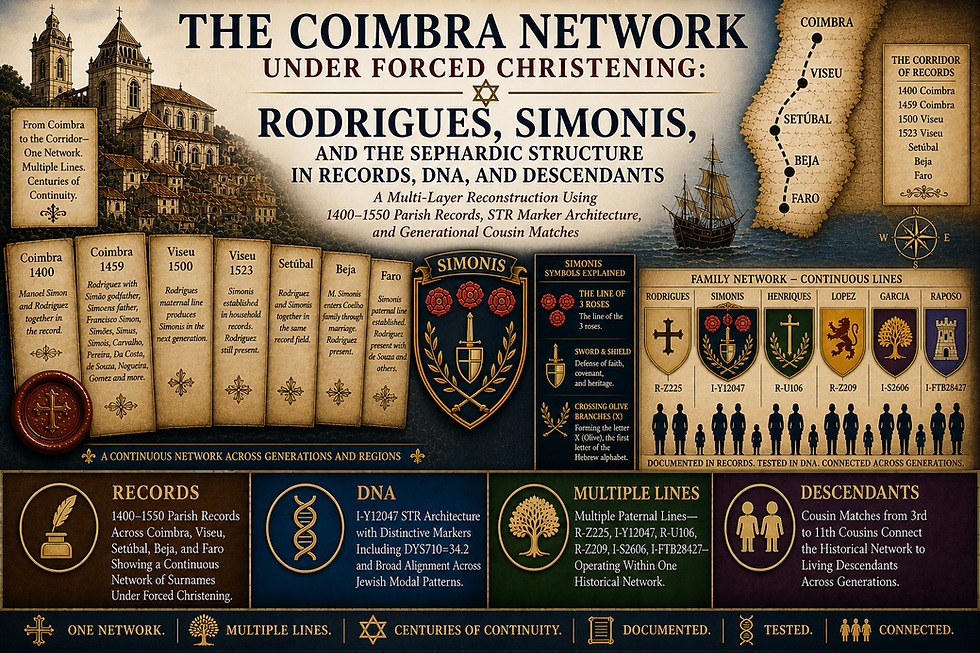
Comments