The Simonis Sephardic Corridor: A Mediterranean–Atlantic Reconstruction of Garcia, Oliveira, Sauer, and Convoy Continuity from Spain and Portugal to the Atlantic World

Updated: May 16

The Mediterranean–Iberian Corridor Framework
The reconstruction is built on repeated convergence across multiple independent systems that continue reinforcing one another even when examined separately. Rather than relying on isolated ethnicity percentages, isolated surnames, or isolated historical records, the framework emerged from observing the same structural patterns repeatedly surviving across historical records, convoy-family clustering, chromosome-position persistence, STR structure, paternal haplogroups, maternal diversification, autosomal cousin continuity, and geographic migration direction at the same time.
The central idea is not that one record proves the reconstruction, nor that one DNA result alone defines the structure. The argument is that a preserved Mediterranean–Iberian corridor population continued surviving through centuries of recombination, migration, religious compression, Atlantic expansion, and regional stabilization while still preserving recognizable continuity underneath those later overlays. The structure repeatedly behaves like a long-duration corridor system rather than a disconnected collection of unrelated populations.
The movement pattern itself repeatedly aligns through Italy, Spain, Portugal, Netherlands, Brazil, Mexico, and later Atlantic descendant populations. Italy and Sicily behave like early Mediterranean bridge environments connecting eastern Mediterranean, Balkan, Iberian, and western maritime systems. Spain preserves Simon-root continuity through western Iberian and Basque-linked structures before the Portuguese compression layers intensify. Portugal then repeatedly behaves like the major consolidation and survival zone of the corridor before the structure stabilizes northward through the Netherlands and expands westward through Atlantic descendant systems in Brazil, Mexico, Puerto Rico, and North America.
Inside these same corridors, the records repeatedly preserve Simon-root naming continuity through forms including Simon, Simón, Simons, Simonis, Simones, Sims, Simoens, Simone, Simona, and Simomez. These names do not repeatedly appear in isolation. Instead, they consistently emerge beside the same convoy-family environments tied to Garcia, Rodrigues, Rodriguez, Lopes, Lopez, Oliveira, Henriques, Carvalho, Ferreira, Pereira, Gomez, Sauer, Souza, Raposo, and related Iberian corridor surnames. The importance of this pattern is not simply that these names existed historically, but that they continue clustering together across the same migration systems and descendant environments over long periods of time.
The structure becomes strongest where multiple layers begin independently reinforcing one another. The same surnames repeatedly appear beside the same convoy families. The same migration corridors repeatedly align with the same paternal structures. The same chromosome behaviors repeatedly appear inside the same descendant systems. The same cousin networks repeatedly preserve the same broader Mediterranean–Atlantic continuity. When examined individually, each layer may appear incomplete. When examined together, the repeated convergence becomes increasingly difficult to dismiss as coincidence.
The reconstruction also approaches historical dates cautiously, particularly within FamilySearch and similar archival systems. Many event dates appear to reflect indexing layers, copied church ledgers, page systems, archival placement dates, or later transcription structures rather than necessarily representing the original birth or death event itself. Because of this, the framework prioritizes lineage positioning, preserved birth references, death references, convoy relationships, surname continuity, and structural placement inside the broader corridor system rather than relying exclusively on literal indexed dates detached from the surrounding family environment.
The DNA layer repeatedly reinforced the same historical direction. The paternal systems repeatedly stabilized around related Haplogroup I branches while the maternal systems repeatedly preserved Haplogroup J continuity alongside broader Mediterranean-associated recombination patterns. Autosomal continuity repeatedly survived through close cousins, mid-range cousins, deep cousin systems, and extended descendant structures preserving the same broader corridor behavior across multiple generations. The STR structures repeatedly behaved like compressed founder-style systems rather than diffuse drifting modal populations, especially through unusually preserved low-mutation markers and internally stable branch behavior.
At the same time, commercial ethnicity systems repeatedly produced another important structural pattern. Large northwestern-European assignments frequently appeared at the broad regional level through Scottish, British, English, Dutch, Germanic, Austrian, and Scandinavian categories, yet the deeper subregional systems often failed to strongly anchor those assignments into stable internal ethnic cores. Many subregions repeatedly returned “Not Detected” despite strong broad northern assignments remaining visible at the upper layer. Under the reconstruction model, this behavior aligns more closely with broad northwestern-European statistical assignment and later stabilization overlays rather than necessarily representing the deepest ancestral origin layer itself.
This interpretation aligns directly with the broader corridor reconstruction already emerging from the combined historical and biological systems. The repeated movement pattern behaves coherently as a Mediterranean foundation expanding into Iberia, consolidating through Portugal, stabilizing through the Netherlands, and continuing outward through Atlantic descendant populations. Rather than treating the northern-European layers as contradictions to the Mediterranean–Iberian structure, the reconstruction interprets them as later regional stabilization phases layered over older preserved corridor continuity still surviving underneath.
The Historical Record Layer and the Iberian Convoy Structure
The historical record layer became the first major breakthrough in the reconstruction because the same Simon-root structures repeatedly appeared beside the same convoy-family systems across Mediterranean, Iberian, Dutch, and Atlantic environments rather than existing as isolated surname occurrences. The records repeatedly behaved like fragments of a larger corridor population that survived through migration, compression, surname adaptation, and regional stabilization while still preserving recognizable continuity underneath.
One of the earliest preserved Mediterranean anchors appeared through the Italian Simon structure. A preserved record for Blessed Simon Of placed a Simon-root figure inside Italy during the late medieval period, identifying a figure born in Cascia, Italy in 1295 and later connected to Florence through a preserved death layer in 1348. The importance of this record was not theological or religious by itself. The importance was that it reinforced preserved Simon-root continuity inside Italy before the major Iberian convoy-consolidation layers fully emerged. Italy and Sicily repeatedly behaved throughout the reconstruction as Mediterranean bridge zones connecting eastern Mediterranean, Balkan, Iberian, and western maritime environments.
The Spain layer became one of the strongest early Iberian breakthrough environments because multiple Simon-root forms repeatedly appeared beside convoy-family systems later seen elsewhere in the reconstruction. One of the most important examples appeared through the Vicente Simón structure preserved inside the Spain Catholic Church Records at Nuestra Señora de la Asunción in Ahigal, Cáceres, Extremadura. The preserved family environment connected Vicente Simón directly beside Ángel Martín García while also preserving Martín, García, Monforte, Manuel Albalat Cirujano, and Martín Clemente inside the same structure. This record became extremely important because Simón, García, and Martín appeared together inside one preserved family environment long before the later Netherlands stabilization phase.
That structure later aligned unexpectedly with Henricus Martini Simonis in the Netherlands layer, creating one of the first major long-range convoy alignments in the reconstruction. The significance was not simply the repeated Simon-root surname itself, but the repeated preservation of Martín/Martini beside Simón/Simonis and García-linked convoy continuity across both Iberia and the later Dutch stabilization system.
Additional western Iberian records reinforced the same broader continuity. Josefa Simón de Alonso Simón appeared inside the Nuestra Señora de los Ángeles environment in Villa del Campo, Cáceres, preserving Josefa Simón, Alonso Simón, and Juan Simón together inside one multi-generational structure. This reinforced direct Simon-root surname continuity within western Iberia rather than isolated single-generation appearances.
The Spain structure expanded further north through Basque-linked systems. Antonio Miguel Simón appeared inside Mondragón and the Guipúzcoa Basque region beside Javier Simón and Margarita Salomé Rivez. This became important because the reconstruction repeatedly showed Basque-linked corridor behavior later appearing again in the chromosome-position analysis and autosomal structural layers.
The persistence of feminine Simon-root forms also became important because it demonstrated that the naming continuity extended beyond isolated paternal preservation. María Simona appeared inside early Spain Catholic Church records tied to a preserved 1307 layer. This became structurally important because Simona later aligned with Simone, Simones, Simoens, and other preserved feminine and compressed Simon-root forms appearing throughout Iberia and Portugal.
The reconstruction intensified dramatically once the records moved into Portugal, especially Coimbra, Aveiro, Viseu, Braga, and surrounding corridor environments. The Portugal layer repeatedly behaved like the major convoy-consolidation and survival system of the entire reconstruction. Rather than disappearing under religious pressure, the Simon-root structure repeatedly appeared to compress, recombine, and adapt while remaining tied to the same broader convoy-family environment.
The early Coimbra foundation layers around 1400–1401 became especially important because multiple convoy surnames repeatedly appeared together inside the same preserved regional structure. The preserved forms included Simonis, Simons, Simone, Maria Simona, Hidriguez, Carvalho Da Pereira, Henriquez, and D Olivra Baptine Souza Campos operating together inside one corridor environment. The significance was not any one surname individually. The significance was the repeated coexistence of Simon-root forms beside Oliveira, Pereira, Henriques, Carvalho, Rodrigues/Hidriguez, and Souza-linked structures inside the same preserved regional system.
The Sauer structure then became one of the most important convoy breakthroughs because it directly connected the early Coimbra layer to the later Atlantic continuation systems. A preserved Coimbra record tied to Sauer and Jozé connected the structure beside de Alvarez, Gomes Da Cruz de Zambujalo, Melo, Salveira, Da Ferra, Mario, and Alvar inside the same convoy environment. This later aligned with the Sauer continuation layers appearing again inside Brazil and Atlantic descendant systems.
The strongest convoy-compression environment emerged through the Sauer record of Mathias in Foz de Arouce, Lousã, Coimbra. This structure preserved Simons, Simoens Barbeiro, Lopes de Souza Telles, Rodriguez, Gomes, Dias, Da Siqueira, and Sauer together inside one preserved regional environment. The record became one of the strongest historical anchors in the entire reconstruction because multiple major convoy surnames appeared compressed together inside the same corridor system rather than existing independently.
The Oliveira structures reinforced the same continuity repeatedly across Aveiro, Coimbra, Viseu, and Braga. One preserved Aveiro structure tied Maria de Jezus Simoens de Jezus beside Da Cruz, de Carvalho, and Simoens inside São Simão, Oiã. Another Aveiro structure connected Simoen, Simoens, Rodrigues, and João de Oliveira de Carvalhaes together inside the same convoy environment. Coimbra records repeatedly preserved Simonis beside de Oliveira, João de Britto Faunto, Cordeiro, and Soares. Viseu preserved Simoens de Oliveira de Figueredo beside Lopes inside São Martinho. Braga preserved Simons beside do Oliveira in a preserved 1500 layer.
These repeated Oliveira-linked structures became critically important because they repeatedly demonstrated that Simon-root forms were not surviving alone. Instead, they repeatedly remained embedded inside broader convoy-family systems tied to Oliveira, Lopes, Rodrigues, Carvalho, Pereira, Souza, and related Iberian corridor structures across multiple Portuguese regions simultaneously.
The 1459 Coimbra compression cluster then emerged as one of the strongest convoy-consolidation environments in the reconstruction. The structure repeatedly preserved Simonis, Simons Lopes, Simoenz Lopez, Lopes Baratta, Rodriguez Almeida, Gomez Marso, Correya, Pires, Carvalho, Rodrigues, and Da Silva-linked forms inside one overlapping regional system. This became one of the clearest preserved examples of convoy surname recombination and corridor compression surviving inside Portugal during the major Converso survival period.
The Netherlands phase later reinforced the idea that the Simon-root structure did not originate independently in northern Europe but instead stabilized there after earlier Iberian consolidation. Henricus Martini Simonis appeared in Veghel in the Netherlands with preserved birth and burial layers tied to 1545 and 1635. The Martini structure aligned directly with the earlier Simón + Martín + García Spain corridor environment, reinforcing long-range Spain-to-Netherlands convoy continuity.
Gerardus Simonis further reinforced this northern stabilization layer because preserved Simonis continuity existed before the later Paoli/Paroli crossed-out baptism structure appeared. This suggested that Paoli/Paroli represented a connected family layer rather than the origin of Simonis itself.
The Atlantic continuation systems extended the same corridor structure outward again through Brazil and New World descendant environments. The Brazil layer became especially important because it preserved Sauer continuation, Gracie overlap, Portuguese convoy persistence, and Atlantic descendant continuity inside the same broader movement field. Rather than behaving like disconnected regional populations, the records repeatedly behaved like one corridor structure adapting through migration, compression, stabilization, and Atlantic redistribution while still preserving the same broader convoy-family continuity underneath.
Haplogroups, STR Structure, Living DNA Continuity, and Commercial Smoothing Reconstruction
The historical record layer established that the same Simon-root forms repeatedly survived beside the same convoy-family systems across Iberian, Dutch, Mediterranean, and Atlantic environments. The DNA layer became important because it repeatedly reinforced the same corridor behavior biologically rather than contradicting it. Instead of collapsing into unrelated populations, the same broader structure continued appearing through paternal continuity, maternal continuity, autosomal persistence, chromosome-position behavior, founder-style STR compression, and living descendant systems extending through deep generational distance.
The paternal structure became one of the strongest continuity anchors in the reconstruction because the same broader Haplogroup I framework repeatedly survived inside Simon-root descendant environments. The central Simonis ladder repeatedly stabilized through I-M170, I-Z2535, I-CTS10937, and I-Y12047, with the downstream Simonis structure preserving continuity through multiple living descendant branches. Rather than appearing as one isolated paternal line, the same broader Haplogroup I environment repeatedly appeared through Simonis, Simons, Sims, and related Simon-root descendants.
The cousin structure became critically important because the same paternal continuity repeatedly survived across close cousins, mid-range cousins, deep cousins, and extended descendant systems rather than disappearing after only a few generations. The Simonis descendant field repeatedly preserved I-CTS10937, I-Z2535, and downstream continuity through multiple cousin branches extending from close family relationships outward into deep generational continuity reaching as far as 11th-cousin structures. The importance was not that every descendant carried identical terminal branches, but that the same broader paternal framework repeatedly survived across separate descendant systems without fully breaking apart.
Additional Simon-root descendant lines reinforced the same broader paternal continuity through I-FGC74345 and I-FGC7189 structures, while convoy-family systems preserved related paternal continuity through I-S2606, I-FTB28427, R-Z225, and R-Z209 environments tied to Garcia, Raposo, Rodriguez, and Lopez convoy systems. These additional paternal lines did not replace the Simonis structure itself. Instead, they reinforced the idea that multiple convoy-family branches operated together inside the same broader Mediterranean–Iberian corridor environment over long periods of time.
The STR layer became one of the deepest structural reinforcement systems because the marker behavior repeatedly resembled compressed founder-style continuity rather than diffuse random population drift. The repeated structure preserved DYS455=8, DYS459=8-9, DYS385=14-14, DYS390=22, DYS391=10, DYS392=11, DYS393=13, DYS448=20, DYS439=11, and especially the unusually important DYS710=34.2 microvariant. The DYS710=34.2 structure became especially important because it repeatedly behaved like a preserved internal branch signal rather than a broad population marker. The decimal microvariant tended to persist inside low-mutation compressed paternal systems with unusually stable downstream continuity.
The importance of the STR layer was not simply the existence of these markers individually, but the way they repeatedly behaved together inside the same broader descendant field. The preserved structure repeatedly resembled internally compressed founder continuity rather than a highly diffused modal population drifting randomly over time. This became even more important once the Sephardic Corridor DNA Analyzer repeatedly aligned the same STR behavior against Mediterranean and Jewish comparison systems.
The analyzer repeatedly showed overlap with J2-like structures, G-M377 founder patterns, T-L208 structures, J1-CMH comparison systems, J2a modal systems, J2b modal systems, E1b comparison fields, Q-M378 comparison structures, and R2-M124 comparison systems. These comparisons were not arguments that the Simonis paternal line changed haplogroups. The importance was that the preserved STR behavior repeatedly resembled long-duration Mediterranean and Sephardic founder continuity under multiple comparison models.
The maternal structure repeatedly reinforced the same continuity from another direction. Haplogroup J repeatedly survived inside Simon-root descendant environments through J1c1b2, J1c1b2b, J1c5, and J1c2b systems. This became important because direct Simon-root naming continuity repeatedly appeared beside the same maternal structures. The reconstruction therefore repeatedly preserved Haplogroup I continuity on the paternal side together with Haplogroup J continuity on the maternal side inside the same broader descendant environments.
At the same time, the maternal systems also demonstrated natural diversification through H6a1b2, B4a1c1, K1, H1p, I1a1, and A2 branches. This became structurally important because the reconstruction repeatedly behaved like a real long-duration population system. The paternal continuity remained comparatively compressed while the maternal lines diversified naturally through recombination, migration, and geographic redistribution over centuries.
The autosomal structure repeatedly reinforced the same corridor continuity again through cousin persistence and chromosome-position behavior. Simon, Simons, Simonis, Simones, Sims, and Simone descendant environments repeatedly preserved close-cousin continuity, mid-range cousin continuity, and deep generational continuity rather than dissolving into disconnected regional ancestry fragments. The chromosome-position scans repeatedly preserved stable megabase bands expressing through Iberian, Italian, Balkan, Levantine, North-African, and eastern Mediterranean comparison systems even when the surrounding regional assignment models shifted around them.
This became one of the strongest structural arguments in the reconstruction because the bands themselves repeatedly remained stable while the statistical ethnicity models repeatedly changed. The structure repeatedly behaved like a preserved corridor system surviving underneath shifting regional overlays rather than a collection of disconnected ancestry fragments.
The Sephardic Corridor DNA Analyzer became especially important because it was specifically designed to examine what commercial DNA systems smooth, absorb, compress, or statistically redistribute. Commercial ethnicity systems are built to create stable modern regional assignments rather than preserve deep founder complexity. Because of this, older Mediterranean, Sephardic, Levantine, and Iberian corridor signals frequently become statistically absorbed into dominant northwestern-European categories.

The analyzer repeatedly demonstrated exactly this behavior.
Sephardic structural signals repeatedly appeared through chromosome persistence, founder retention, convoy continuity, STR behavior, Mediterranean overlap, Iberian corridor continuity, and autosomal reinforcement while simultaneously disappearing almost completely after commercial smoothing redistribution. In one major reconstruction layer, the Sephardic structural signal preserved 96% raw structural support while being almost entirely redistributed into broader northwestern-European assignment categories after smoothing. Levantine, North-African, Ethiopian Jewish, and Italian Jewish structural layers behaved similarly, repeatedly appearing through corridor persistence while disappearing inside commercial ethnicity assignment systems.
At the same time, broad northwestern-European assignment zones repeatedly gained statistical weight through commercial aggregation systems. English, Danish, Norwegian, Irish, Dutch, Germanic, Scottish, Austrian, and broader northwestern-European categories repeatedly absorbed large portions of the underlying structural signal. The Germanic aggregation layer became especially important because multiple corridor systems repeatedly appeared compressed into a broad stabilization category rather than remaining regionally separated.
The northern-European layers themselves became structurally important because the deeper subregional systems repeatedly failed to strongly anchor the ancestry into stable internal ethnic cores. Large British, Scottish, English, Dutch, Austrian, Germanic, and Scandinavian assignments repeatedly appeared at the broad regional level while the deeper subregional systems repeatedly returned “Not Detected” across much of the internal ethnic structure. Scottish Highlands, Northern Isles, Scottish Lowlands, East Anglia, Lancashire, Cumbria, Groningen, Zeeland, Northern Germany, and multiple Austrian/German subregions repeatedly failed to preserve strong deep localization despite large upper-level northern assignments remaining visible.
Under the reconstruction model, this behavior aligns far more closely with later stabilization overlays than with deep isolated northern-European origin continuity. The repeated pattern repeatedly behaved like a Mediterranean–Iberian corridor population that later stabilized inside northwestern-European regional shells while still preserving deeper southern structural continuity underneath.
When the paternal systems, maternal systems, autosomal continuity, STR behavior, chromosome-position persistence, convoy-family continuity, cousin networks, and commercial smoothing reconstruction are examined together rather than separately, the same broader corridor structure repeatedly survives. The records preserve it historically, the chromosomes preserve it biologically, and the living descendants continue preserving it genealogically across Mediterranean, Iberian, Dutch, Balkan, North-African, and Atlantic descendant environments.
Northern-European Broad Assignment vs Deep Regional Detection
One of the strongest structural behaviors repeatedly observed inside the Sephardic Corridor DNA Analyzer was the difference between broad northwestern-European assignment and deep internal ethnic anchoring. The commercial systems repeatedly produced large upper-level northern-European categories while simultaneously failing to strongly localize those assignments into stable internal regional cores. This became one of the major reasons the reconstruction interpreted many northern-European layers as stabilization overlays rather than necessarily the deepest ancestral origin layer itself.
The broad northern-European assignment structure repeatedly appeared as:
Broad Assignment Category | Reported Percentage |
British & Irish | 40.2% |
Scottish | 27.7% |
English | 11.8% |
Dutch & Northern German | 18.9% |
Austrian & Southern German | 4.7% |
East European | 8.9% |
Dutch | 8.2% |
Irish | 5.3% |
Norwegian | 1.0% |
Swedish | 1.0% |
French | 1.7% |
Balkan | 1.1% |
At first glance, these percentages appear heavily northwestern-European. However, once the deeper regional breakdown systems were examined, many of the internal ethnic subregions repeatedly returned either “Not Detected” or extremely weak localization signals despite the large upper-level assignments remaining visible.
Inside the Scottish layer, the deeper subregional system repeatedly failed to strongly anchor the ancestry into preserved Scottish ethnic cores. The following repeatedly returned “Not Detected”:
Scottish Subregion | Result |
Grampian | Not Detected |
Northeastern Coastal Scotland | Not Detected |
Northern Isles | Not Detected |
Scottish Highlands and Western Islands | Not Detected |
Scottish Lowlands and Southern Uplands | Not Detected |
The English breakdown produced the same broader pattern. Large upper-level English assignment remained visible while deep internal regional anchoring repeatedly failed to stabilize.
English Subregion | Result |
Lancashire | Not Detected |
East Anglia | Not Detected |
West Midlands | Not Detected |
Yorkshire | Not Detected |
Cumbria | Not Detected |
Southern England | Not Detected |
The Dutch and Northern German systems behaved similarly.
Dutch / Northern German Subregion | Result |
Groningen and Northern Drenthe | Not Detected |
Northern Germany | Not Detected |
Zeeland and South Holland | Not Detected |
Utrecht and Gelderland | Not Detected |
Ruhrgebiet and Westphalian Highlands | Not Detected |
The Austrian and Southern German systems also repeatedly showed broad assignment without deep localization. Most internal subregions remained weak or “Not Detected,” with only one stronger preserved signal repeatedly appearing:
Austrian / Southern German Subregion | Result |
Eastern Bavarian Highlands | Very Close |
Most other internal subregions | Not Detected |
This behavior became one of the most important structural observations in the reconstruction because the systems repeatedly detected broad northwestern-European placement while simultaneously failing to strongly preserve deeply rooted internal ethnic continuity within those same northern categories.


The Sephardic Corridor DNA Analyzer interpreted this as a stabilization-overlay phenomenon. Under this model, the northern-European systems are not necessarily “false.” Instead, they appear to reflect later regional absorption and statistical assignment layers built on top of older Mediterranean–Iberian corridor continuity.
This interpretation became even stronger once the commercial smoothing reconstruction was compared against the raw structural support systems.
Structure | Commercial Read | Raw Structural Support | Hidden / Absorbed |
Sephardic Jewish | 0% | 96% | 96% |
Ethiopian Jewish | 0% | 1.6% | 1.6% |
Levantine | 0% | 1.1% | 1.1% |
North African | 0% | 0.6% | 0.6% |
Italian Jewish | 0% | 2.4% | 2.4% |
At the same time, broad northwestern-European aggregation zones repeatedly absorbed large portions of the corridor structure.
Redistribution Zone | Commercial Read | Raw Structural Support | Hidden / Absorbed |
English | 21.9% | 52.5% | 39.8% |
Danish | 12.4% | 38.5% | 29.0% |
Norwegian | 1.0% | 16.3% | 16.3% |
Irish | 5.3% | 7.5% | 6.7% |
The Germanic aggregation layer became especially important because multiple corridor structures repeatedly compressed into one broad stabilization category.
Aggregation Zone | Commercial Read | Raw Structural Support | Smoothed Fit |
Germanic | 17.5% | 24.2% | 75.4% |
This became one of the clearest examples of commercial smoothing redistribution behavior. Multiple corridor layers repeatedly appeared to be statistically absorbed into broad Germanic and northwestern-European assignment systems rather than preserved independently.
Under the reconstruction model, the repeated pattern behaves coherently as:
Mediterranean foundation → Iberian expansion → Portuguese consolidation → Netherlands stabilization → Atlantic continuation.
The broad northern-European categories therefore appear less like isolated deep-origin ethnic anchors and more like later stabilization shells layered over older preserved Mediterranean–Iberian corridor continuity still surviving underneath through chromosome persistence, founder retention, STR structure, convoy-family continuity, autosomal cousin systems, and living descendant networks.
The Living Descendant Corridor
The reconstruction became significantly stronger once the same structural behavior continued appearing not only in historical records and DNA comparison systems, but also inside living descendant networks extending across multiple generations. The importance of the living descendant layer was that the corridor structure did not remain trapped inside medieval parish systems or abstract chromosome models. Instead, the same broader continuity repeatedly survived through close cousins, distant cousins, autosomal overlap, paternal continuity, maternal persistence, and shared founder-style marker behavior still visible in living descendants today.
One of the most important observations was that the Simonis structure did not collapse after only a few generations. The same broader continuity repeatedly survived through first cousins, second cousins, third cousins, fourth cousins, and even deep descendant systems extending into eleventh-cousin continuity. This became important because long-duration dispersed populations often lose recognizable structural coherence after repeated recombination and migration. The Simonis descendant field repeatedly behaved differently. The same broader corridor behavior continued reappearing even after significant generational distance.
The paternal systems repeatedly reinforced this continuity. Multiple cousin branches continued preserving the broader Haplogroup I framework through I-Z2535, I-CTS10937, I-Y12047, I-FGC74345, and related downstream structures. The importance was not that every descendant carried identical terminal branches, but that the same broader paternal environment repeatedly survived across separate cousin systems without fully dissolving into unrelated structures.
The STR behavior reinforced the same continuity again. The repeated preservation of DYS455=8, DYS459=8-9, DYS385=14-14, DYS390=22, DYS391=10, DYS392=11, DYS393=13, DYS448=20, DYS439=11, and especially DYS710=34.2 repeatedly behaved like preserved founder compression surviving through living descendant continuity rather than random population drift. The DYS710=34.2 microvariant became especially important because it repeatedly behaved like a preserved internal branch signal surviving through multiple descendant systems over long generational periods.
The autosomal systems reinforced the same pattern through shared corridor behavior. Living descendants repeatedly preserved overlapping Mediterranean, Iberian, Levantine, Balkan, Italian, and Sephardic-aligned structural continuity while simultaneously carrying broad northwestern-European stabilization overlays. The same chromosome-position persistence repeatedly survived through shared megabase regions even when the commercial ethnicity systems shifted their regional assignment categories around them.
This became one of the strongest arguments that the corridor structure itself remained biologically active underneath commercial smoothing systems. The same descendants repeatedly preserved shared chromosome persistence, convoy-family overlap, and founder-style continuity even when the upper-level ethnicity labels appeared heavily northern-European.
The Simon-root naming field also continued surviving alongside the biological continuity. Simonis, Simons, Sims, Simones, Simoens, Simone, and related descendant structures repeatedly preserved overlapping biological behavior rather than existing as disconnected surname environments. This became especially important because the reconstruction repeatedly showed the same naming continuity surviving together with the same paternal structures, autosomal continuity, and chromosome persistence rather than operating independently.
The convoy-family systems continued reinforcing the same continuity again. Garcia, Rodrigues, Lopes, Oliveira, Henriques, Carvalho, Ferreira, Pereira, Gomez, Raposo, Sauer, Souza, and related Iberian corridor structures repeatedly appeared beside the same descendant environments extending into Atlantic populations. Rather than behaving like isolated regional populations, the living descendant systems repeatedly behaved like extended branches of the same broader historical corridor.
The Atlantic continuation layer became especially important because it demonstrated that the corridor did not terminate after the Portuguese and Netherlands stabilization phases. Instead, the structure repeatedly extended westward through Brazil, Mexico, Puerto Rico, and North American descendant systems while still preserving recognizable continuity underneath. The Sauer continuation layer became especially important here because Sauer appeared directly inside the early Coimbra convoy environment before later reappearing inside Atlantic continuation systems connected to Brazil and broader New World descendant structures.
The Gracie overlap systems reinforced this same Atlantic continuity again through Portuguese maritime expansion environments tied to broader convoy-family persistence. Mexico and New Spain continuation systems preserved Garcia continuity, Antúnez structures, and western Atlantic descendant overlap while repeatedly aligning with the same broader Iberian corridor behavior already visible in Portugal.
Rather than behaving like disconnected migrations, the Atlantic systems repeatedly behaved like extensions of the same corridor structure adapting to new geographic environments while still preserving internal continuity underneath. The repeated movement direction remained coherent across both historical and biological systems:
Mediterranean foundation → Iberian expansion → Portuguese consolidation → Netherlands stabilization → Atlantic continuation.
The living descendant layer became one of the strongest parts of the reconstruction because it demonstrated that the corridor structure was not merely historical. The same continuity repeatedly survives today through living cousin systems, chromosome persistence, founder-style STR behavior, paternal continuity, maternal continuity, convoy-family overlap, and Atlantic descendant networks still preserving traces of the same broader Mediterranean–Iberian corridor structure.
The Living Descendant Corridor
The reconstruction did not end inside the historical record layer. One of the strongest developments in the entire framework occurred when the same structural behavior continued appearing inside living descendants through cousin continuity extending from close family relationships into deep generational networks. The importance of this layer was that the corridor structure remained biologically visible rather than surviving only as a historical theory built from medieval parish records and surname reconstruction.
The living descendant systems repeatedly preserved continuity through first cousins, second cousins, third cousins, fourth cousins, and even deep descendant structures extending into eleventh-cousin continuity. What made this especially important was not simply that cousin relationships existed, but that the same broader structural behavior continued appearing through them across multiple independent biological systems at the same time.
The paternal layer repeatedly preserved the broader Haplogroup I framework through descendant continuity tied to I-CTS10937, I-Z2535, I-Y12047, and related downstream structures. Even where later downstream diversification appeared, the same broader paternal environment continued surviving through multiple cousin branches instead of fragmenting completely into unrelated lineages. The reconstruction therefore did not depend on one isolated paternal descendant, but on repeated preservation across extended generational distance.
The STR systems reinforced this continuity again through preserved low-mutation founder behavior. DYS710=34.2 remained one of the most important structural markers because it repeatedly behaved like a preserved internal branch signal surviving through descendant continuity over long periods of time. DYS455=8, DYS459=8-9, DYS385=14-14, DYS390=22, DYS391=10, DYS392=11, DYS393=13, DYS448=20, and DYS439=11 continued expressing the same broader compressed founder-style behavior rather than drifting randomly across unrelated populations.
This became especially important because the preserved STR structure repeatedly aligned with the same broader Mediterranean and Sephardic comparison environments already identified elsewhere in the reconstruction. The living descendant layer therefore continued reinforcing the same founder-style continuity visible inside the paternal corridor systems rather than contradicting them.
The autosomal systems strengthened the reconstruction further because the same corridor continuity remained visible through shared chromosome persistence extending across multiple cousin layers. First-cousin continuity preserved close structural overlap, but the broader corridor behavior remained visible even through distant generational relationships. Rather than dissolving completely after repeated recombination, the descendant systems continued carrying overlapping Mediterranean, Iberian, Levantine, Balkan, Italian, and Sephardic-aligned structural behavior alongside the same northern-European stabilization overlays already identified by the Sephardic Corridor DNA Analyzer.
This became one of the strongest arguments that the corridor structure itself remained active underneath commercial smoothing systems. The same descendants repeatedly preserved broad British, Scottish, Dutch, Germanic, and Scandinavian upper-level assignments while simultaneously retaining deeper Mediterranean and Iberian corridor behavior through chromosome persistence, founder retention, and autosomal overlap. Under the reconstruction model, these northern-European layers behaved more like stabilization environments accumulated over centuries rather than replacing the older corridor continuity underneath.
The naming continuity reinforced the same biological structure again. Simonis, Simons, Sims, Simone, Simones, Simoens, and related Simon-root descendants repeatedly aligned with overlapping paternal continuity, autosomal persistence, founder-style STR compression, and shared corridor behavior rather than existing as disconnected surname systems. The importance of the descendant layer was therefore not only that the names survived historically, but that the biological continuity repeatedly survived beside the naming continuity at the same time.
The broader convoy-family systems continued appearing inside the same descendant environments as well. Garcia, Rodrigues, Lopes, Oliveira, Henriques, Carvalho, Ferreira, Pereira, Gomez, Raposo, Sauer, and Souza structures repeatedly aligned beside the same extended descendant systems already tied historically to Portugal, Netherlands, Brazil, Mexico, and Atlantic continuation environments. The living descendant layer therefore reinforced the same broader Mediterranean–Atlantic corridor behavior already established in the historical record systems.
Rather than behaving like isolated modern family lines, the descendant structures repeatedly expressed the characteristics of a long-duration corridor population that survived migration, recombination, surname adaptation, regional stabilization, and commercial smoothing while still preserving recognizable continuity underneath.
The Simonis Cousin Ladder: 1st Through 11th Cousin Continuity
The living descendant layer becomes strongest when the Simonis matches are read as a cousin ladder rather than as separate isolated matches. The structure begins close to the present generation, then continues outward through deeper cousin levels without losing the same core pattern. This matters because the reconstruction is not only finding distant surname echoes. It is showing that the Simonis line preserves continuity from close relatives into deep generational descendant layers.
At the closest level, the 1st cousin Simonis match preserves I-CTS10937. This is one of the strongest living anchors because the surname, the close cousin relationship, and the paternal branch all align directly. It shows that the paternal structure is not only theoretical or distant. It remains present inside the close family layer.
The 2nd cousin range strengthens the autosomal side of the same structure. A 2nd-cousin-once-removed Simonis match preserves strong shared DNA at 92 cM, while another Simonis match in the 2nd-to-4th cousin range preserves 52 cM with a 38 cM longest block. These are important because they show the Simonis surname continuing with measurable autosomal continuity, not only distant name resemblance.
The 3rd cousin layer then extends the paternal structure farther outward. One Simonis branch preserves I-Z2535, the upstream branch feeding the later I-CTS10937 and I-Y12047 structure. Another 3rd-cousin-twice-removed Simonis branch preserves I-CTS10937. This matters because the same Haplogroup I framework continues appearing through separate Simonis cousin branches instead of collapsing after the close-family layer.
The 4th cousin layer continues the same pattern. A 4th-cousin-once-removed Simonis branch preserves I-CTS10937, extending the same paternal structure deeper into the family network. At this level, the value is not only the relationship estimate. The value is that the same Simonis surname and the same Haplogroup I parent structure continue together across generational distance.
The 11th cousin layer becomes the deep continuity marker. An 11th cousin Simonis match preserves 15 cM of shared DNA, showing that the Simonis field continues to appear even at deep cousin distance. This does not function like a close-family proof by itself, but inside the full structure it becomes important because it extends the surname and autosomal continuity into a much older generational layer.
Read together, the cousin ladder preserves a continuous structure: close Simonis relatives, mid-range Simonis relatives, deeper Simonis branches, and an 11th cousin continuation. The repeated pattern is the key. The same surname continues. Haplogroup I remains visible. I-CTS10937 persists across multiple branches. I-Z2535 appears as the upstream structure. The autosomal matches continue through measurable shared DNA. The STR framework tied to DYS455=8, DYS710=34.2, DYS459=8-9, and DYS385=14-14 remains part of the same paternal environment.
This is why the Simonis cousin ladder matters. It shows that the reconstruction is not only built from medieval records or broad ethnicity categories. The same structure continues into living descendants, from the closest cousin layer outward into deep cousin continuity.
Shared Ethnic Patterning Across the Simonis Descendant Network
The cousin ladder became even more important once the ethnicity structures of the living descendant systems were compared against one another. The significance was not that every descendant carried identical percentages, but that the same broad pattern repeatedly appeared across multiple Simonis-related descendant environments at different cousin distances.
At the upper regional level, many descendants repeatedly received strong northwestern-European assignments through categories such as British & Irish, Scottish, English, Dutch & Northern German, Austrian & Southern German, Danish, Norwegian, and broader Germanic structures. Viewed in isolation, these results initially appear heavily northern-European. However, when the deeper regional breakdowns and structural layers were examined more closely, a second pattern repeatedly emerged underneath those broad assignments.
The same descendants repeatedly preserved Mediterranean, Levantine, North-African, Balkan, Italian, Sephardic, and Near Eastern structural continuity underneath the larger northern stabilization layers.
This became one of the strongest repeated behaviors across the descendant network because the same broad northwestern-European assignment pattern repeatedly appeared together with weak deep localization inside those northern categories. Many descendants preserved large British, Scottish, English, Dutch, or Germanic assignments while simultaneously returning “Not Detected” across major internal northern subregions. The systems repeatedly assigned broad northern placement while struggling to strongly anchor the ancestry into deeply rooted internal northern-European ethnic cores.
At the same time, the deeper corridor structures repeatedly remained visible underneath through the Sephardic Corridor DNA Analyzer and the autosomal comparison layers. Sephardic structural support repeatedly survived despite being statistically absorbed during commercial smoothing. Levantine overlap repeatedly remained visible through chromosome persistence and corridor comparison systems. North-African maritime continuity continued appearing through shared corridor bands tied to Iberian and Mediterranean structures. Italian and Balkan overlap repeatedly surfaced through preserved Mediterranean bridge behavior.
The importance of this pattern was that it did not appear in only one descendant or one isolated branch. The same broader structure repeatedly appeared through multiple Simonis-related cousin environments while still preserving shared paternal continuity and shared autosomal behavior.
The 1st through 11th cousin systems repeatedly preserved this same dual-layer structure. Broad northern-European stabilization overlays remained visible at the surface level, while deeper Mediterranean and Near Eastern corridor continuity continued expressing underneath through autosomal persistence, founder retention, chromosome-position overlap, and Sephardic structural alignment.
The reconstruction therefore interprets these ethnicity patterns as layered historical accumulation rather than contradiction. Under this model, the northern-European systems represent later stabilization phases connected to Netherlands settlement, Atlantic redistribution, and regional absorption, while the deeper Mediterranean, Levantine, North-African, and Sephardic structures represent older corridor continuity surviving underneath those later overlays.
This interpretation aligned closely with the repeated migration direction already established throughout the reconstruction. The descendant systems repeatedly behaved like populations that moved outward from Mediterranean and Iberian foundations into later northwestern-European stabilization environments while still preserving older structural continuity underneath.
The shared ethnic patterning across the descendant network therefore became another reinforcement layer connecting the historical records, convoy-family systems, paternal structures, maternal continuity, STR preservation, autosomal overlap, and chromosome persistence into the same broader Mediterranean–Iberian corridor framework.
The Maternal J-Line Structure and Direct Simon Continuity
The maternal layer became increasingly important once the mtDNA match field began preserving direct Simon-root continuity inside the Haplogroup J environment itself. Earlier stages of the reconstruction had already established strong paternal Haplogroup I continuity, broad Simon-root autosomal continuity, preserved convoy-family clustering, and historical corridor continuity extending across Italy, Spain, Portugal, Netherlands, Scotland, and Atlantic descendant populations. The maternal systems then demonstrated that the Simon-root structure was not limited only to paternal surname survival or autosomal overlap. Direct Simon-root continuity also appeared inside the maternal J-line framework itself.
This became one of the strongest convergence points in the reconstruction because it connected the maternal layer directly into the same broader corridor environment already established elsewhere through the paternal, autosomal, historical, and convoy-family systems.
The central maternal anchor inside the reconstruction preserved J1c1b2 together with the paternal structure of I-Y12047 downstream of I-CTS10937, I-Z2535, and I-M170. This combined structure became important because it established the simultaneous preservation of Haplogroup J continuity on the maternal side together with the broader Haplogroup I corridor framework on the paternal side inside the same descendant environment. The importance was not simply the existence of J1c1b2 alone, but the way the maternal and paternal systems aligned together inside the broader Simonis reconstruction.
The mtDNA match field then strengthened the reconstruction further once direct Simon-root surname continuity began appearing inside Haplogroup J itself. One of the strongest examples emerged through a direct Simon mtDNA match preserving Haplogroup J. This became one of the most important maternal continuity markers in the reconstruction because the Simon surname itself appeared directly inside the maternal J-line structure. The significance was not merely that Haplogroup J existed within the descendant field, but that direct Simon-root continuity survived inside the same maternal framework already tied elsewhere to J1c1b2 continuity.
The reconstruction became even stronger once combined J + I continuity appeared together inside the same descendant profile. A major example preserved J1c1b2 together with the downstream J1c1b2b Mitotree structure while simultaneously preserving the paternal Haplogroup I branch I-FGC74345. The same descendant system also preserved a Scotland maternal layer tied to Glasgow through a documented maternal ancestor born in 1864. This became structurally important because the reconstruction had already identified Scotland and broader northern-European systems as later stabilization environments layered over older corridor continuity. The descendant profile therefore aligned directly with the broader reconstruction model showing Haplogroup J continuity on the maternal side together with Haplogroup I continuity on the paternal side inside the same Simon-root descendant environment.
The importance of this combined structure was not that every individual carrying Haplogroup J or Haplogroup I belonged to one immediate family. The significance came from the repeated appearance of J maternal continuity, I paternal continuity, and Simon-root naming continuity surviving together inside the same broader descendant environment across multiple independent layers.
Additional mtDNA matches reinforced the same maternal pattern. Simon-root descendants preserving Haplogroup J repeatedly appeared through additional descendant environments tied to the United Kingdom and England. The importance of these matches was that the maternal J-line continuity repeatedly surfaced beside Simon-root surname continuity rather than appearing disconnected from the broader reconstruction.
The Simone forms became especially important because the historical reconstruction had already established repeated continuity through Simone, Simona, Simones, Simonis, and Simoens across Iberian and Atlantic convoy environments. Additional maternal J-line matches preserving Simone forms therefore reinforced the idea that the broader Simon-root naming field itself continued surviving inside the maternal descendant structure. The precise genealogical placement of every Simone branch remained uncertain, but the repeated preservation of Simone-form continuity inside the Haplogroup J environment remained structurally significant.
Taken together, the maternal systems repeatedly preserved Haplogroup J continuity, direct Simon surname continuity, Simone-form continuity, and broader Simon-root persistence inside the mtDNA descendant environment. At the same time, the paternal systems preserved Haplogroup I continuity, downstream I-CTS10937 and I-Y12047 persistence, founder-style STR compression, and broader corridor continuity across living descendants.
When combined with the historical record systems, convoy-family continuity, autosomal overlap, chromosome persistence, and Sephardic Corridor DNA Analyzer reconstruction, the maternal layer reinforced the same larger pattern already visible throughout the article. The later Scottish, English, Dutch, and broader northern-European environments consistently behaved more like stabilization and regional drift layers accumulated over time rather than representing the deepest origin layer of the corridor itself.
The Deeper Simon / Shimʿon / Simeon Structure
The deeper reconstruction of the Simonis corridor does not begin in medieval Europe or in the later Iberian parish systems where the name becomes highly visible. The structure begins much earlier, inside the Near Eastern and southern kingdom environment itself, where the Hebrew form Shimʿon (שמעון) becomes the earliest preserved root layer of the broader Simon naming field.
From this early root, the structure continues forward through multiple historical transformations while still preserving recognizable continuity across Mediterranean, Iberian, and Atlantic corridors. The reconstruction approaches Simon, Simeon, Simone, Simón, Simonis, Simones, Simoens, Sims, and related forms as historically connected developments emerging from the same long-duration naming framework as populations migrated, recombined, adapted linguistically, and stabilized regionally across centuries.
The earliest preserved layer begins with Shimʿon / Shimon, meaning “he has heard” or “hearing,” anchored inside the southern kingdom environment long before the later Iberian and Atlantic phases emerge. Within the biological structure, the paternal framework already aligns with I-Y12047 around 1000 BCE during the early Iron Age, placing the lineage itself before the major Assyrian, Babylonian, Hellenistic, Roman, Iberian, and Atlantic dispersions that later shape the corridor.
Alongside the deep I-Y12047 backbone, the Simonis STR structure preserves a stable low-mutation framework through DYS455=8, DYS459=8-9, DYS385=14-14, DYS390=22, DYS391=10, DYS392=11, DYS393=13, DYS448=20, DYS439=11, and especially DYS710=34.2. The DYS710=34.2 microvariant becomes especially important because it behaves like an internal lineage signal rather than a broad population marker. This type of decimal mutation tends to survive when a branch remains internally stable enough to preserve recognizable continuity over long periods of time. The biological structure therefore aligns directly with the historical argument rather than sitting outside it.
During the monarchy under King David, the Tribe of Simeon had already become geographically and politically embedded within Judah. This becomes one of the most important structural concepts in the reconstruction because it explains why Simeonite continuity later becomes difficult to isolate independently in historical records. The identity does not disappear. It becomes integrated inside the broader southern kingdom structure.
This embedded continuity becomes visible through naming behavior itself. Within the southern kingdom environment, names repeatedly carried thematic structures tied to identity, covenant, divine response, and hearing, directly aligning with the meaning of Shimʿon. Under this model, Simeonite continuity survives through embedded preservation inside the wider Judahite population rather than through permanent political separation.
The historical record also demonstrates that Simeonite populations were not confined entirely to the southern kingdom. During the reign of Asa in the 900s BCE, 2 Chronicles 15:9 describes individuals from Ephraim, Manasseh, and Simeon moving between kingdoms, showing that portions of the Simeonite population already existed inside northern territory systems. The same pattern appears again during the reign of Josiah in the late 600s BCE when 2 Chronicles 34:6 places Simeon beside northern regions during later reforms. The significance of these references is that Simeonite continuity had already become distributed across both southern and northern environments before the Assyrian collapse.
This becomes critical by 732 BCE during the campaigns of Tiglath-Pileser III. Assyrian deportation systems operated at the level of kingdoms and political territories rather than isolated tribes. Because Simeon had already become structurally integrated within Judah and partially distributed into northern territory systems, Simeonite populations would not necessarily appear independently named during the deportation process. Their absence as a separately listed tribal entity reflects embedded integration inside broader kingdom populations already undergoing forced displacement.
At the same time, the southern records show outward movement and restructuring. First Chronicles 4:39–43 describes Simeonite groups expanding toward Gedor and Mount Seir during the reign of Hezekiah in the late 700s BCE, displacing earlier populations and establishing new settlement zones. This becomes important because the reconstruction repeatedly behaves like a corridor structure surviving through expansion, relocation, integration, and redistribution rather than through fixed geographic isolation.
The biological distribution repeatedly aligns with this same movement field. Ancient DNA findings have identified Haplogroup I lineages, including branches tied to I1-related structures, across the Near East, northern Syria, Anatolia, and the Balkans. These are the same geographic corridors repeatedly aligning with the historical movement systems described throughout the reconstruction. As populations shift through warfare, Assyrian deportation, internal migration, Mediterranean redistribution, and later Atlantic expansion, the biological footprint follows the same directional pathways.
The first major rupture in the reconstruction comes with the Babylonian destruction of Jerusalem in 586 BCE. At this point, populations embedded within the southern kingdom, including Simeonite-integrated descendant systems, are displaced into Babylonian and surrounding environments. The significance of this phase is that it represents the scattering of an already existing lineage rather than the creation of a new one.
The second major transformation emerges during the Hellenistic expansion beginning in 333 BCE. As Greek administrative systems spread across the eastern Mediterranean, names begin adapting linguistically into Greek and later Latinized forms. Shimʿon transforms into Simeon, Simon, and Simone inside Mediterranean bureaucratic and linguistic environments. This transformation does not represent a break in continuity. It reflects the same naming structure adapting to changing political and administrative systems.
This Mediterranean transformation phase becomes especially important because Italy preserves Simon, Simone, and Simeone structures long before the later Iberian convoy systems fully emerge. The reconstruction had already identified early Italian Simon continuity through the preserved Blessed Simon Of structure tied to Cascia and Florence between 1295 and 1348. Italy and Sicily repeatedly behave throughout the reconstruction as Mediterranean bridge environments connecting Levantine, Byzantine, Balkan, Adriatic, and western maritime systems.
By 63 BCE, the Simonis form itself is already present in Sicily, creating a western Mediterranean anchor before the major Iberian expansion phases intensify. This becomes extremely important because Sicily later aligns directly with the Iberian corridor, Adriatic movement systems, and later northern-European reappearance of the Simonis structure.
As the reconstruction moves into Spain and Portugal, the naming field expands dramatically through Simón, Simon, Simões, Simoens, Simonis, Simones, Sims, Simone, and related compressed forms repeatedly appearing beside Garcia, Rodrigues, Lopes, Oliveira, Henriques, Carvalho, Pereira, Ferreira, Gomez, Souza, Raposo, Sauer, and broader convoy-family structures. This becomes the phase where the convoy system becomes fully visible.
The major surname compression and recombination hub emerges in Coimbra between the 1400s and 1500s. Simonis, Simons, Simoens, Simons Lopes, Simoenz Lopez, Oliveira-linked Simon structures, and Rodriguez-linked Simon structures repeatedly appear together beside the same convoy-family systems. Rather than behaving like isolated surnames, the structures repeatedly behave like compressed descendant continuity surviving inside Converso and Atlantic redistribution environments.
The northern-European phase then becomes a stabilization layer rather than a separate origin system. Netherlands, Rhineland, Scotland, England, and broader northern-European overlays preserve Simonis continuity after the earlier Iberian consolidation already occurred. Henricus Martini Simonis and Gerardus Simonis become especially important because they preserve stabilized Simonis continuity inside Dutch and Germanic environments while still aligning structurally with the earlier Iberian corridor systems.
The final major expansion phase continues outward through Brazil, Mexico, Puerto Rico, California, and North America. Sauer, Gracie, Jimenez, Raposo, Simonis, Simons, Sims, and related convoy structures continue appearing inside living descendant systems preserving the same broader Mediterranean–Atlantic continuity already established in the historical and biological layers.
The deeper historical framework therefore behaves like a long-duration corridor population that migrated, recombined, adapted linguistically, stabilized regionally, drifted genetically, expanded across maritime systems, and still preserved recognizable structural continuity across names, chromosomes, convoy systems, haplogroups, STR behavior, and living descendants.
The Sephardic Corridor DNA Analyzer
The Sephardic Corridor DNA Analyzer was designed to examine structural continuity rather than rely only on commercial ethnicity assignment systems. Instead of treating ancestry as a simple collection of modern regional percentages, the analyzer cross-examines autosomal structure, founder preservation, chromosome persistence, STR compression, HVR continuity, corridor overlap, and historical migration direction together in order to determine whether deeper Mediterranean and Sephardic-linked structures survived underneath later regional smoothing layers.

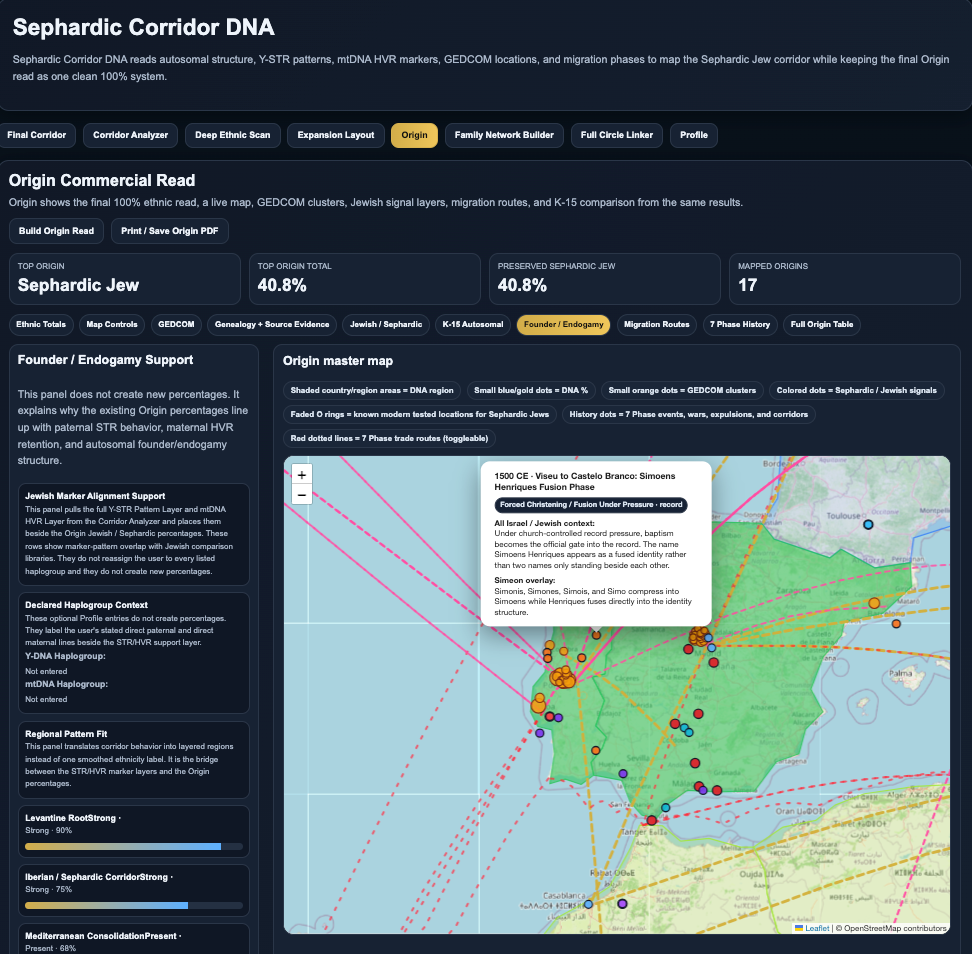
The Origin read resolved as one complete 100% system. The strongest preserved layer was Sephardic Jew at 40.8%. This was followed by Levantine at 13.3%, Italian at 9.2%, Balkan at 7.7%, Iberian at 7.2%, North African at 6.5%, Eastern European at 3.8%, British at 2.3%, Ashkenazi Jewish at 1.8%, Scottish at 1.7%, German at 1.6%, Irish at 1.5%, Dutch at 1.1%, French at 0.9%, Iranian Jewish at 0.3%, Ethiopian Jewish at 0.2%, and Other Jewish at 0.1%.
The importance of this structure was not simply that Sephardic Jewish emerged as the largest category. The significance was that the strongest preserved layers repeatedly clustered inside Mediterranean, Levantine, Iberian, Balkan, Italian, and North African corridor environments before the smaller northern-European stabilization layers appeared. Rather than behaving like an isolated northwestern-European profile with minor southern admixture, the system repeatedly reconstructed a Mediterranean-centered corridor with later northern overlays.
The analyzer also preserved Jewish subgroup structure independently instead of collapsing all Jewish-related continuity into a single generalized category. Sephardic Jewish, Ashkenazi Jewish, Levantine, Iranian Jewish, Ethiopian Jewish, and Other Jewish layers remained independently visible inside the reconstruction. This became important because the system was not attempting to force the structure into one simplified identity label. Instead, it repeatedly behaved like a distributed eastern Mediterranean and Sephardic corridor network surviving through multiple historical phases.
The K-15 comparison layer independently reinforced the same broader structure from another autosomal direction. West Mediterranean resolved at 25.6%, East Mediterranean at 23.5%, West Asian at 13.6%, Atlantic at 12.4%, North African at 8.2%, Red Sea at 5.3%, North Sea at 4.8%, Eastern European at 3.3%, and Baltic at 3.3%.
The analyzer specifically notes that the K-15 system does not replace the Origin reconstruction. Instead, it functions as an independent structural confirmation layer. The importance of the K-15 read was that the same Mediterranean, Levantine, Iberian, North African, and Atlantic corridor structure continued reappearing even when viewed through a separate autosomal framework. The repeated convergence across different systems became one of the strongest parts of the reconstruction.
The grouped structural comparisons reinforced this even further. Sephardic Jewish together with Iberian structure resolved as 48.0% on the Origin layer and 49.1% on the K-15 support layer. Levantine together with West Asian structure resolved as 13.7% on the Origin layer and 18.9% on the K-15 support layer. Italian together with Mediterranean structure resolved as 17.8% on the Origin layer and 49.1% on the K-15 support layer. Northern and Central Europe resolved significantly smaller at 9.1% on the Origin layer and 17.2% on the K-15 layer, while North African and African trace continuity resolved at 6.7% on the Origin side and 8.2% on the K-15 side.
The analyzer then examined how those regional structures behaved inside the founder and corridor framework itself. The strongest regional pattern fit resolved as Levantine Root at 90% with a Strong designation. Iberian / Sephardic Corridor resolved as Strong at 75%. Mediterranean Consolidation resolved as Present at 68%. Balkan Bridge resolved as Present at 55%. North African Distributed Layer resolved as Trace at 45%, while Northern European resolved as Trace at 39%.
This became one of the most important observations in the entire reconstruction because the Northern European layer remained present but did not behave like the deepest structural foundation. Instead, the analyzer repeatedly treated the northern systems as later stabilization and compression environments layered over older Mediterranean-Sephardic corridor continuity. Under this model, northwestern-European assignment was not considered “false.” It was interpreted as a later regional absorption shell formed after centuries of migration, Atlantic redistribution, and population blending.
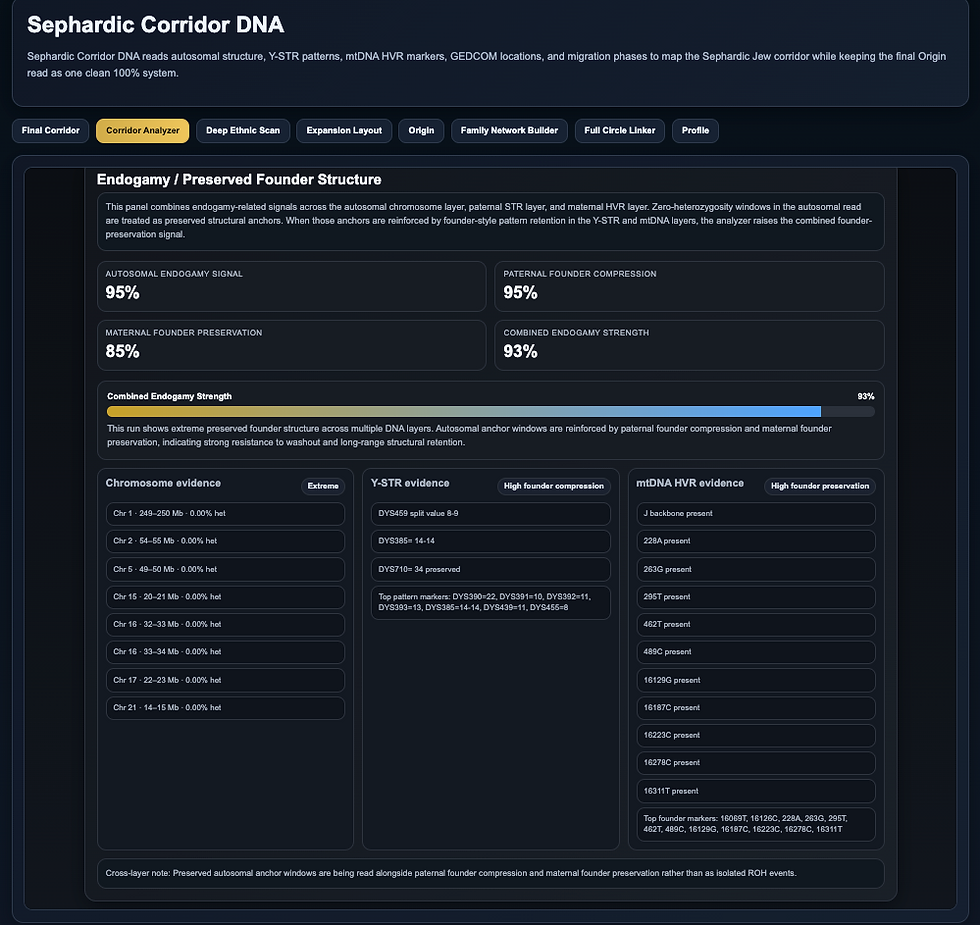
The autosomal founder layer reinforced this interpretation directly. The analyzer measured a 95% endogamy signal together with 99 zero-heterozygosity preserved blocks distributed across Chromosomes 1, 2, 3, 4, 5, 6, 8, 10, 11, 15, 16, 17, and 21.
The system specifically distinguished this from ordinary background relatedness. Rather than showing scattered isolated fragments, the genome preserved repeated low-heterozygosity and zero-heterozygosity core regions across multiple chromosomes simultaneously. The analyzer interpreted this as preserved founder continuity surviving through repeated corridor recombination instead of fully dissolving into generalized surrounding populations.
The autosomal preservation structure was then reinforced by the paternal STR framework. The strongest recurring anchor markers repeatedly stabilized around DYS455=8, DYS459=8-9, DYS385=14-14, DYS710=34, DYS390=22, DYS391=10, DYS392=11, and DYS393=13.
These markers repeatedly aligned against preserved Mediterranean and Jewish-pattern comparison systems. The strongest modal alignments included J2-like Jewish pattern structure at 100%, G-M377 Jewish founder cluster at 100%, T-L208 Jewish modal structure at 100%, I-Y12047 Simeon Cluster at 100%, and J1-CMH priestly-pattern overlap at 93%.
The analyzer explicitly stated that these systems were not direct haplogroup reassignment tools. Their purpose was to determine repeated pattern convergence. The significance of the result was that the uploaded STR structure repeatedly behaved like preserved Mediterranean-Sephardic founder systems across multiple independent comparison libraries instead of aligning as a diffuse or isolated northern-European modal pattern.
The maternal HVR layer reinforced the same preservation structure from another lineage direction. Recurring maternal markers repeatedly stabilized around 16067T, 16069T, 16126C, 16129A, 16129G, 16145A, and 16145C while continuing to align with the J1c1b2 maternal framework already established elsewhere in the reconstruction.
The analyzer also reconstructed the broader movement direction of the corridor itself. The combined systems repeatedly converged through Iberia, Italy, Balkans, North Africa, the Levant, Netherlands, Germany, Britain, and later Atlantic migration environments without collapsing into one isolated regional identity.
Taken together, the Sephardic Corridor DNA Analyzer concluded that the structure behaved less like a generalized modern ethnicity estimate and more like a preserved Mediterranean-Sephardic corridor system surviving underneath later regional overlays. The reconstruction repeatedly converged through autosomal preservation, founder continuity, STR compression, maternal retention, regional corridor persistence, convoy-family alignment, and historical migration direction simultaneously rather than through one isolated evidence layer alone.
The Atlantic Continuation and Living Descendant Network
The reconstruction does not terminate inside medieval Iberia, the Netherlands stabilization layer, or the early Mediterranean corridor systems. One of the strongest parts of the entire framework is that the same structural continuity continues appearing inside living descendant networks extending outward through Atlantic migration systems into Brazil, Mexico, Puerto Rico, California, and North America while still preserving recognizable historical, biological, and naming continuity underneath.
The importance of the Atlantic layer is that the corridor did not disappear after the Portugal and Netherlands phases. Instead, the same convoy-family structures continued moving through maritime expansion systems while preserving overlapping autosomal continuity, paternal continuity, maternal persistence, and recurring Simon-root naming fields across multiple descendant environments.
The Brazil continuation layer became especially important because several major convoy-family systems reappeared there after already being established earlier inside the Coimbra and Portuguese corridor structure. The Sauer continuation became one of the strongest examples because Sauer first appeared inside the early Coimbra convoy environments tied to Simons, Simoens, Lopes de Souza Telles, Rodriguez, Gomes, Dias, Da Siqueira, Oliveira-linked systems, and related Iberian corridor families before later reappearing again inside Atlantic descendant environments connected to Brazil. Rather than behaving like disconnected regional occurrences, the structure continued expressing the same broader convoy continuity through separate historical phases.
The Oliveira continuation became equally important because Oliveira repeatedly appeared throughout the Portuguese convoy layer long before the Atlantic migration phase intensified. Oliveira-linked Simon structures repeatedly surfaced across Coimbra, Aveiro, Braga, and Viseu beside Simoens, Rodrigues, Lopes, Carvalho, Pereira, Souza, and related convoy systems. The later appearance of Oliveira-linked descendant continuity in Brazil reinforced the broader reconstruction pattern showing that the Portuguese corridor families did not vanish after Iberian consolidation. Instead, portions of the convoy structure continued westward through Atlantic redistribution while still preserving recognizable continuity inside Brazil and later Atlantic descendant environments.
The Gracie overlap became important for similar reasons. The Gracie family emerged historically inside Brazilian Portuguese environments already tied to Atlantic migration systems flowing outward from Iberia and Atlantic maritime redistribution. Inside the reconstruction, the Gracie overlap reinforced the idea that portions of the broader Portuguese convoy structure continued stabilizing inside Brazil rather than terminating in Europe.
Mexico and New Spain continuation layers reinforced the same movement pattern again. Garcia-linked continuity, Jimenez structures, Antúnez overlap, Raposo continuation, and Simon-root descendants repeatedly aligned inside western Atlantic descendant systems already connected historically to Portuguese and Iberian movement environments. The importance of this phase was that the corridor structure continued appearing biologically and historically across multiple Atlantic regions rather than remaining confined to one localized national identity.
The living descendant systems strengthened this even further because the same continuity survived through measurable cousin relationships extending from close family lines into deep generational networks. The Simonis descendant structure repeatedly preserved continuity through first cousins, second cousins, third cousins, fourth cousins, and even eleventh-cousin systems while still retaining overlapping autosomal corridor behavior and paternal framework continuity.
The first-cousin Simonis layer preserved direct I-CTS10937 continuity, providing one of the strongest living paternal anchors inside the reconstruction. The second-cousin systems reinforced the autosomal continuity through strong shared DNA segments while still preserving Simonis naming continuity. The third-cousin and fourth-cousin layers extended the same paternal structure outward again through I-Z2535 and I-CTS10937 descendant continuity across separate branches. Even the eleventh-cousin layer retained measurable autosomal overlap tied to the same broader Simonis descendant environment.
This became important because the reconstruction was no longer operating only through historical surname comparison. The same corridor continuity remained biologically visible inside living descendants across multiple generations.
The repeated STR framework reinforced the same structure through descendant continuity. DYS455=8, DYS459=8-9, DYS385=14-14, DYS390=22, DYS391=10, DYS392=11, DYS393=13, and especially DYS710=34 continued behaving like preserved founder markers surviving through the living descendant field rather than diffusing randomly into unrelated populations.
The autosomal systems reinforced this again through shared corridor behavior. The same descendants repeatedly preserved overlapping Mediterranean, Levantine, Balkan, Italian, Iberian, and Sephardic-aligned structural continuity while simultaneously carrying broad northern-European stabilization overlays. Rather than eliminating the older corridor structure, the northern layers repeatedly behaved like later regional absorption environments formed after centuries of migration and redistribution.
The naming continuity also survived alongside the biological continuity. Simonis, Simons, Sims, Simone, Simones, Simoens, and related Simon-root descendants repeatedly aligned with overlapping paternal structure, autosomal continuity, founder retention, and convoy-family persistence. The significance was not only that the names survived historically, but that the biological continuity repeatedly survived beside the naming continuity at the same time.
The broader convoy-family systems continued appearing inside the same descendant environments as well. Garcia, Rodrigues, Lopes, Oliveira, Henriques, Carvalho, Ferreira, Pereira, Gomez, Raposo, Sauer, Souza, Jimenez, and related Atlantic corridor structures repeatedly aligned beside the same descendant systems already tied historically to Portugal, Netherlands, Brazil, Mexico, Puerto Rico, and later North American continuation environments.
The repeated movement direction therefore remained coherent across every layer of the reconstruction:
Near Eastern and southern kingdom foundation → Mediterranean transformation → Iberian expansion → Portuguese consolidation → Netherlands stabilization → Atlantic continuation.
The historical systems aligned with the migration structure. The convoy surnames aligned with the geographic flow. The paternal systems aligned with the descendant continuity. The maternal systems aligned with the broader J-line preservation framework. The STR systems aligned with founder retention. The autosomal systems aligned with corridor persistence. The Sephardic Corridor DNA Analyzer aligned with the deeper Mediterranean-Sephardic reconstruction underneath later northern-European overlays.
The Garcia–Simon Iberian Corridor and the Paoli / Paroli Mediterranean Connection
One of the deeper structural alignments inside the reconstruction emerges through the repeated convergence of the Garcia and Simon-root systems across the Iberian corridor together with the later Paoli / Paroli continuity appearing through Italy, Netherlands, and living descendant DNA continuity.
The Spain corridor repeatedly preserved Simon and Simón structures beside Garcia environments long before the later Netherlands stabilization phase emerged. One of the strongest examples appeared through the Vicente Simón structure in Extremadura, where Simón and García appeared together inside the same preserved family environment. This became important because the Garcia–Simon relationship was already visible inside western Iberia before the later Dutch Simonis phase became fully established.
The significance of the Garcia alignment increased because the same broader convoy systems repeatedly survived through Portugal, Atlantic redistribution, and living descendant continuity rather than remaining isolated to one Spanish parish layer. Garcia repeatedly remained tied beside Rodrigues, Lopes, Oliveira, Henriques, Pereira, Carvalho, Gomez, Raposo, Sauer, and Simon-root forms across the same broader Mediterranean–Iberian corridor environment.
The deeper Mediterranean connection became more important once the Paoli / Paroli structure was examined together with the Netherlands Simonis line.
Gerardus Simonis was already historically preserved in Beers, Netherlands in 1611, establishing Simonis continuity independently before the later baptism irregularity appeared. However, inside the 1650 baptism layer connected to Joannen Simonis, the name Paroli appears crossed out and Gerardus Simonis becomes inserted as the father instead. This became structurally important because the Paroli layer appeared unexpectedly inside an already existing Simonis environment rather than originating the Simonis line itself.
The reconstruction became even stronger once living descendant continuity aligned with the same pattern through a Paoli DNA match preserving tenth-cousin continuity. The autosomal layer therefore connected the modern descendant structure back into the same broader Mediterranean naming environment rather than leaving the Paroli insertion as an isolated archival anomaly.
This matters because Paoli and Paroli themselves belong to older Italian and Mediterranean naming systems historically connected to Pauline, Paolus, and broader Greco-Roman and Mediterranean corridor environments. Once placed beside the earlier Simon, Simeon, Shimon, Simone, and Simonis transformations already established in the reconstruction, the structure begins behaving like a deeper Mediterranean naming continuum rather than disconnected regional surname accidents.
The significance is not that Paoli suddenly replaces Simonis or becomes the direct origin of the Simonis structure. The significance is that the crossed-out Paroli layer appears inside an already established Simonis environment while a living Paoli descendant connection later survives through measurable autosomal continuity. That combination creates a bridge between:
the Iberian Garcia–Simon corridor,
the Italian Mediterranean naming layer,
the Netherlands Simonis stabilization phase,
and the living descendant DNA systems.
The result is that the Simon-root structure no longer behaves like a surname appearing suddenly in northern Europe. Instead, the reconstruction repeatedly points back toward an older Mediterranean and Near Eastern continuity field where Simon, Simeon, Shimon, Simone, Simonis, Paoli, and related corridor structures continue intersecting through historical records, convoy-family continuity, autosomal persistence, and living descendant networks across centuries of migration and regional stabilization.
Final Structural Convergence
When the full reconstruction is viewed together, the historical records, convoy-family systems, naming continuity, haplogroups, STR structures, autosomal persistence, living descendant systems, and Sephardic Corridor DNA Analyzer no longer behave like isolated evidence layers. The same broader structure continues converging from multiple independent directions while repeatedly pointing back toward the same Mediterranean–Iberian corridor foundation.
The historical systems preserved Simon, Simón, Simone, Simonis, Simoens, Simones, Sims, and related forms moving through Italy, Spain, Portugal, Netherlands, and Atlantic descendant environments beside Garcia, Rodrigues, Lopes, Oliveira, Henriques, Pereira, Carvalho, Gomez, Raposo, Sauer, Souza, Jimenez, and related convoy-family systems. The Mediterranean layer preserved the earlier Simon, Simeon, and Shimʿon continuity extending back into the Near Eastern and southern kingdom environment before the later Iberian expansion phases emerged.
The biological systems repeatedly reinforced the same movement structure. The paternal framework preserved continuity through I-M170, I-Z2535, I-CTS10937, I-Y12047, I-FGC74345, and related downstream branches while the maternal systems preserved J1c1b2 and broader Haplogroup J continuity inside direct Simon-root descendant environments. The STR layer continued stabilizing around DYS455=8, DYS459=8-9, DYS385=14-14, DYS390=22, DYS391=10, DYS392=11, DYS393=13, and especially DYS710=34, repeatedly behaving like preserved founder continuity rather than diffuse random drift.
The living descendant systems strengthened the reconstruction even further. First-cousin through eleventh-cousin Simonis continuity preserved overlapping autosomal corridor structure, paternal continuity, shared Mediterranean alignment, and recurring Sephardic-linked preservation behavior across separate descendant branches. The Paoli tenth-cousin continuity then connected the Netherlands Simonis stabilization layer back into the older Mediterranean naming field already tied to Simon, Simeon, Shimʿon, Simone, and related corridor forms. At the same time, the Garcia–Simon relationship remained preserved through the Iberian corridor itself, reinforcing the long-duration convoy continuity already visible in Spain and Portugal.
The Sephardic Corridor DNA Analyzer then provided the structural reconstruction explaining why these deeper systems remain visible underneath later regional smoothing layers.
The Origin reconstruction repeatedly resolved the strongest preserved layer as Sephardic Jew at 40.8%, followed by Levantine at 13.3%, Italian at 9.2%, Balkan at 7.7%, Iberian at 7.2%, and North African at 6.5%. Northern stabilization layers remained present through British at 2.3%, Scottish at 1.7%, German at 1.6%, Irish at 1.5%, Dutch at 1.1%, and French at 0.9%, but they appeared structurally smaller than the combined Mediterranean and Sephardic corridor itself.
The K-15 reconstruction independently reinforced the same direction through West Mediterranean at 25.6%, East Mediterranean at 23.5%, West Asian at 13.6%, Atlantic at 12.4%, North African at 8.2%, and Red Sea at 5.3%.
When grouped structurally, the Sephardic plus Iberian layer stabilized around 48.0% in the Origin reconstruction and 49.1% inside the K-15 support layer. Levantine and West Asian structure stabilized between 13.7% and 18.9%, while Mediterranean and Italian structure repeatedly expanded toward nearly half of the autosomal framework itself. Northern and Central European structure remained present, but consistently smaller than the combined Mediterranean corridor systems.
The founder layer explained why the deeper structure survived at all. The analyzer measured a 95% endogamy signal together with 99 zero-heterozygosity preserved blocks distributed across numerous chromosomes, demonstrating that portions of the corridor remained preserved instead of fully recombining outward into surrounding populations.
The analyzer then reinforced the same framework through modal STR comparison systems. J2-like Jewish structure, G-M377 founder overlap, T-L208 Jewish modal alignment, I-Y12047 Simeon comparison structure, and J1-CMH priestly-pattern overlap all repeatedly converged against the same preserved STR framework tied to DYS455=8, DYS459=8-9, DYS385=14-14, and DYS710=34.
Taken together, the reconstruction repeatedly converges toward the same larger historical direction:
Near Eastern and southern kingdom foundation → Mediterranean transformation → Iberian expansion → Portuguese consolidation → Netherlands stabilization → Atlantic continuation.
The records align with the migration structure. The convoy surnames align with the corridor flow. The haplogroups align with the descendant continuity. The STR systems align with founder preservation. The autosomal systems align with chromosome persistence.
The Sephardic Corridor DNA Analyzer aligns with the deeper Mediterranean–Sephardic reconstruction surviving underneath later northern-European stabilization layers.
Viewed independently, each layer preserves only part of the structure.
Viewed together, the same corridor repeatedly reconstructs itself across history, biology, migration, surnames, chromosomes, and living descendants.


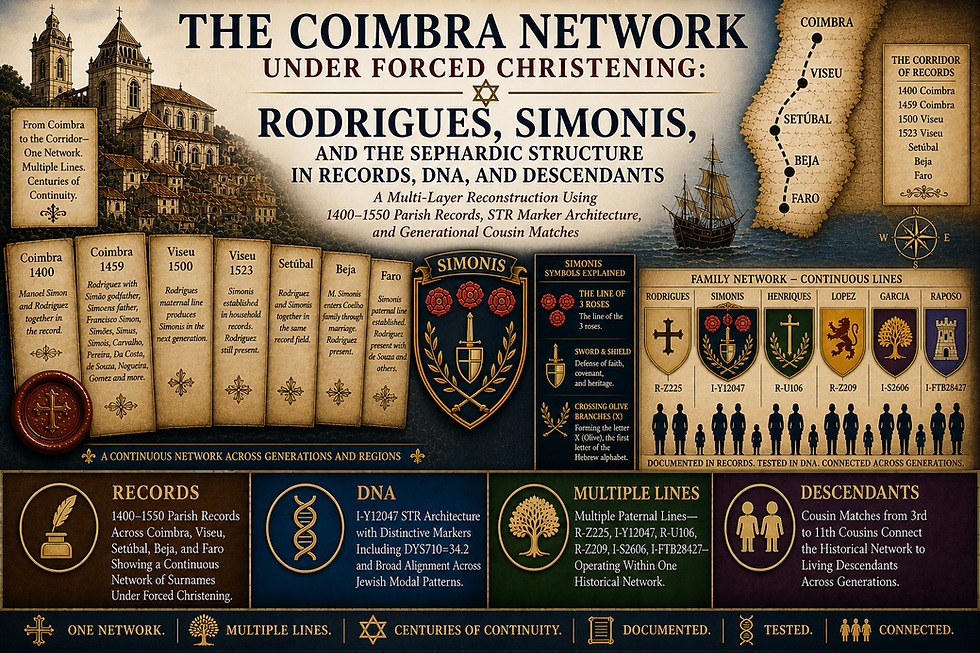
Comments